
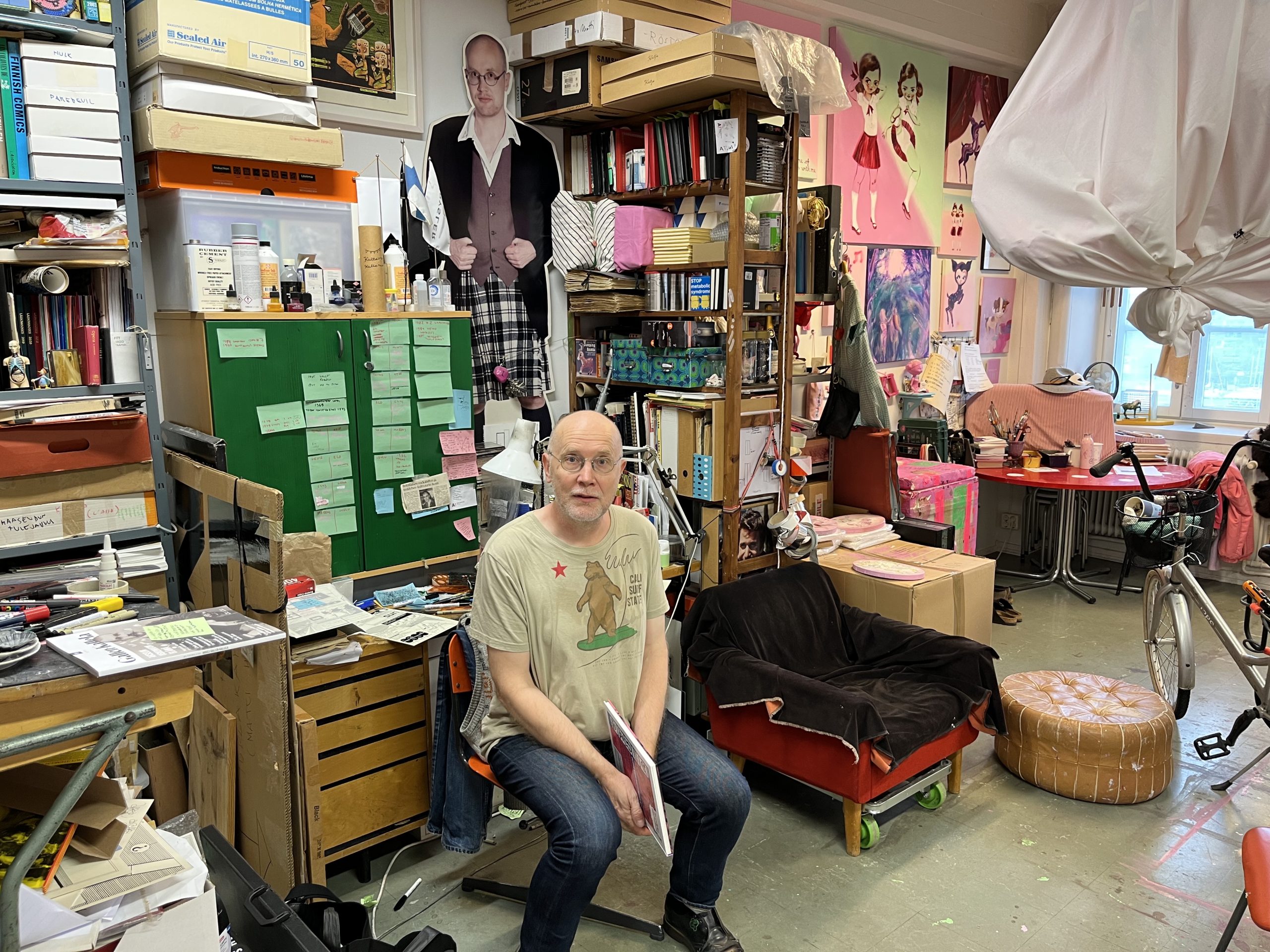
Finnish cartoonist Matti Hagelberg was born in 1964 in Kirkkonummi, a small town located a 30 minute car drive west of Helsinki. After studying at the Academy of Fine Arts in Helsinki, he has, since 1992, been producing new installments of his ongoing series B.E.M. — a name borrowed from 1930s science fiction, and short for Bug-Eyed Monsters, the kind of bulging-eyed creatures that every hero of the era was expected to battle with a laser pistol.
The first issue of B.E.M. was a small self-published booklet. Since then, the format and size of the series have varied greatly: the second issue, Marsin alkeet (The Origins of Mars, 1994), was an elegant and aesthetically striking cardboard box containing ten small 8-page booklets that could be read independently. B.E.M. 5, Venuksen sulttaani (The Sultan of Venus, 1996), was a 48-page softcover book in a larger format, while the ninth issue was the acclaimed graphic novel Holmenkollen (2000), a 128-page book that has been translated into several other languages. And there have been many more.
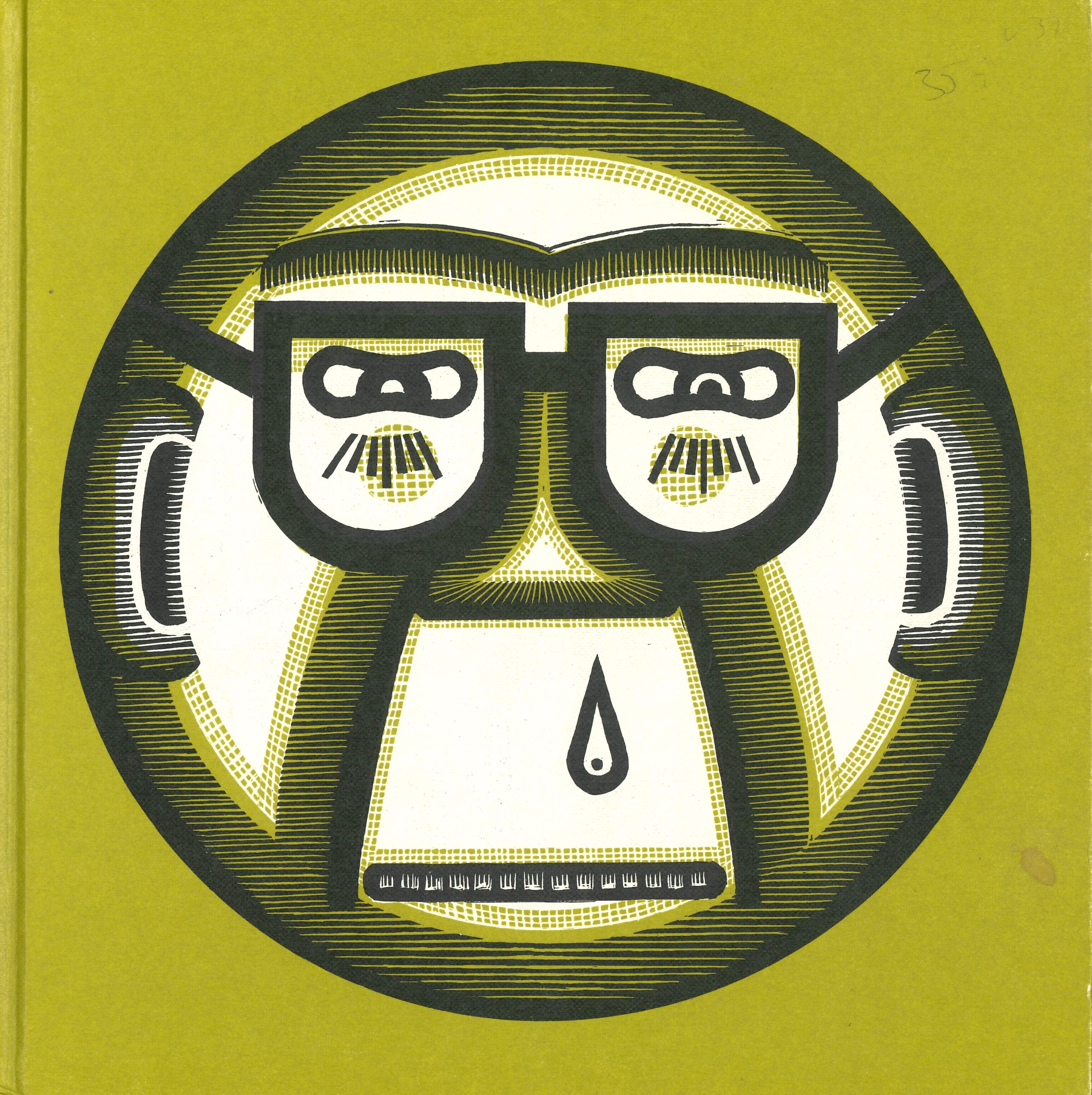 Cover of Kekkonen.
But Hagelberg’s spirit of experimentation is evident not only in the formal qualities of his work, it is equally present in its content. His comics draw inspiration from a wide range of sources, most notably the novels of Edgar Rice Burroughs, including the Tarzan stories but above all the tales of John Carter’s battles against evil creatures on the planet Mars. In a documentary from 2018, Hagelberg describes his comics universe as Kalevala — the austere Finnish national epic first published in 1835 — meeting Rice Burroughs, but spiced with a few pinches of Alfred Hitchcock’s films, surrealism, popular culture, and even the Bible. It is the sum of all these elements that constitutes Hagelberg’s idiosyncratic universe.
Not infrequently, Hagelberg juxtaposes philosophical or theological speculation with a liberatingly childlike logic, and his absurdist comic twists are consistently entertaining. He also plays a major role within his own comics, appearing in various incarnations and alter egos such as Mr. Matti Hagelberg, Matti Hagelberg, and the superhero Lauri Kenttä (the name “Kenttä” dates back to the 1950s, when Clark “Superman” Kent was given a Finnish-sounding surname in translation). Hagelberg’s absurd humor is particularly evident in his 2004 graphic novel Kekkonen, in which he reimagines former president Urho Kekkonen — the most dominant Finnish politician of the postwar period, who served for 26 years — as a fantastical storybook character rubbing shoulders with Elvis, Jesus, and extraterrestrials. This was followed in 2010 by Silvia Regina, a biting and darkly humorous portrayal of Finland as a nation driven by greed.
His latest — and unquestionably most ambitious — project is Läskimooses, which began in 2012 and was completed in 2020. Originally published in an American comic-book format at a pace of seven issues per year, it became the longest single comics narrative ever produced in Finland. In 2021, the work was collected in Finnish as a boxed set of three hardbound volumes totaling 1,488 pages, marketed as “150 pages thicker than the Bible.” This epic science fiction narrative opens with a celestial body called Läskimooses heading toward Earth, before unfolding into an expansive meditation on the origins and possible destruction of our planet, liberally interspersed with digressions and meta-references to figures such as Donkey Kong and Bart Simpson.
In addition to his domestic albums and magazine publications, Hagelberg has gradually seen a significant number of works published abroad, translated into six languages across eight countries. In France, he has published with small presses such as Chacal Puant (B.E.M. 4: The Sinful Ways of Simpli City) and Le Dernier Cri (B.E.M. 8: Zombie Justice and B.E.M. 10: Mr. Mokamat), as well as several titles with the major alternative publisher L’Association. In the United States, he was a regular contributor to the anthology Blab!, and there are persistent rumors that Fantagraphics plans to introduce Läskimooses to an English-speaking readership.
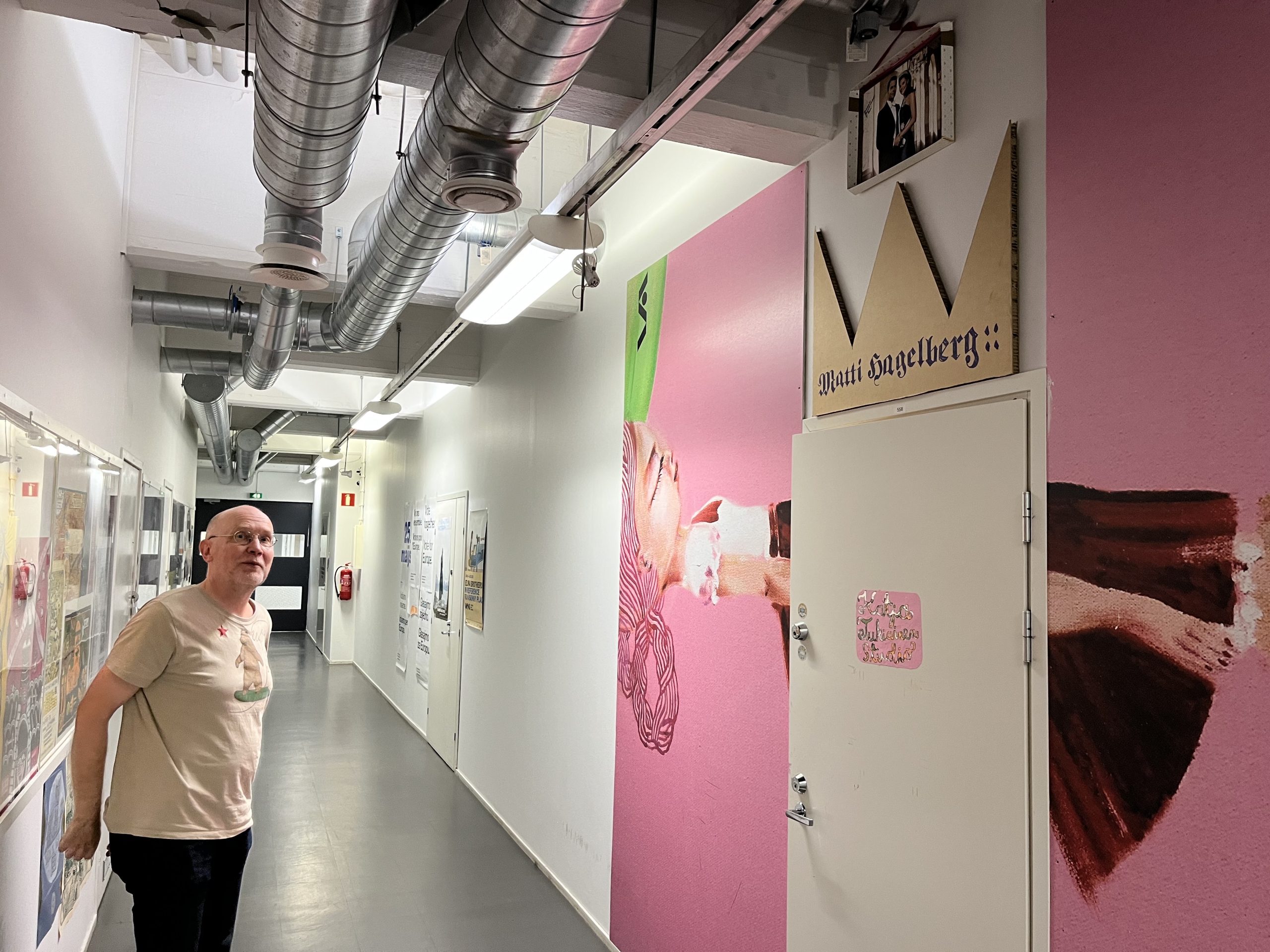 The entrance to Matti Hagelberg and Katja Tukiainen’s studio.
Hagelberg’s studio is located on the fifth floor of the Cable Factory, a rugged former industrial complex in Helsinki’s Ruoholahti district in the southwestern part of the city. Once Finland’s largest building and a production site for marine cables, the Cable Factory now serves as one of the country’s most important cultural centers. Finding Hagelberg’s studio, however, is not difficult because of the building’s size, but because the long list of artists’ names posted at the entrance includes neither “Matti Hagelberg” nor any of his many aliases — whether “Herr Matti Hagelberg,” “Doctor Matti Hagelberg,” “Lauri Kenttä,” “mti hglbrg,” or others familiar from his spoof-autobiographical comics. Instead, visitors should follow the sign pointing toward “Katja and Matti’s Detective Agency,” where “Katja” refers to his wife, the artist Katja Tukiainen, with whom he shares the studio. The atelier itself is a large open space filled with paintings, books, and the smell of paint. Hagelberg’s desk is positioned at the center of the room, where the interview takes place. He speaks slowly and thoughtfully, in a slightly raspy voice that can suddenly increase in both tempo and warmth when he becomes engaged.
ROBERT AMAN: You’ve been active since the early 1990s, and you’re often described as Finland’s most successful cartoonist since Tove Jansson. Do you ever feel like the godfather of Finnish comics?
MATTI HAGELBERG: [Laughs] I look forward to the day when other cartoonists come over to kiss my ring. But to answer your question — no, I don’t really think so. That’s for others to judge. It is true that I’ve been active since 1992, when the first B.E.M. book came out, even though it was only eight pages long. That marked the beginning of my professional career. Since then, it’s been nothing but comics.
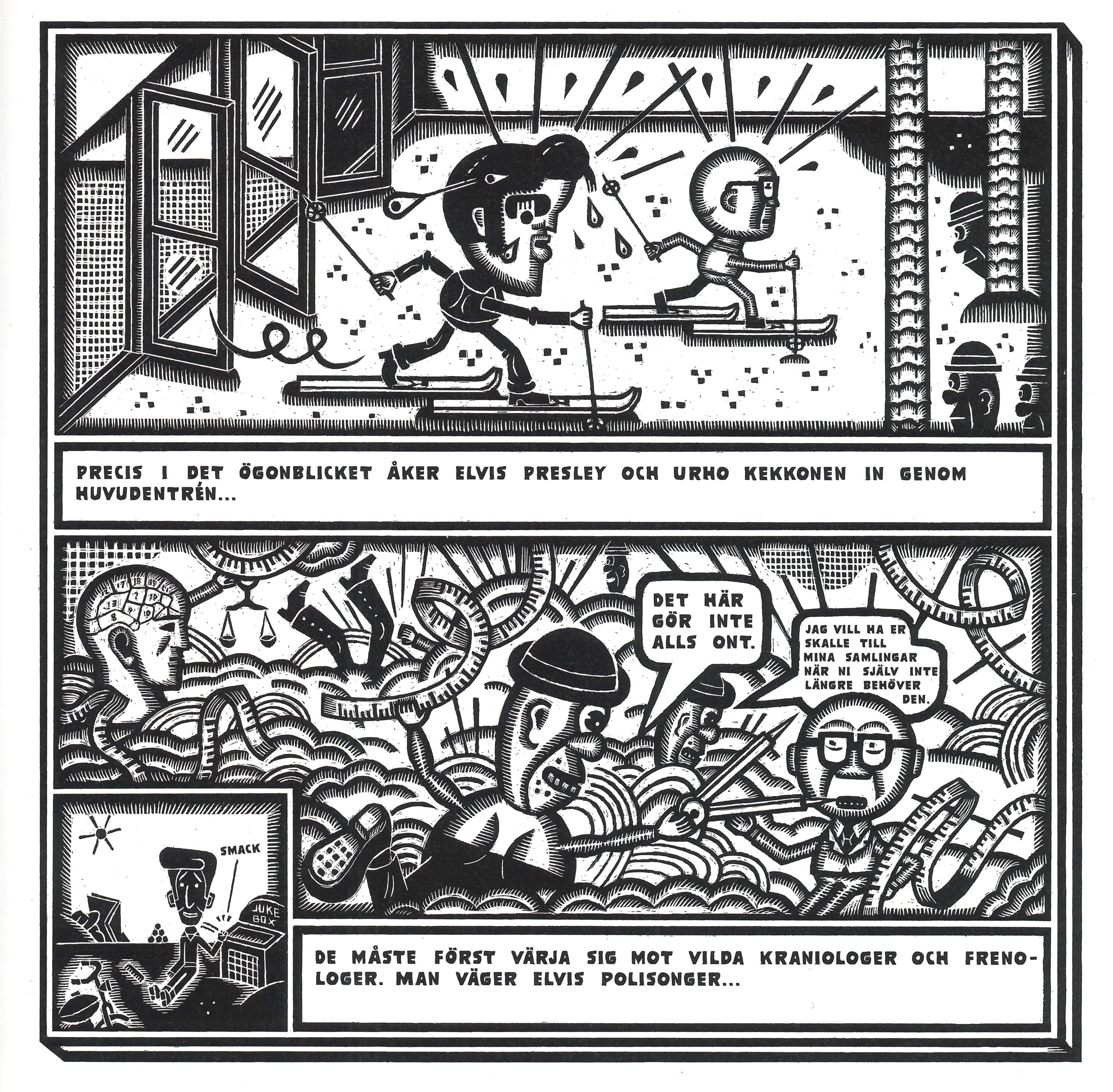 Page from Kekkonen: Kekkonen and Elvis Presley cross-country skiing together.
Your work has been widely translated.
That happened, yes. Mostly in France and Sweden, which makes a certain kind of sense, since Bernadotte — the Swedish king in the early nineteenth century — was originally French.
What was your first encounter with comics as a child?
You could ask almost anyone in Finland, and they’ll say Donald Duck, especially the strips drawn by Carl Barks. After that, there were many other things. I really enjoyed Popeye, although I can’t remember where I first encountered him. Otherwise, I grew up with Tintin, Asterix, and Lucky Luke — the usual suspects.
When I got older, I had to start reading comics in Swedish, because Finland didn’t really have an output of adult comics. In Sweden, you could find books by Enki Bilal, Jacques Tardi, and others. It was probably Tardi’s album The Arctic Marauder that first introduced me to comics made with scraperboard. I actually had the privilege of seeing the original artwork in Basel some years ago.
The cover is displayed at the Comics Museum in Angoulême, where the sheer size of the drawing is impressive. But returning to your childhood reading in Finland — didn’t any American superheroes catch your attention?
I discovered Spider-Man when I was in high school and thought it was really cool. I also liked The Hulk — I only had a single issue, and it was in Swedish. I read some bootleg versions of The Avengers and other material that circulated in Finland in the 1970s. My favorite, however, was a Finnish version of Spirou magazine called Ruutu. In addition to Spirou, it featured Yoko Tsuno, Natacha, and others. My mother refused to buy it, though — she thought it was a scam.
Did she regard comics as a form of minor literature?
No, not at all. The problem was that all the stories were serialized, which meant you always had to buy the next issue. She objected to the business model.
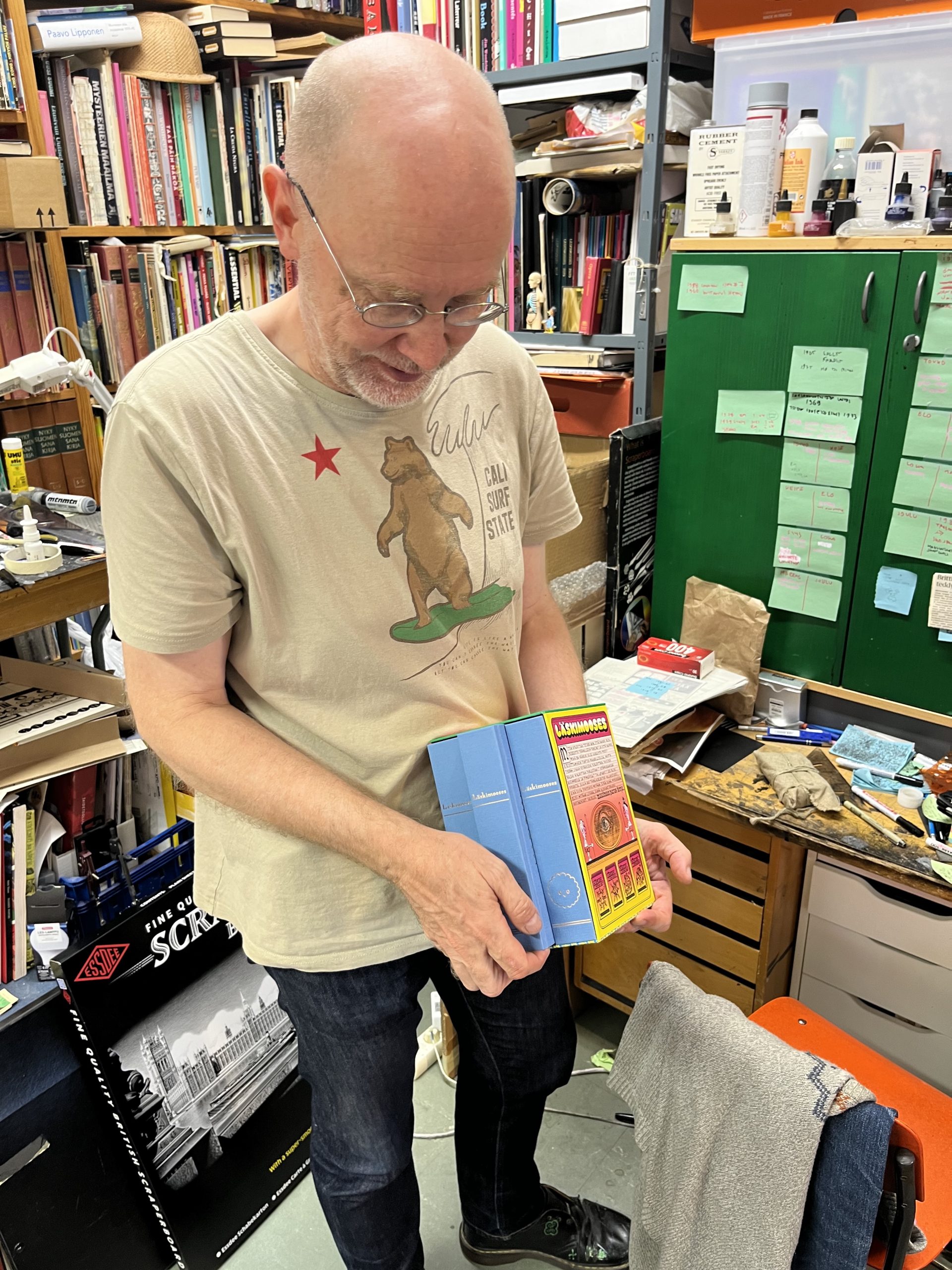 Hagelberg with the collected Läskimooses, published by Asema Kustannus.
The poor souls who bought the first issue of Läskimooses might agree with your mother — thinking they were investing in something that would be around 150 pages, only to discover they had signed up for an ever-expanding, neverending story. A clever scam on your part.
That’s all true, of course. But more seriously, the original plan was for the story to be around 250 pages, finished in a year. As you know, it didn’t quite turn out that way. I failed miserably.
What did your parents do?
My mother took care of children at home — she was a childminder — so there were always kids running around. My father worked at a printing house that was actually printing Asterix at the time, as well as other Franco-Belgian comics. Because of that, I often got my hands on new Asterix albums shortly after they came out. I also remember how exciting it was to visit the printing house as a child — the noise, the smell. I didn’t go there many times, but it’s a memory that has stayed with me.
Would you describe your family as lower middle class?
Probably, yes. My grandparents were all working class. My father’s father, for example, was a farmhand. My father managed to get a better education and improve his situation. At the printing house, he wasn’t working the machines — he was involved in production planning.
Did your parents encourage your artistic interests?
In a way, yes — although my mother always said that making comics wasn’t something you could really make a living from.
Perhaps she was right?
She was definitely right. [Laughter] When did you decide you wanted to become a comics artist?
Is that something you ever really decide? When I was in high school, I started a kind of serialized comic, and a friend helped me get it published in the local newspaper. It ran there for a few years. It was very clumsily drawn, but it was still an education of sorts — and I got paid. I’ve never shown it to anyone, because I consider my professional debut to have happened later, around 1991 or 1992.
Did you make any fanzines between your high school comics and your more professional work with B.E.M.?
No. I knew some people who were making fanzines, but I was very cut off from that whole scene. It wasn’t even something I imagined doing.
Did you go to university after high school?
I studied graphic design at the School of Arts and Design in Helsinki. I applied three times before I was accepted, and I stayed there for eight years. Quite early on, I realized that graphic design wasn’t giving me what I was looking for, so I started exploring other areas, like painting. At one point I even thought I might try to pursue a career as a painter. Then I encountered Raw magazine in London, and suddenly it felt like comics were possible.
When was this?
The first issue of Raw I bought was one of the smaller-format volumes — volume two, I think. It must have been around 1988 or 1989. It was a revelation. I wanted to make comics, but I didn’t know how, or what kind of stories I should tell. I lacked both direction and enthusiasm. After reading Raw, I decided to do something comics-related for my master’s project. I made a kind of magazine with self-portraits, inspired by David Sandlin and other things I had seen in Raw. After that, I began working on the first B.E.M. story. Things suddenly started to come together.
I figured out how to write, how to combine text and images, and it began to feel like there was a point to what I was doing. I started with small horizontal eight-page comics with only one panel per page. Then gradually I moved toward two panels per page. I began with short stories. I remember how enormous it felt to complete ten pages — and then fifty pages. And then I moved on to 1,500 pages. [Laughter]
When you say that things started to come together, what do you mean?
I had several sources of inspiration. I’m actually not done with this yet — I’m currently drawing them all for the third book about the Ateneum: Hergé, Julie Doucet, William Blake, Gary Panter, Mark Beyer, Dominique Goblet, and others. Do you know the Ateneum building?
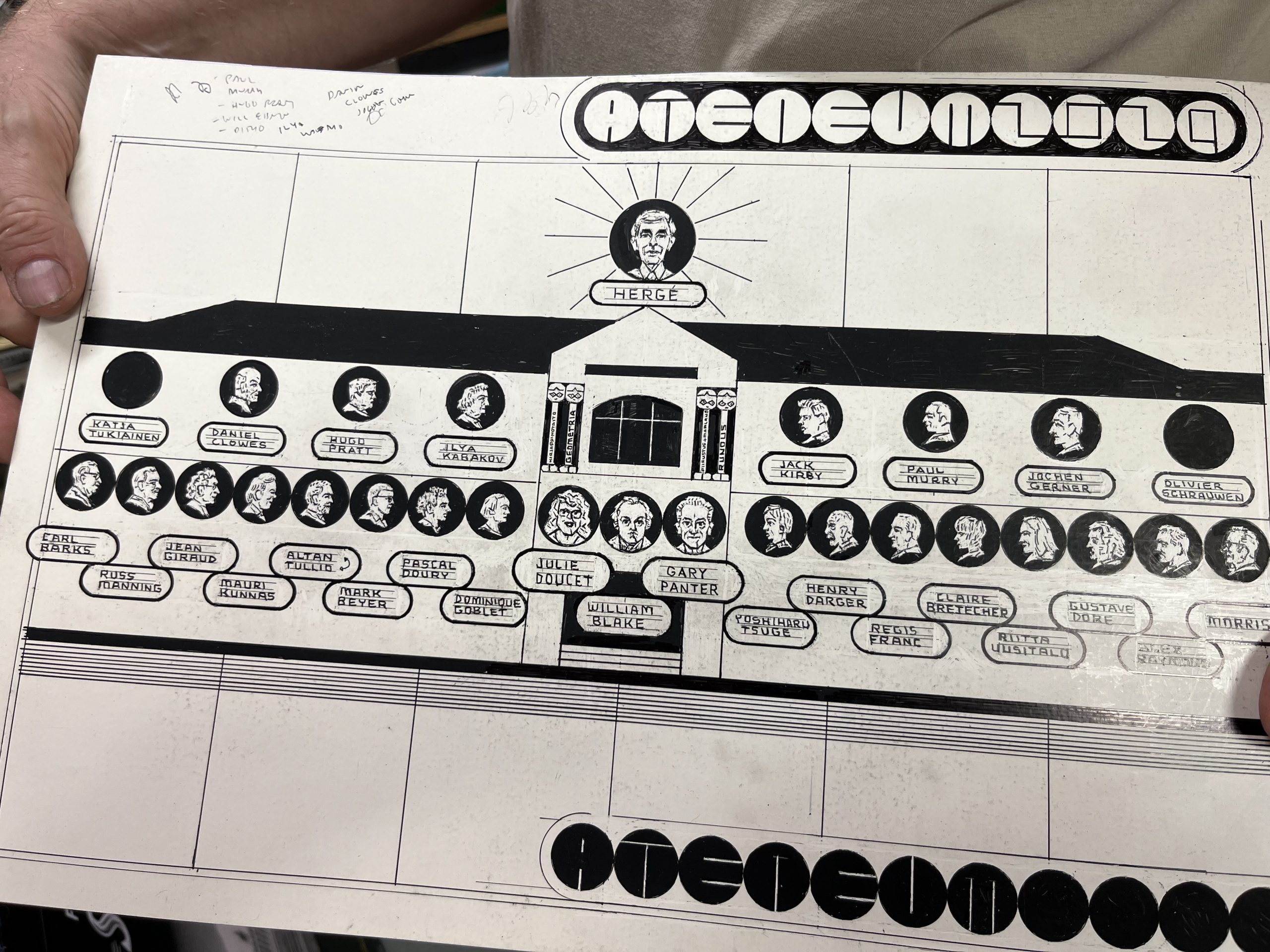 Hagelberg shows a page from the forthcoming third installment of his Atenatum series, featuring a list of his sources of inspiration.
You mean the art museum in Helsinki?
Yes. In the real Ateneum, there are busts of three of the most important artists: Raphael, Bramante, and Phidias — an architect, a sculptor, and a painter. The ones in my book are my equivalents. On the sides, I’ve included Finnish artists. The most important influences for me have probably been Gary Panter and Julie Doucet.
When I first encountered Julie’s work, autobiographical comics already existed, but I didn’t feel that it was something I could do — until I saw how she approached it differently. I was especially inspired by her style and her way of making comics, particularly her dream narratives. With Panter, it’s more about attitude — the way he draws, the way he thinks about art. It’s hard to explain clearly, but it’s really about the act of drawing itself and how he approaches his subjects. That had a huge influence on me as well.
How did you discover Julie Doucet’s work?
There was an article about her work in Sarjainfo — the trade magazine of the Finnish Comics Association — written by Ville Pirinen, and I was impressed by her approach. I bought several issues of Dirty Plotte at a local comics shop and was immediately struck by her way of making comics. Later, in 1997, she came to the Helsinki Comics Festival, where we got along very well. After that, we began corresponding — and have continued to do so ever since.
Bug-Eyed Monsters
How did you come up with the name Bug-Eyed Monster, and why did you decide to use it for your comics? Were you a big science fiction fan?
In my youth, I really enjoyed reading science fiction but I wouldn’t go so far as to call myself a fan. I’m familiar with Star Wars and Star Trek, but I wouldn’t go out of my way to see a new film or follow the franchises closely. What I do like, though, is the idea of monsters from outer space as they appeared in American science fiction films of the 1950s.
The concept of the bug-eyed monster really inspired me, especially because of the cheapness and simplicity of those productions. For me, the term also refers to a feeling of being an outsider. I probably still feel a bit like an outsider.
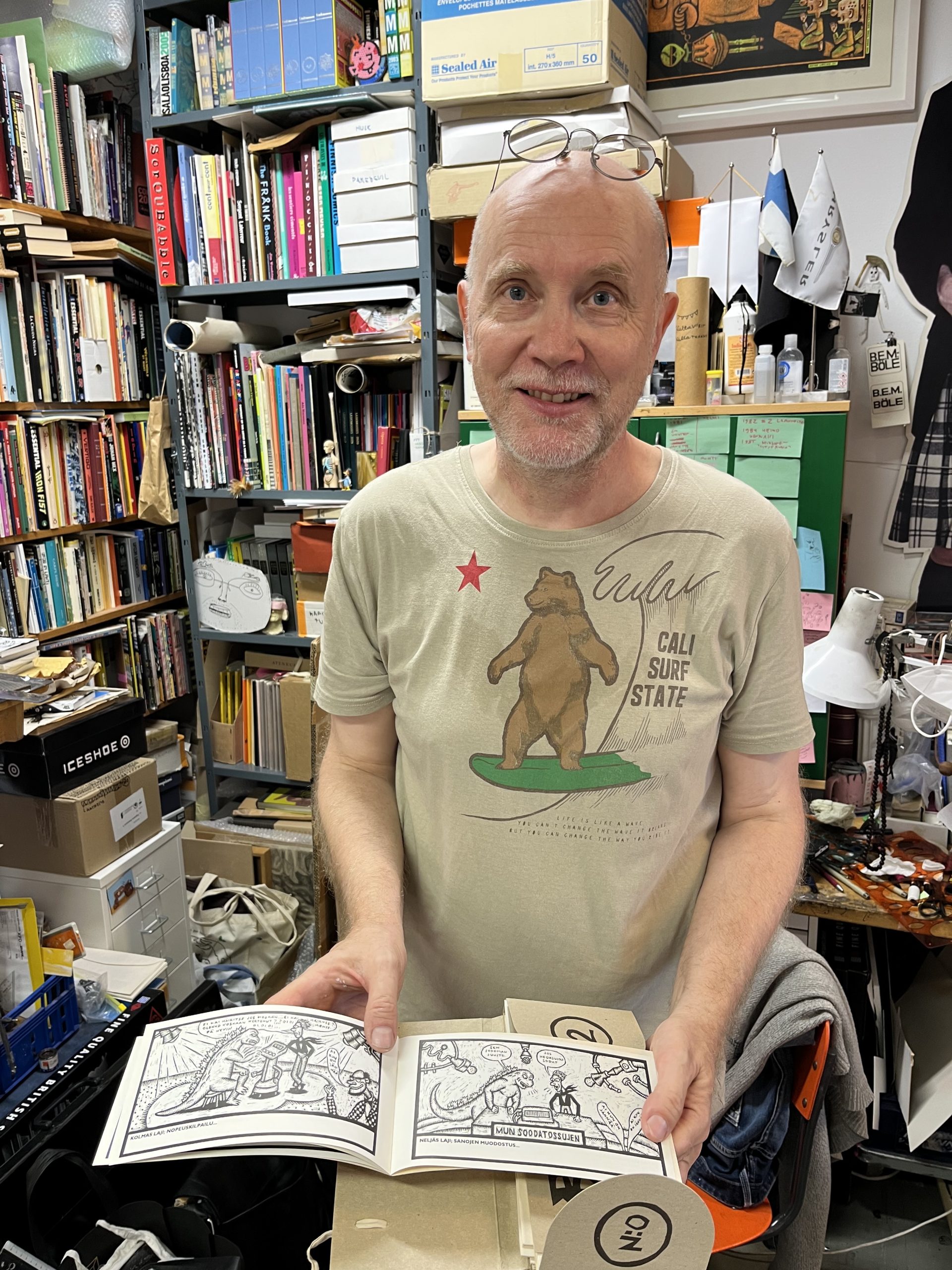 Hagelberg with the second issue of B.E.M.
When you made the first issue of B.E.M. back in the early 1990s, did you already know that you would use the name for a series?
Actually, yes. I had this vision or mental image of a landscape, something like Caspar David Friedrich’s painting Wanderer Above the Sea of Fog, with mountains in the background and clouds and mist below. On the horizon, I could see all these future projects approaching. So yes, it was planned from the outset.
How many issues did you self-publish before you found a publisher willing to take you on?
The first two issues were self-published. My first publisher was Suuri Kurpitsa. Then Stéphane Blanquet and Chacal Puant published issue number four. Later, issue number eight, Zombie Justice, was published by Le Dernier Cri.
How did all this come about? You seem to move quite quickly from being a self-publishing newcomer on the Finnish comics scene to having your work published by major players in the vibrant French comics culture of the 1990s.
At that time, there was no Internet, so you had to rely on smoke signals and other means of communication. [Laughter] Anyway, a friend of mine brought some of my books to France and gave them to a bookstore in Paris called Un Regard Moderne. That’s where Blanquet discovered my work. Pakito Bolino, one of the founders of Le Dernier Cri, found it there as well. My address was printed in the books, so Pakito sent me a letter saying that my work looked cool and asking if I’d be interested in doing something for them. At the time, I already had my hands full with other projects, so it took a couple of years before I was able to do Zombie Justice. But I really wanted to do something for Pakito.
That’s how it worked back then: they sent me a letter, I answered the letter, and little by little I gained more exposure in France. Eventually, I received a letter from Jean-Christophe Menu saying that he wanted to publish Holmenkollen, which L’Association did in 2002.
You almost make it sound as if everything happened by chance. But before you were published by L’Association, your work had already appeared in their anthology Lapin, which suggests that you were already on their radar.
That’s true, although I can’t really remember how the events unfolded in detail. I assume someone in France saw my work, mentioned it to people at L’Association, and then someone — probably Jean-Christophe — sent me a letter asking me to contribute something.
At that time, I didn’t have a proper font, which made translation complicated. First the text had to be translated, and then I had to do all the lettering myself.
So you did all the lettering yourself?
In the beginning, yes, although I’ve always been quite opposed to doing the lettering myself. In any case, I was first published by Blanquet, Le Dernier Cri, and L’Association, and later by Hoochie Coochie. France has been good to me.
Do you feel recognized within the French comics scene?
At one point, I felt that most of my colleagues were abroad. I knew people in Finland, of course, but it was especially with artists in other parts of Europe that I felt a sense of kinship in how we approached comics. I felt that my work was understood elsewhere in a way that it perhaps wasn’t in Finland. For example, I received the Swedish Urhunden Award for best book. But of course, this could also be a misconception — being a guest at a foreign comics festival is very different from sitting alone in your studio in Finland.
In what way do you think your work was better understood elsewhere?
Honestly, I have no idea how people actually read my work, or whether they like it at all. I very rarely find myself in situations where I get to discuss my work — or anything else, really — with others. I don’t think I handle those kinds of social situations very well. I don’t really have any connection to my audience, assuming I have one. I don’t receive fan mail. You probably know better than I do what people think about my books.
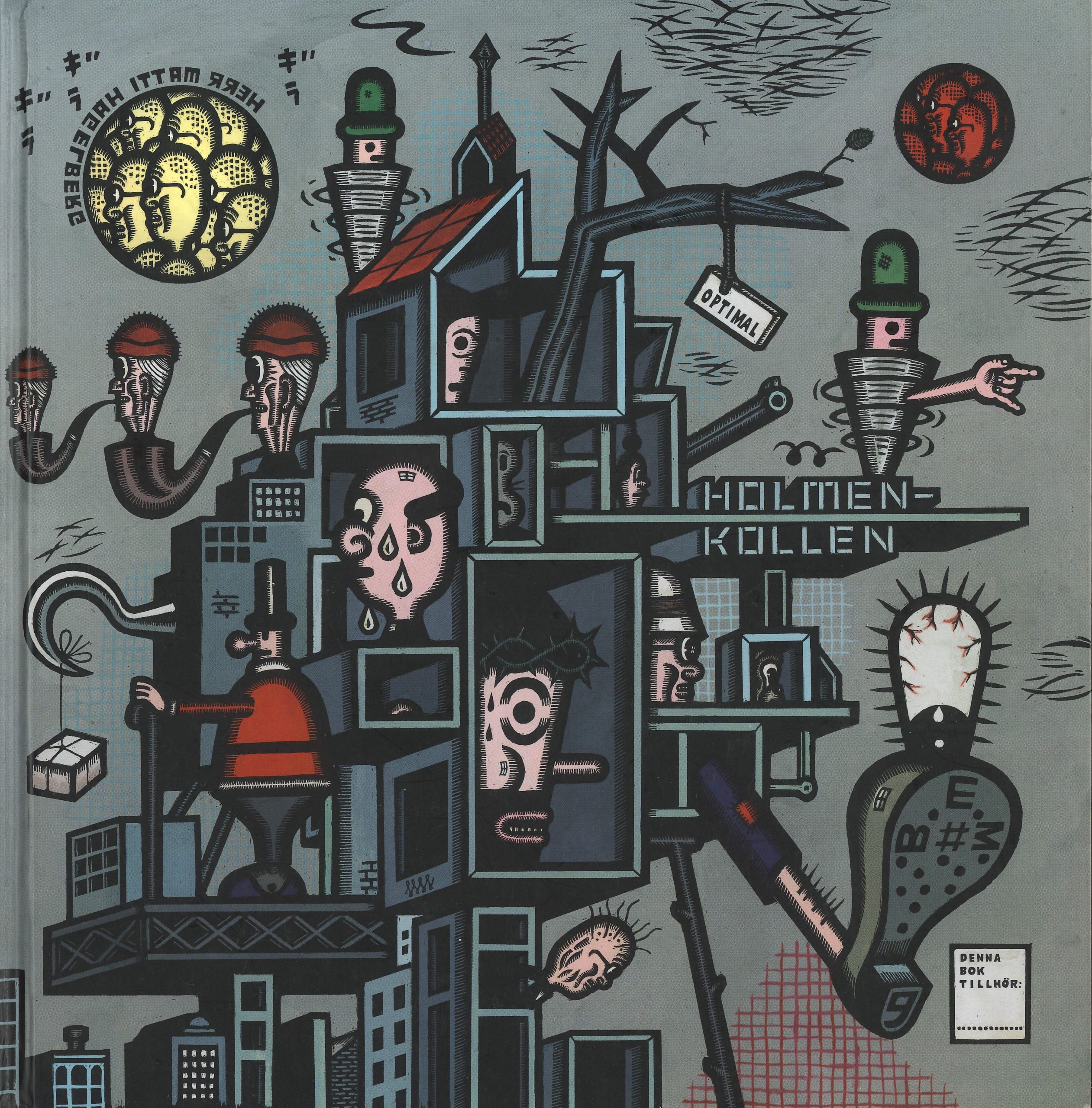 The cover of the Swedish edition of Holmenkollen, published by Optimal Pres.
I know that I brought my old, sun-bleached copy of Holmenkollen for you to sign when we met a couple of years ago. I reread it before this interview, and it remains one of the books that has made me laugh the most in my life — especially the comic where you claim that Matti Hagelberg is an expert on women and then leave a trail of bologna sandwiches for women to follow.
[Laughter] Oh dear. What have I done?
Humor is central to your comics. Have you always had a funny bone? Were you the class clown at school?
No, no, no. Not at all. I was a complete outsider at school. I barely had any friends.
Where do you think your sense of humor comes from?
One of my friends once said that the secret to my humor is that I have no sense of humor at all. Maybe that’s true — I honestly don’t know. I haven’t really thought about it much, but perhaps my humor comes from feeling like an outsider.
So you would say that your comics employ an outsider’s gaze?
Yes, I think so. For example, I really connected with Oliver Sacks’ book An Anthropologist on Mars. It’s very much about the outsider’s way of looking at life, about not fully connecting with humanity, or at least experiencing it differently.
Spoof autobiography and pop-cultural icons
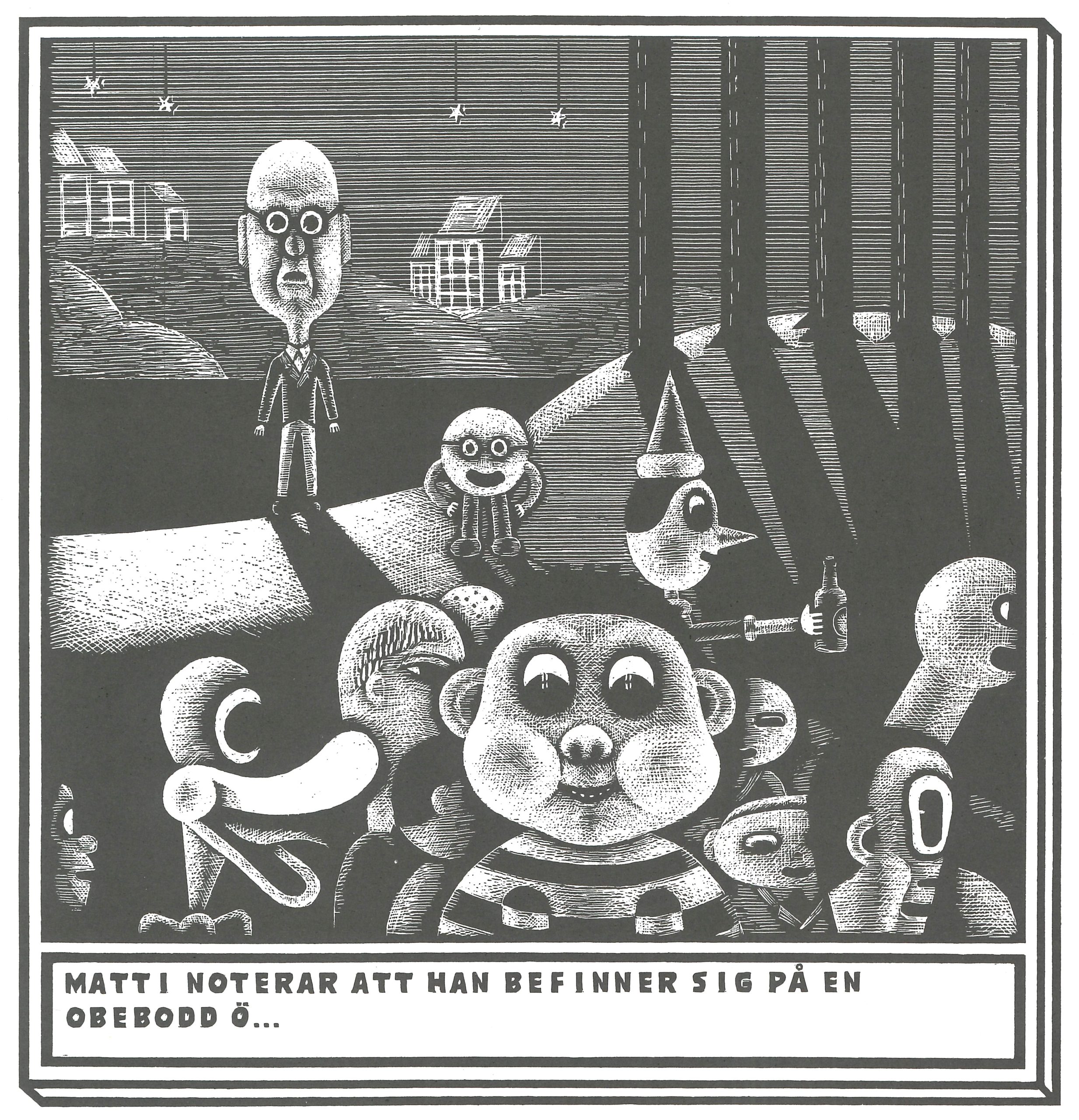 Page from Holmenkollen: Matti Hagelberg finds himself on a deserted island.
In Holmenkollen, your first graphic novel, you play with the autobiographical genre in what might be described as a spoof autobiography. The reader encounters several versions of you: Matti Hagelberg, Herr Matti Hagelberg, and the nemesis Lauri Kenttä. Could you talk about why you wanted to approach the genre in this way?
It probably comes from several places. I have a problem with authorship — I see the reader as the true author. So when I use terms like Herr or Mister, it’s a way of distancing myself and creating an inventor-like figure rather than presenting myself directly. I try to blur my own presence in the comic and leave the reader alone with the work. That’s something I keep thinking about and working on.
When it comes to Lauri Kenttä, though, it’s more about exploring ideas of masculinity and the expectations placed on men — how one positions oneself within a system of gender difference. In those stories, I’m playing with those ideas through the character of Lauri Kenttä. In short, it’s a play with identities, where I try to confuse the reader or offer several possible ways of understanding the limits of the self and the other within the story — perhaps even deliberately misleading the reader.
Along similar lines, your work — especially through Lauri Kenttä — is full of pop-cultural references. Elvis Presley, Tarzan, and Jesus all play roles.
I remember a student once telling me that she used to marry Barbie dolls to He-Man figures. I thought that was funny and interesting, and it kind of sums up what I’m trying to do: I take this thing and put it together with that thing and see what happens.
The first story I did where I not only included pop-cultural characters but also real historical figures brought together Alvar Aalto and Albert Speer, putting them in the same narrative and making them interact. It was a kind of intertextuality. Another way students have described my work is that I take an existing text and write on top of it, and that’s actually a good description of what I do.
Could you give an example of what you mean by that?
For instance, I take Edgar Rice Burroughs’s science fiction texts set on Mars and write on top of them, placing my comics in the same environments and contexts, creating something new out of the old by playing with the original material. And when I say “text,” I mean it in the broadest possible sense: cultures, characters, myths, and so on.
I also have a big problem with masculinity, as I mentioned earlier, which is why I especially enjoy playing with masculine heroes like Tarzan, Superman, and also Kekkonen.
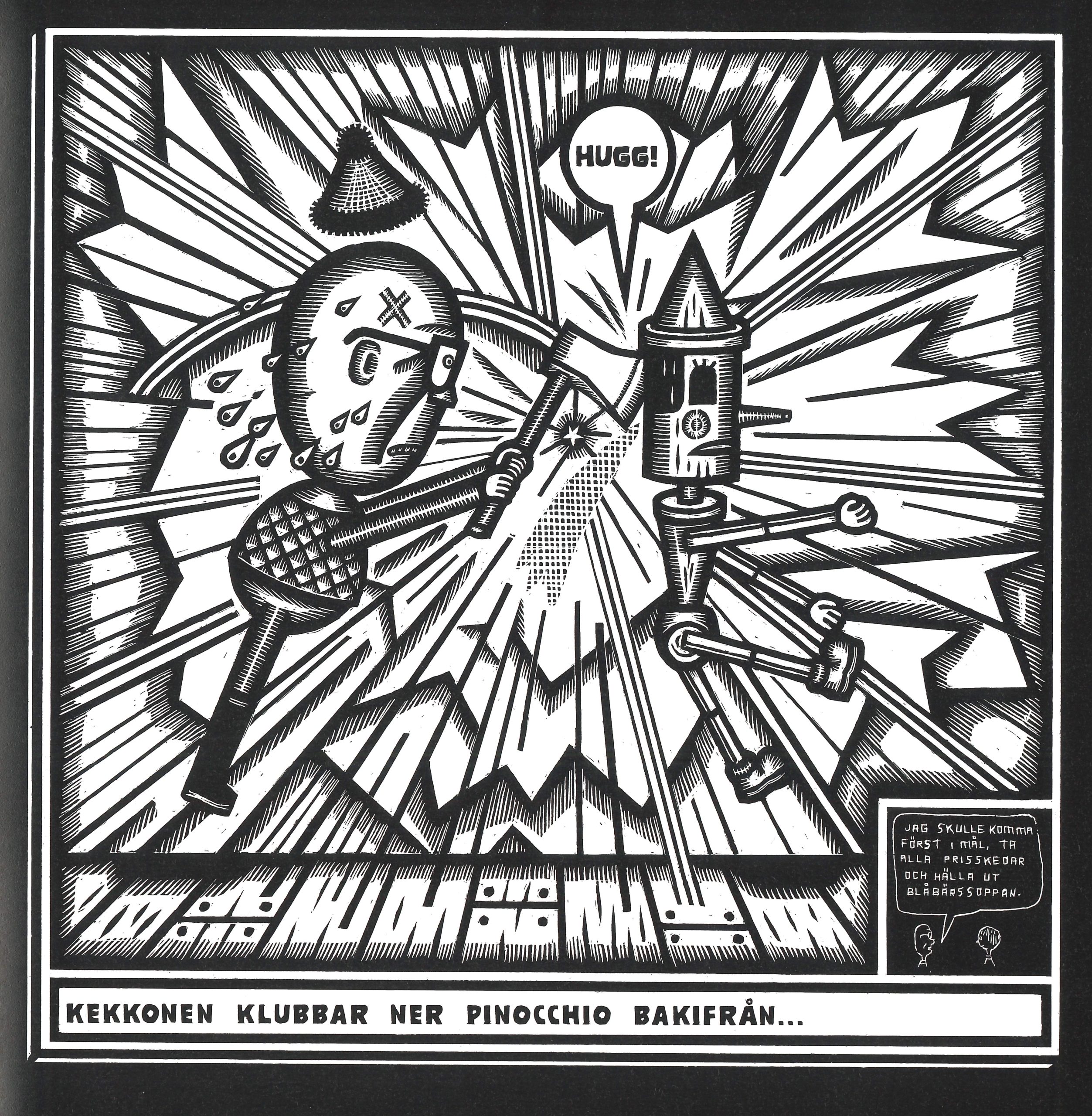 Page from Kekkonen, in which Kekkonen kills Pinocchio.
So that was the motivation behind the book about Kekkonen, where you transform Finland’s most influential politician of the postwar period — also known for his drinking and extramarital affairs — into a fantastical narrative?
Yes, and for being too close to Russia, among many other things.
What were the reactions to the book? Surely some people must have considered it blasphemous.
Well, it’s a comic, so not many people actually read it. But those who did generally liked it. That said, of all my books, it’s the one I’m least satisfied with.
Why is that?
I’m not entirely sure. Partly because the printing was disastrous — in the Finnish edition, the cover literally comes off. I’m still annoyed about that. The book did receive a few reviews in major newspapers and some public attention, but no real criticism reached me.
However, parts of the book were serialized in Suomen Kuvalehti, a prestigious weekly magazine, and there were some angry responses — people complaining about how such a travesty could be published. That kind of reaction actually felt like a proper reception. [Laughter] But the book itself didn’t cause much of a stir. There are so few people reading comics in Finland that you can almost do anything you like without provoking backlash.
So none of Kekkonen’s relatives contacted you with complaints?
No, none at all. What I was trying to do with Kekkonen was something like what in German is called Jedermann — to portray him as a person who struggles in vain before disappearing. That was the aim of the book: to free Kekkonen from the burden of being a monument and see him simply as one person among others, all sharing the same fate.
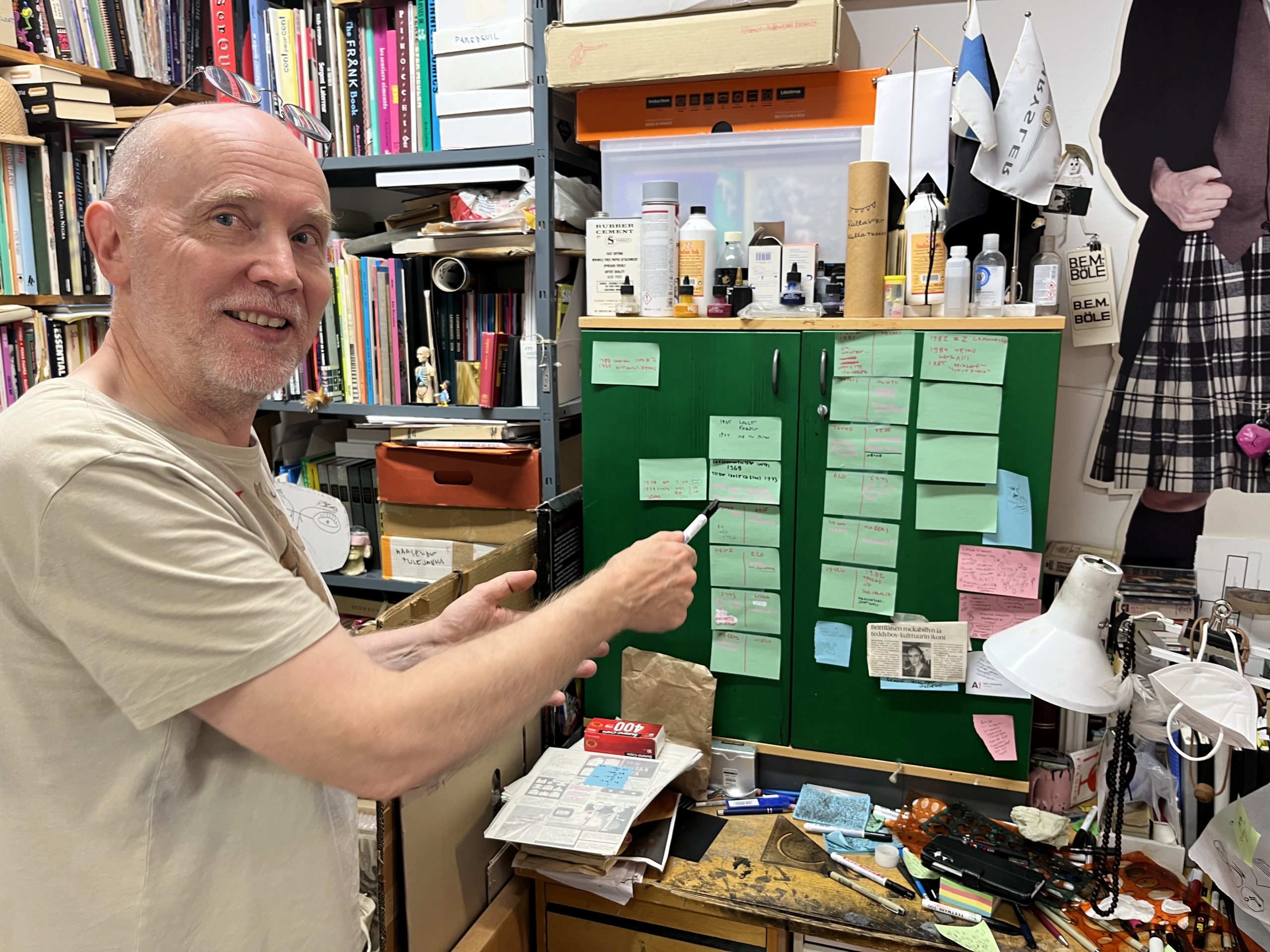 Hagelberg shows a breakdown of the book is currently working on.
Method
When you start a new project, do you have everything mapped out in advance, or do you make things up as you go along? We already know the answer when it comes to Läskimooses.
It’s a mixture of both. Läskimooses is actually a good example of how my process usually works. I more or less have a plan mapped out.
Do you write a synopsis?
Yes, more or less. I write down that the story will include these elements, that they will develop toward a certain kind of ending, and so on. I need that information in place before I can begin. Then I figure out a starting point and get going. But new questions always emerge as I work. For example, the ending might change along the way. It’s a process. I always start with a fairly clear sense of what I want to do, but new feelings and ideas inevitably appear.
Läskimooses is something of an exception. From the beginning, I planned it to be roughly 250 pages. After working on it for a year, I realized I would probably need at least 600 pages. Something similar is happening with the Ateneum books I’m working on right now. I have several short sections planned, but I doubt that all of them will make it into the final book. I’ll probably stick only with what feels absolutely necessary.
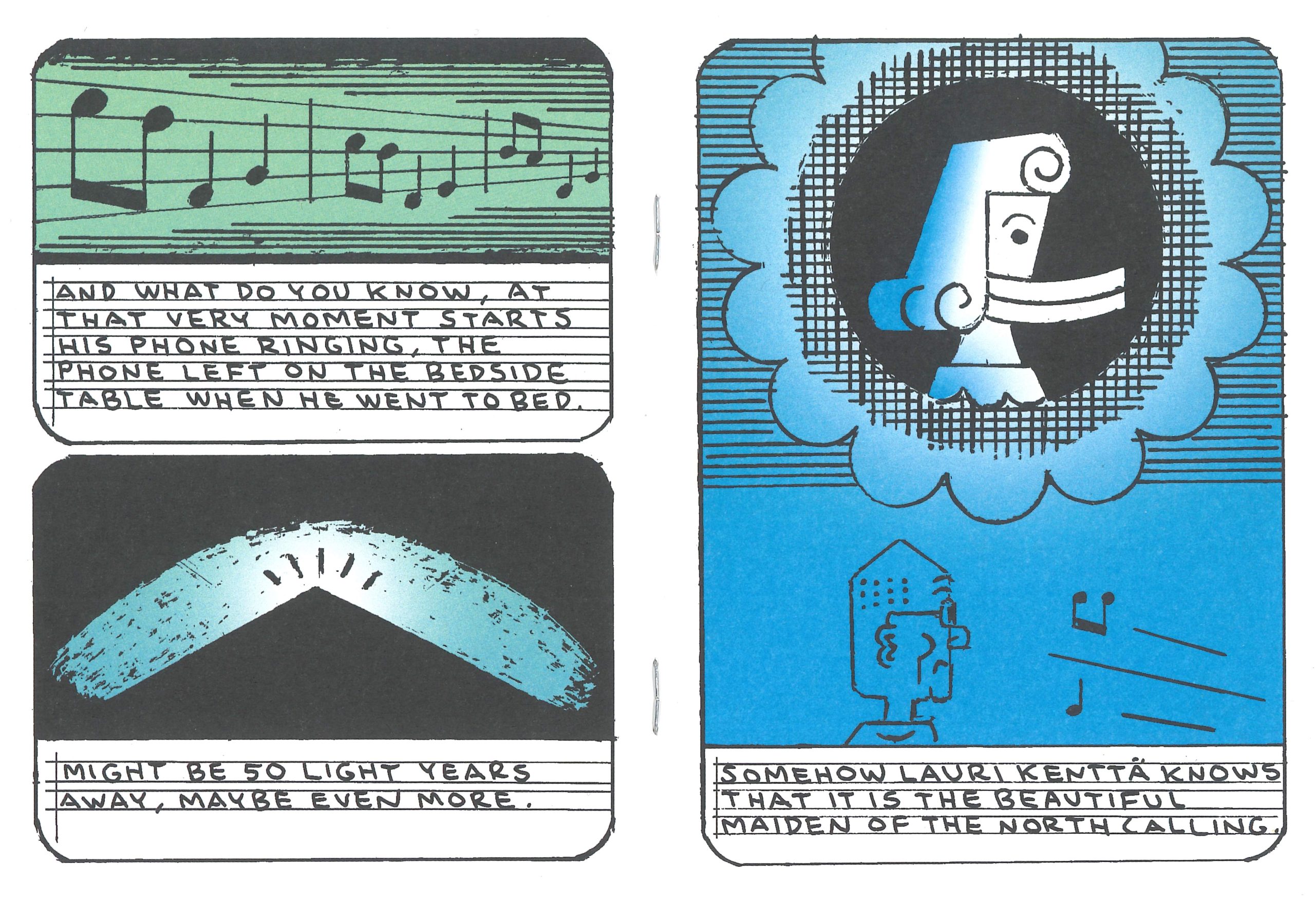 Page from On the Honeylands of Mars.
Speaking of both Läskimooses and Ateneum: few things in life seem harder than collecting all issues of B.E.M., scattered as they are across different publishers and languages. In addition to all the publishers already mentioned, you recently made a small booklet with the Latvian publisher Kuš! titled On the Honeylands of Mars, labeled as B.E.M. 29. Is this new material, or a fragment of earlier work?
Originally, I made On the Honeylands of Mars for Kirjailija, a trade magazine for literary authors, as a four-page comic, which I later turned into a small booklet for Kuš!. I simply thought it would be fun to include it in the B.E.M. series when I proposed it to David [Schilter] at Kuš!.
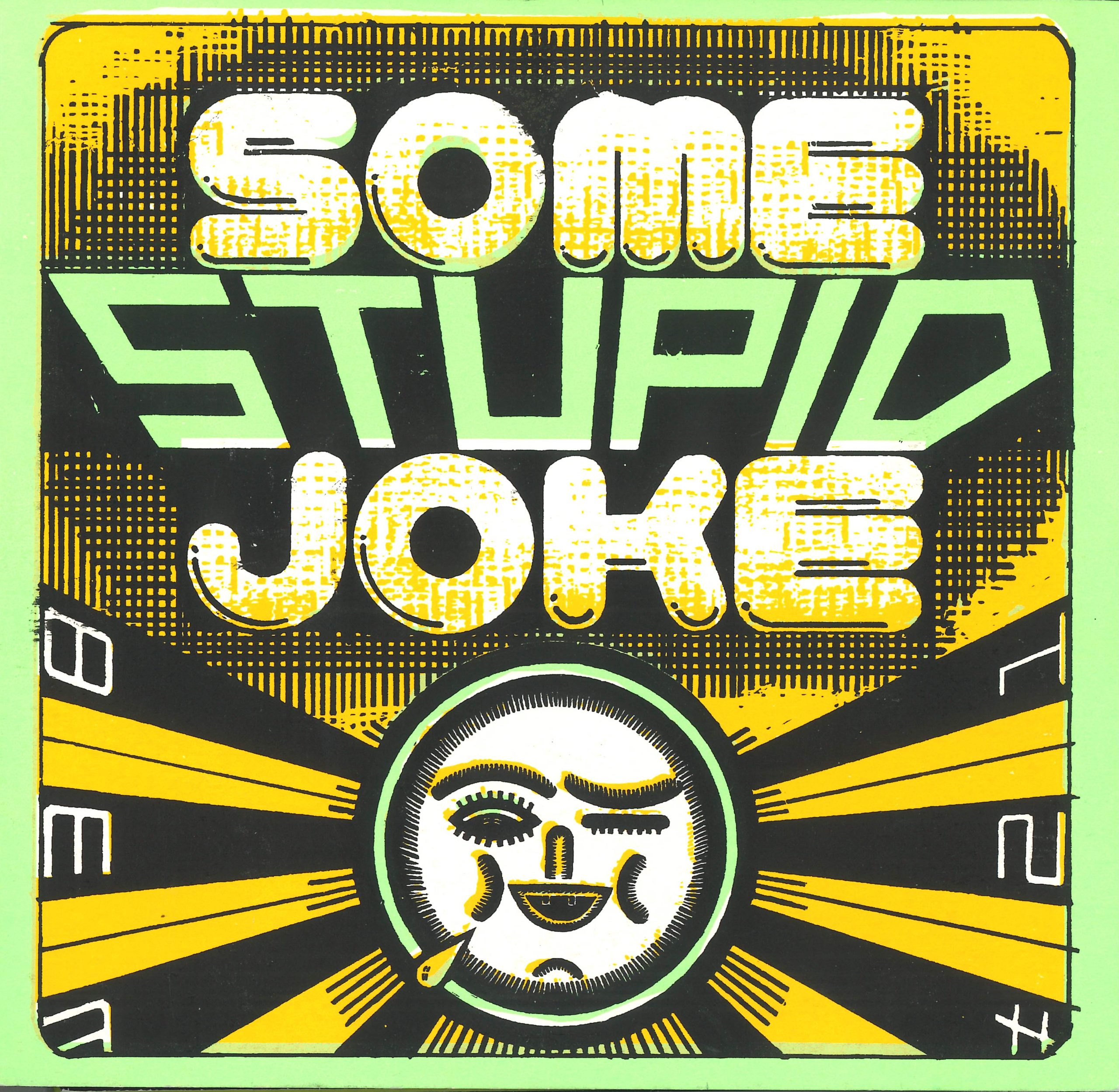 Cover of Some Stupid Joke, published by Le Dernier Cri.
You’ve worked with many different publishers, including several in Finland. Why is that?
That’s true, and overall I’m quite happy with the Finnish publishers I’ve worked with, at least the ones I’m working with now. The exception is Otava, which published Kekkonen. That experience was a major disappointment, not least for the reasons I mentioned earlier.
So why do you keep switching publishers?
The main issue is how difficult it is to find someone willing to publish your work. At the moment, I have three — no, four — no, five books that I’m trying to find publishers for. Another problem is that the books require a lot of preparatory work: scanning, cleaning up pages, and so on.
I’m currently applying for several grants, hoping to be able to pay my former publisher, Hans Nissen, to help me with this work. He’s also assisting me with the English version of Läskimooses, which I hope Fantagraphics will publish.
You seem to work at a very high pace, with so many projects going on at once. Every time I visit your blog, there’s either a new comic finished or a post where you complain about your life and working conditions. I recently read one where you wrote, “Aalto University makes me wanna smoke crack!”
[Laughter] That’s true! It’s a paraphrase of a Beck song called “MTV Makes Me Wanna Smoke Crack.” But the students are all nice. Still, please don’t read my blog.
Scratchboard
You draw comics using a scratchboard technique. What is it about the material that appeals to you?
When I was at university, learning to draw and all that, one of my favorite things was to start with charcoal. By the way, do you draw? Are you an artist yourself?
No, I write about and research comics, I don’t make them myself.
Well, James Elkins has this idea that in order to write about art, you need to make art.
Good point. Does he say the same thing about writing about drugs?
Probably yes. [Laughter] Anyway, at university I often drew on a black background with charcoal. I was in a free-hand drawing class where we were sent to a natural history museum to draw animals and things like that, and the method was to erase the black away from the surface. Starting from black suited me very well.
Scratchboard works in a similar way: you start from black and draw with white. With Läskimooses, however, I worked on white scraperboard using ordinary markers. I used scraping more like an eraser, and sometimes for specific effects, so it’s a bit different from working on black scraperboard. But overall, it all felt very natural to me. More or less everything I’ve done has involved scraperboard in one form or another.
The problem is that in 2011 Essdee — the best scraperboard manufacturer in the world at the time — ceased production. The machine they used broke down, and it was too expensive to fix. Since then, scraperboards of the same quality simply haven’t been available. What they offer now isn’t even half as good as the old material. I honestly don’t know what Thomas Ott is using, because his work still looks as good as ever.
He may have a secret supplier.
Possibly. When the machine broke down, I ordered scraperboards from all over the world to see if I could find something comparable, but no luck. So I’ve had to work with inferior material. I’ve tried to turn that limitation to my advantage, to find new ways of drawing. That’s something I did consciously in Läskimooses.
In what way?
The poorer material allows me to draw in a looser manner. The surface behaves differently. One of the reasons I wanted to do Läskimooses was that I felt a need to relearn how to draw. In Holmenkollen, Kekkonen, and Silvia Regina, the work sometimes felt closer to typography than to drawing.
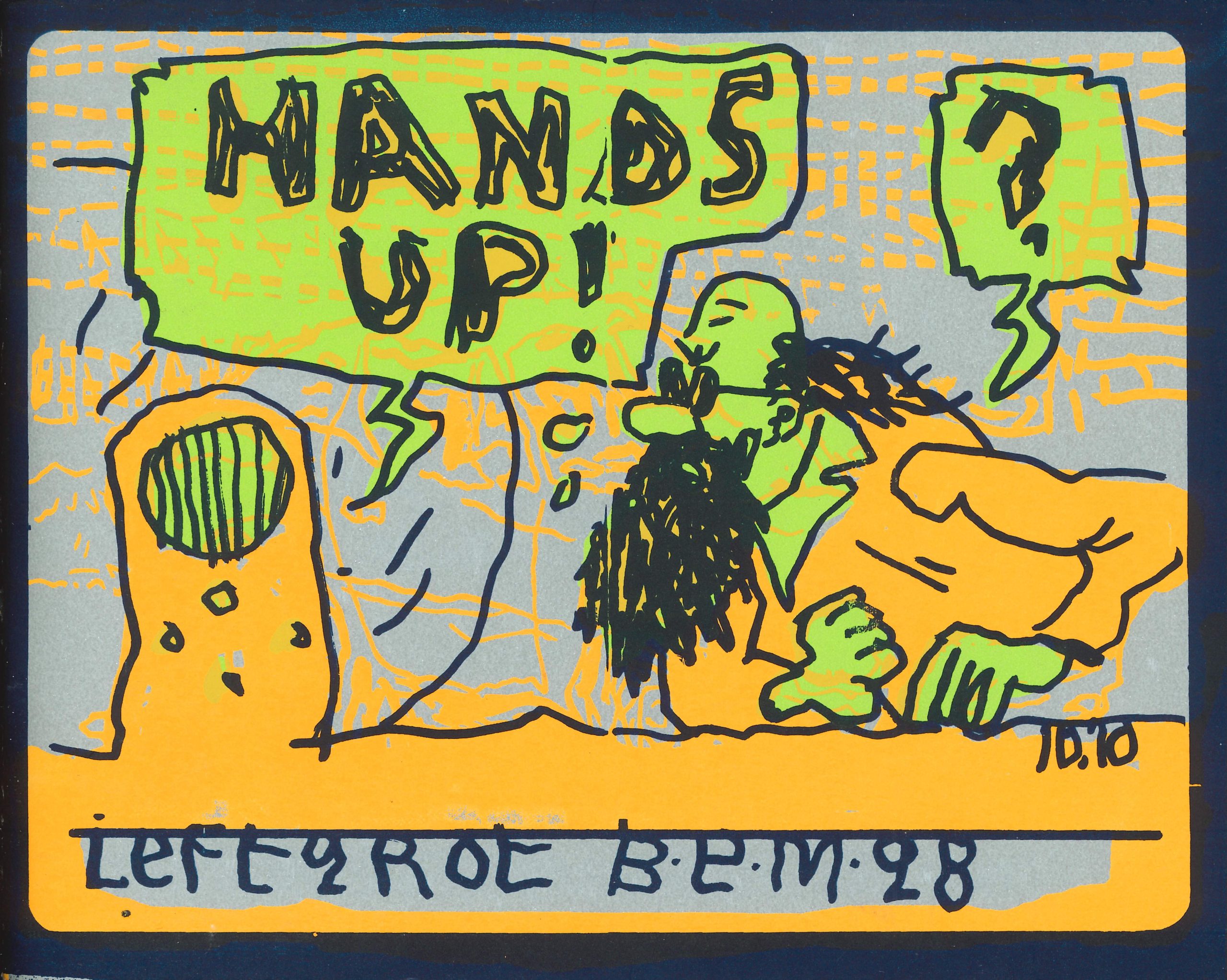 Cover of Hands Up!, published by Le Dernier Cri.
You recently made a book published by Le Dernier Cri consisting of drawings made with your left hand. How did that idea come about?
Pakito picked some of my many dumb pictures — I have plenty of those. The images in the book are mostly drawn with Posca markers. When I draw with my right hand, I’m very much in control, and I notice that I tend to repeat certain solutions—certain types of lines, certain gestures. When I draw with my left hand, I can’t do the same things, and that really interested me.
Some of the drawings look good, others look terrible. But the process made me think more deeply about the line itself — about what it is that makes one line work and another fail. I might continue drawing more with my left hand.








 English (US) ·