
Tom Shapira | December 9, 2025
It is probably serendipity that I was given a copy of Free Planet Volume 1 while reading Boris Pasternak’s Doctor Zhivago. True, the two books are very different in terms of medium, genre, scope and (one would assume) number of Nobel Prizes won. Still, in their heart of hearts the two works share a common theme: what do you do after the revolution has been won? What sort of a world do you want see and what is the price you are willing to pay to make it happen?
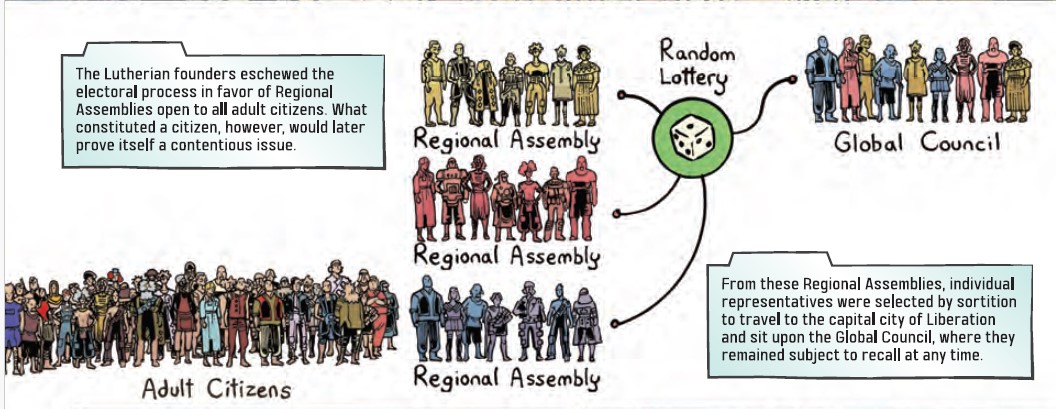 All images from Free Planet, written by Aubrey Sitterson, illustrated by Jed Dougherty, colored by Vittorio, lettered by Taylor Esposito.
Written by Aubrey Sitterson, drawn by Jed Dougherty with colors by Vittorio Astone and letters by Taylor Esposito, Free Planet isn’t quite as good as Doctor Zhivago. Shocking, I know. Still, it says something that I would even make the comparison. Most science fiction comics titles are better off being compared to David Drake ephemera; not even the Hammer’s Slammers stuff. Free Planet dreams big, but sometimes dreams aren’t enough.
Where most comics stories, especially those of science-fiction and fantasy bent, end, Free Planet starts. The good guys are literally called The Freedom Guard and have vanquished the forces of the evil from the corporate star government and helped to establish the first "free planet" in the known galaxy, Lutheria. However, simply calling the planet "free" doesn’t magically solve all the problems of society. The Freedom Guard, as well as other factions of the newly-established Lutherian government must contend with questions of economy, religion, civil disobedience, corporate interests, resource scarcity … and just because one evil government has been beaten away doesn’t mean it's gonna stop meddle in Lutheria’s affair.
In short: “A republic, if you can keep it”
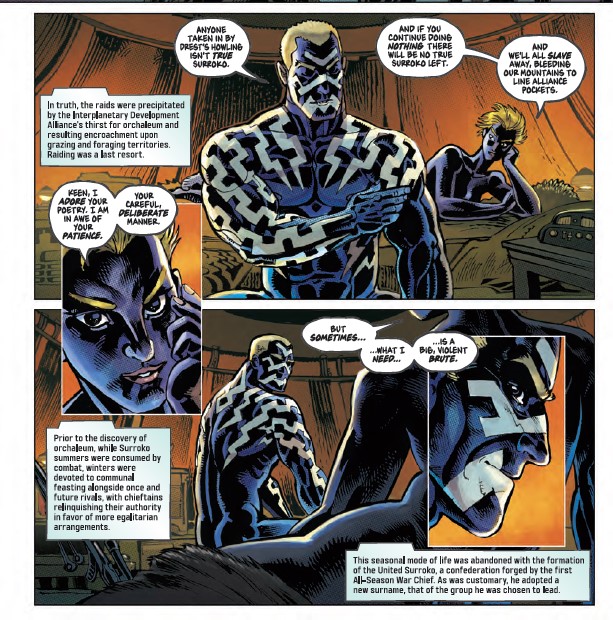
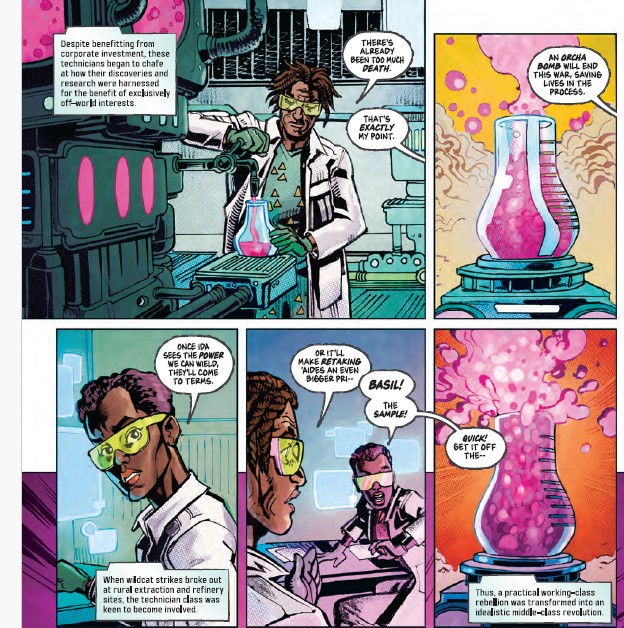
Free Planet’s strength, its desire to try a tell something more than a "story" of a few individuals, to introduce a true cross-section of a society in the midst of transformation, is also its weakness. Volume 1 engages in constant information dump, not as part of natural dialogue, or as an outgrowth of previous parts of the story, just one globe of faux-context after another: Imagine Brunner’s Stand on Zanzibar if most of the plot has been excised, or Moby Dick with just the Ishmael rumination chapters. This is the sort of thing that works better in one these fat science fiction novels, those that have the space to engage with such world-building. In the case of Free Planet the amount of pages being cannibalized leave the actual plot — or the characters — little place to go.
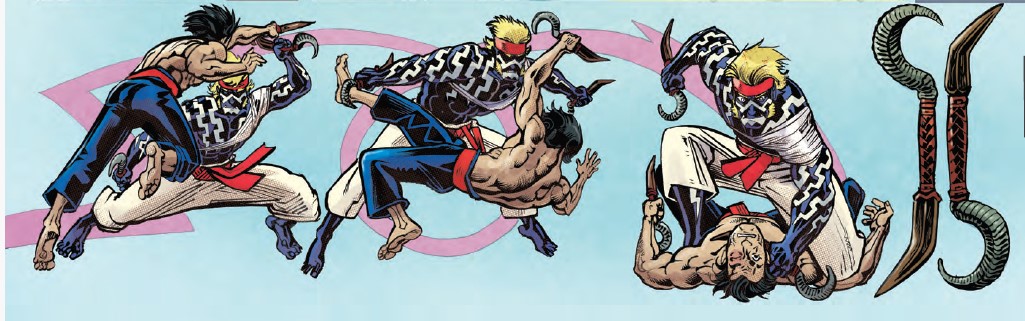
The story, as much of it as we get, seems stuck in third gear throughout, at least until the final chapter, which throws us a big space battle as a consolation prize. Well ... it's "big" in theory at least. Despite its proposed scope, most of the fights in the series seem to involve a couple dozen of people. Even considering a whole planet having a smaller population than some countries, the series' notion of interplanetary combat seems widely undersized. Much of Free Planet is spent in large double-spreads that feature an interaction of action and information. These are more impressive than they are good. It is well and good that the creators can juggle all these elements at once, but the end result is that Free Planet more often than not feels like its own fan-wiki.
The art, at least, rises above the competition by dint of a certain roughness. It doesn’t have the clean-lines and lightweight construction of many modern-day mainstream comics and is all the better for it. I believe these people (and other beings) can hurt and sweat and bleed. It's old-school in that, like the science fiction that inspired it, it becomes new school again; an echo of some of the recent efforts by Simon Roy.
There are several interesting ideas that never get fully developed, each of which is probably worthy of its own series, but instead becomes just another factoid that needs to be kept in the reader’s head. The religious fractioning in the society is a good example. Free Planet gives us a world with Orthodox and Reform churches and lets the two factions interact. But interaction is seemingly limited to the characters "portraying" each of these factions. I never truly got the sense of how the person-on-the-street feels about the two orders. Which has more popular support? What course do their rituals take in everyday life? Its not a question one often asks of this kind of story, but Free Planet seemingly demands us to ask it, it wants the reader to engage with the society it portrays, but offers no answer. It doesn’t help that eventually all roads lead to the Freedom Guard. They are the protagonists of the story after all, and seemingly stand apart from the rest of the population. Which is a rather odd choice for a story aiming at egalitarianism.
There is also the case of Jackson Carter, another revolutionary from a different planet who gets added to the Freedom Guard against their wishes — the extremist "terrorist" to their "freedom fighter." I just don’t buy the naiveté of the characters at the moment, their sheer outrage at a notion that a child-killer might dwell amongst them. This is the sort of thing that I could buy from characters at the lower-rung of a revolution, or at the beginning of their journey. Its seems impossible that people who fought a long and bloody battle against the yoke of oppression would be so aghast at thought of realpolitik.
I kept thinking back to a certain short scene, about halfway through Doctor Zhivago, a little nothing of a moment that hardly relates to any of the main characters, which involves a man entering the wrong room at the wrong time and, instead of finding a new job, finds himself imprisoned (because someone had to be), and that very same man sells out a younger family member simply to gain his freedom. You won’t find moments like this in Free Planet, not because it is counter-revolutionary, but because it offers a glimpse of humanity amidst the large historical moment. Without these glimpses what you are left with is an impressive scaffolding that supports nothing. A building with no tenants. Free Planet shows us an impressive fictional universe, but not much more.









 English (US) ·