
Youngins these days … how dare they even attempt to tell us what the best Marvel comics are of all time … when they’ve barely been out on their own in the real world?
Take Blaise Santi at SlashFilm, for instance. Based on his Linkedin page the dude’s a Centennial, so if you guessed that he has stories on his list that belong nowhere near it, pat yourself on the back. Two of his first three entries (#15 and #13) are — wait for it — 2023’s Scarlet Witch and Ms. Marvel: No Normal. On a “Best Ever” list?! Note, too, that Santi put Ms. Marvel ahead of The Amazing Spider-Man: Kraven’s Last Hunt…

Ye gad.
Other Santi head-scratchers include 2012’s Hawkeye, Doctor Strange & Doctor Doom: Triumph and Torment, and Annihilation (which isn’t bad, but at #2??)
ScreenRant’s Andrew Dyce, who’s a bit older than Santi, has some better entries on his list … until we get to the top two: Ultimate Spider-Man (#2) and 2011’s Fantastic Four (#1). Come the f*** on — who in their right mind would ever put Jonathan Hickman’s Fantastic Four run at number-freakin’ one on a list of best Marvel comics ever?
Below is a real list — from someone who’s actually lived through almost the entire Marvel Universe (minus a couple’a years at the beginning):

#10. The Death of Gwen Stacy. Writer Gerry Conway is a total douchebag, but his tale from Amazing Spider-Man #121 and 122 about the Green Goblin offing Spidey’s girlfriend never fails to tug at the heartstrings, no matter how many times you reread it. Unfortunately, it didn’t take long to bring Gwen back (as a clone) even back in the day, and now these days with Gwenpool yada yada yada … ugh, don’t get me started!

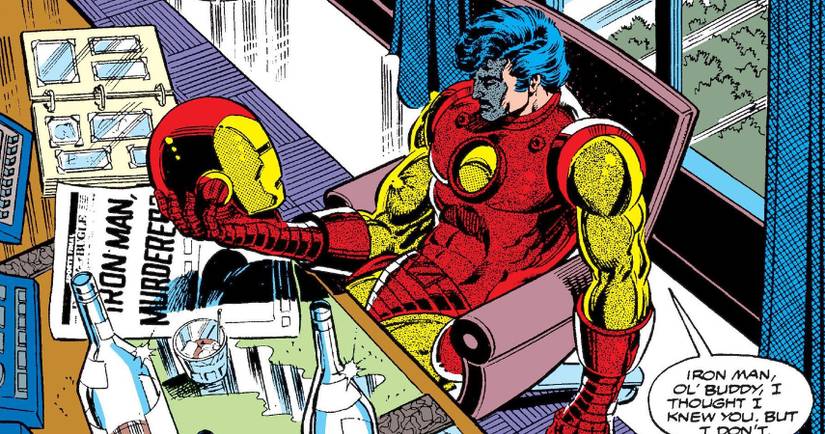
#9. Iron Man: Demon in a Bottle. David Michelinie and Bob Layton’s late-70s masterpiece published in issues 120 through 128 is where Tony Stark battles — and eventually defeats — alcoholism. The cover of one of the most memorable issues (#128, 1979) is Layton’s most requested commission, and if I recall correctly he now limits this particular work to just one per year.
#8. The Ultimates. What’s this — Hube picking a new millennium offering for this list? I admit I do so mainly due to Bryan Hitch’s magnificent cinematic artwork, similar to that of his sensational pictures in The Authority. Mark Millar’s plot and scripting are nothing to write home about, but this super-group did end up serving as the template for the MCU Avengers.
#7. Avengers Forever. Like Gerry Conway, writer Kurt Busiek is another big douchebag on social media to anyone not left-of-center, but he’s one of Marvel’s best writers ever, hands down. Probably because he actually cares about continuity, something which was discarded long ago by the company. At any rate, if you’re just a casual fan of Earth’s Mightiest you may find this 12-issue limited series a bit too in-depth. But if you dig the team, this yarn will make you cream your pants, no matter your gender.

#6. X-Men: Days of Future Past. Remember when “landmark” comics events didn’t mean you had to buy titles you never normally would just to follow what was going on with a character you loved? Chris Claremont and John Byrne only needed two, count ’em, two issues (#141-142) to create one of the best epics ever (so good, in fact, it was turned into one of the top X-Men movies). Written in 1980, the story takes place alternatively in the-then future 2013 where the Sentinels have taken over North America and now plan to expand across the planet. Not only are most mutants dead, but most super-beings period. A last-ditch plan concocted by Magneto, Kitty Pryde, and a few others seeks to alter their present.

#5. X-Men: Dark Phoenix. Just prior to “Days of Future Past,” Claremont and Byrne offered up one of the best comicbook tragedies in history: Jean Grey, aka Phoenix aka Marvel Girl, increasingly cannot withstand the effects of the Phoenix Force she acquired in Uncanny X-Men #100-101, and eventually she ends up destroying an entire solar system. This system happens to be part of the Shi-ar Empire, and they come looking for her — and plan to execute her. The empire’s super-team, the Imperial Guard, ends up battling the X-Men for Jean’s life.

#4. Avengers #54-99. I’m cheating here, of course, but it would be unfair to Roy Thomas to pick just one of his arcs during this run (well, if I want to be unfair it would be the “Kree-Skrull War” in #89-97) as so many in this run of issues are just so kick-ass good. The introduction of Ultron (#55), the team at Cap’s behest going back in time to World War II to see if Bucky actually survived (#56, boy, if they only knew), which led to an even cooler story where Avenger fights Avenger (Annual or “King-Size Special” #2), the intro of my second fave Marvel hero the Vision (#57), the introduction of adamantium and Ultron’s theft of it (#66-68), and the introduction of the Justice League-analogue Squadron Sinister and Squadron Supreme (#69 and #85). Thomas’ and (mainly) John Buscema’s creations are second only to those of Stan The Man and King Kirby (see below).

#3. Daredevil: Born Again. I was never a big fan of Daredevil outside of some of Stan Lee’s and Gene Colan’s early stories (Stan’s dialogue is hilarious, especially when “Mike” Murdock shows up), but Frank Miller’s and David Mazzucchelli’s 1986 arc with issues #226–233 is where the Kingpin learns DD’s secret identity is some of the best writing and art in comics history … ever. It also features one of my favorite story-ending splash pages of all-time:

#2. Fantastic Four #1-90. More cheating: I know it’s a whopping ninety issues but Stan “The Man” Lee and Jack “King” Kirby essentially created the entire foundation of the Marvel Universe during their (uninterrupted) run. Dr. Doom. Return of the Sub-Mariner. Galactus. The Silver Surfer. The Inhumans. The Kree. The Skrulls. Super Skrull. Sub-Atomica. The Negative Zone. The Watcher. The moon’s “Blue Area.” And on and on.

#1. Marvels. Oddly enough, one would think Stan and Jack’s FF run would be an unsurpassed #1; however, super fan-turned-super scribe Kurt Busiek teamed up with painter Alex Ross to produce what is for me the best single production in the company’s history. And it works so well in part because it is the ultimate homage to much of what Stan and Jack created, including meticulous continuity footnotes by Busiek. Told through the lens of Daily Bugle photographer Phil Sheldon, the reader is treated to a retrospective of the Marvel Universe’s beginnings, starting with the Original Human Torch and Namor the Sub-Mariner.
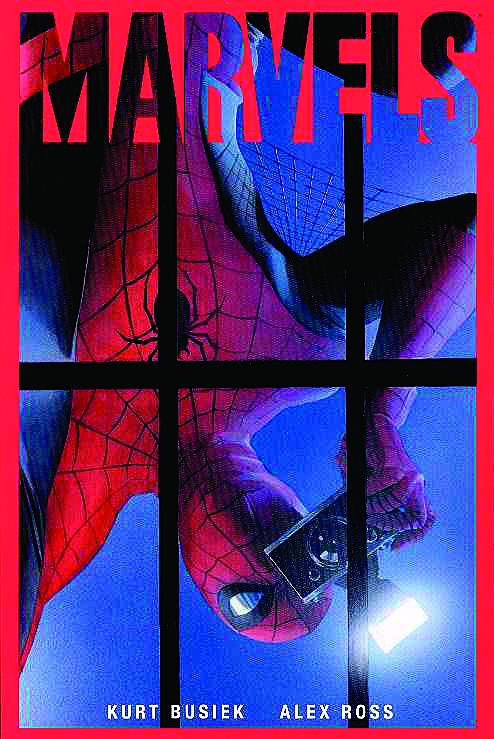
But Busiek really shines in the Mutant Scare/X-Men portion of the tale (“Monsters”): After witnessing (and participating in) an angry mob encounter with the original X-Men, Sheldon’s daughters befriend the young, misshapen, runaway mutant girl Maggie and beg their dad to let her stay at the house. Phil is torn, yet heartbroken, and after rushing home following another (Sentinel-featuring) anti-mutant mob action, his wife and daughters are devastated: Maggie’s run away because she didn’t want to endanger the family.

If “Monsters” doesn’t cause you to tear up, even a little, I question your humanity.

What are some Marvel Comics runs or issues you think are worth mentioning? Sound off in the comments.
****









 English (US) ·