
 Image via Marvel

Published Jan 26, 2026, 7:16 PM EST
CBR senior staff writer Brian Cronin has been writing professionally about comic books for over fifteen years now at CBR (primarily with his “Comics Should Be Good” series of columns, including Comic Book Legends Revealed). He has written two books about comics for Penguin-Random House – Was Superman a Spy? And Other Comic Book Legends Revealed and Why Does Batman Carry Shark Repellent? And Other Amazing Comic Book Trivia! and one book, 100 Things X-Men Fans Should Know & Do Before They Die, from Triumph Books. His writing has been featured at ESPN.com, the Los Angeles Times, About.com, the Huffington Post, Vulture and Gizmodo. He features legends about entertainment and sports at his website, Legends Revealed and other pop culture features at Pop Culture References. Follow him on Twitter at @Brian_Cronin and feel free to e-mail him suggestions for stories about comic books that you'd like to see featured at brianc@cbr.com!
Sign in to your CBR account
The longtime Marvel Comics artist, Sal Bucema, known for his iconic runs on titles such as Spectacular Spider-Man, Incredible Hulk, Rom the Spaceknight, and Captain America, has passed away at the age of 89, according to artist Sterling Clark, who recently worked with Buscema on a project:
“Wow. I just received word from Mrs. Joan that Sal Buscema passed away last Friday. He was 89. Today, he would’ve turned 90. When I think back on my childhood and all of the comic books that I read, Sal’s name seems to have appeared in just about all of them. I didn’t just read the books that he illustrated, I studied them.
Every nuance in his pencils and his inks I saw and tried to mimic. He was definitely one of the greats during those years at Marvel, when handling more than three titles a month was not just a requirement but a necessity. Sal’s art had a direct impact on my own, along with his older brother John, Jack Kirby, Gil Kane, John Romita Sr and Ron Frenz.
Sal Buscema was still in high school when he first started working in comic books in the early 1950s, doing inking work at Dell Comics over the pencils of his older brother, the superstar artist, John Buscema (John was a little more than 8 years older than Sal). After high school, Buscema served in the military, and then went to work in advertising in the late 1950s/early 1960s, including working with his brother again at an advertising agency. When John returned to comics, Sal went to a different commercial art studio until John finally convinced him to come back to comics in 1968.
John Buscema's interest in his brother doing comics was partially inspired by John's desire to see Sal ink his work, as he trusted his brother more than any other inker at the time (and even years later, Sal remained John's favorite inker). While not the first assignment he had at Marvel, Sal's first PUBLISHED Marvel comic book story was the legendary Silver Surfer #4, inking his brother John, which came out in late 1968, featuring one of them most iconic covers in Marvel history (Sal inking John on the cover)...
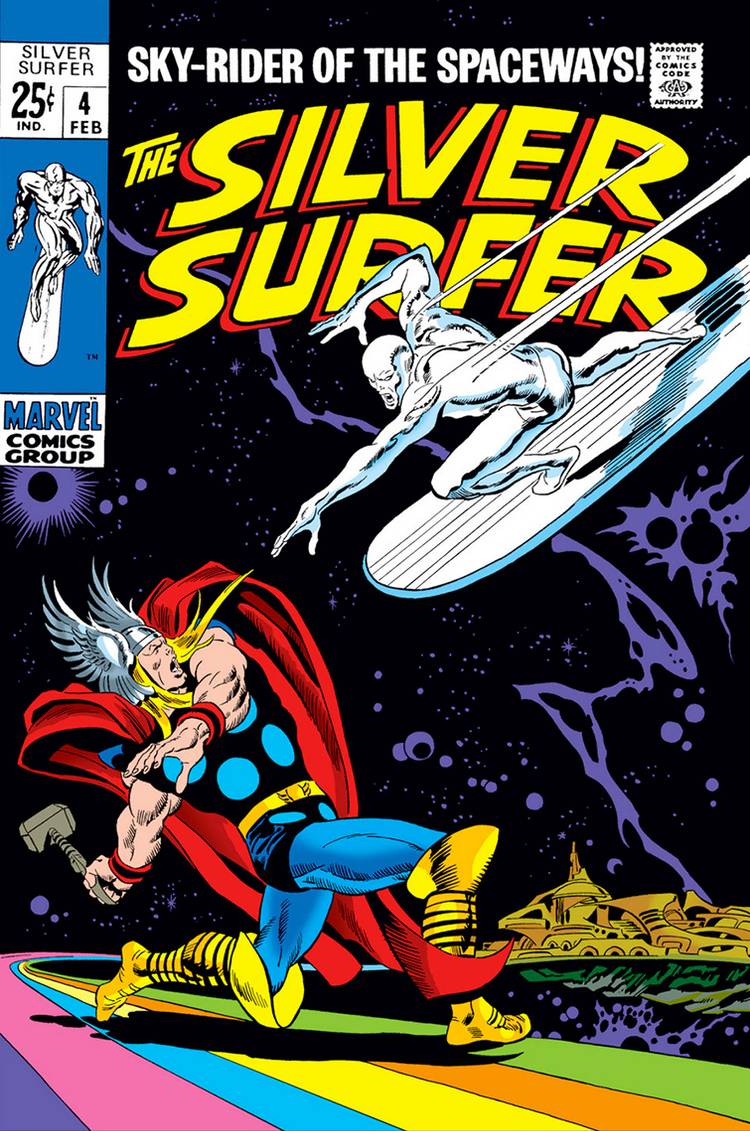 Image via Marvel
In the excellent historical book, Sal Buscema: Comics' Fast and Furious Artist, Jim Amash detailed Buscema's career. Buscema noted how he got such a plum Silver Surfer assignment:
Joe Sinnott inked the first three Silver Surfer [issues]. John was not happy with the inking Joe was doing ... because Joe's style of inking was somewhat overpowering, and at the end it ... didn't look like John Buscema anymore.... John told [Stan], 'I don't want Joe inking my work. He's losing my penciling.' ... He said, 'I want my brother' ...[H]e knew that I knew how to ink his work. He was a little spotty on my first issue, but after that he was absolutely delighted with what I did.
Initially a inker, Buscema moved to penciling, where he soon became one of the most prolific artists of the era, telling Amash, "At first I was very slow. If I knocked out six or eight pages a week I was happy. Then I started getting a little bit better, and I could probably do a couple of pages a day. But once I hit that five-year transitional period, I was like a machine. I could grind the stuff out. ... Everything just fell into place, and all of a sudden I found it very easy to do."
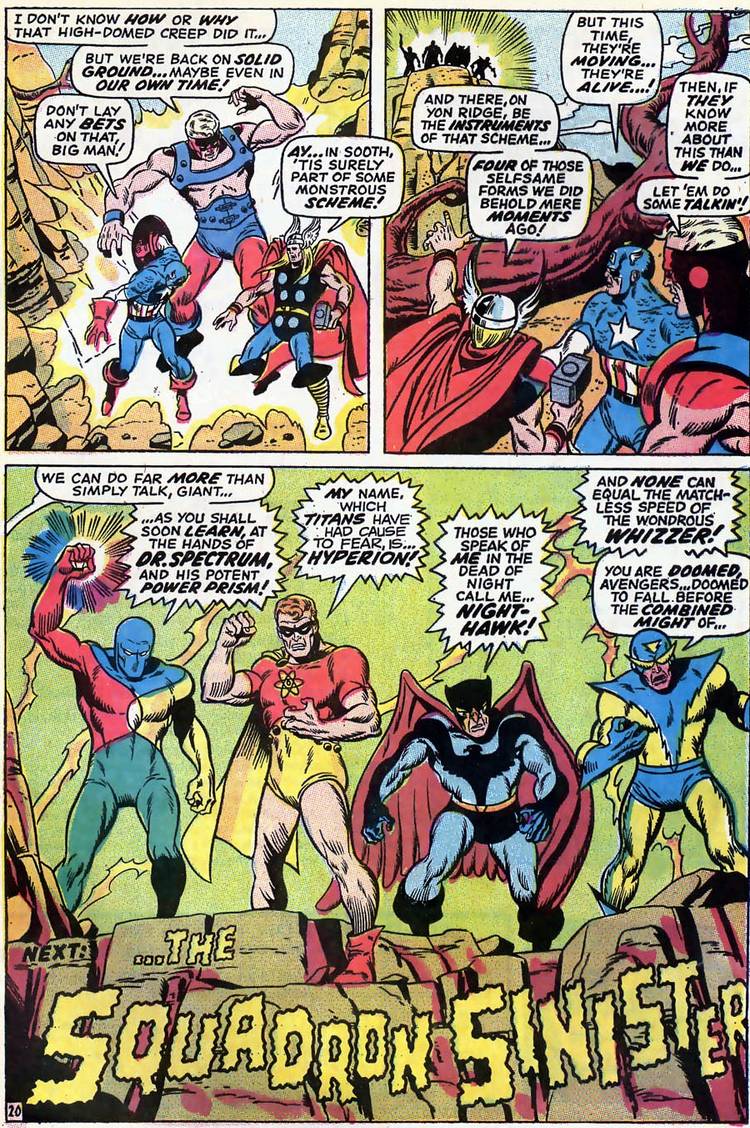
Sal Buscema's first regular assignmant was drawing Avengers with Roy Thomas while John was taking a break from the series (John had been chosen to fill-in for John Romita on Amazing Spider-Man, with finishes by Jim Mooney. Eventually, Gil Kane was hired to take over the book on a regular basis, and Buscema returned to Avengers, where he took the book back from Sal). During this run, Buscema and Thomas introduced the Squadron Sinister (the inspiration for the later Squadron Supreme, who ALSO debuted in an issue drawn by Sal Buscema)..
After finishing out the original run of X-Men with Thomas in 1970's X-Men #66, Buscema then moved over to Sub-Mariner, a series that, interestingly enough, had been launched by John Buscema in 1968. Buscema draw Sub-Mariner #25-36. After another fill-in stint on the Avengers in the lead-up to the Kree/Skrull War, Buscema joined writer Steve Englehart on Captain America with 1971's Captain America #146, remaning on the book through Captain America #181.
Buscema and Englehart had an iconic run on Captain America together, which culminated with the classic "Secret Empire" storyline that revealed that the President of the United States was part of the secret criminal organization, right before he died by suicide in front of Captain America.
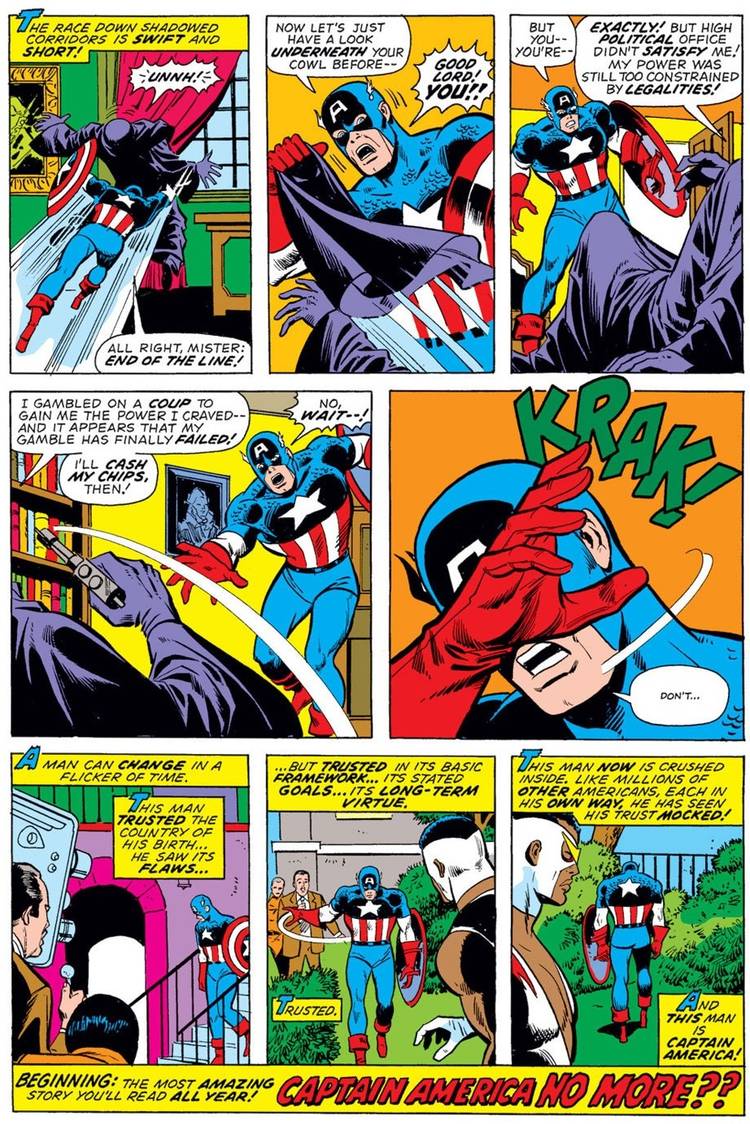 Image via Marvel
Steve Rogers was so shaken by that tragedy that he temporarily retired as Captain America, becoming a superhero tied to no nation known as Nomad.
In 1972. Buscema launched the Defenders with writer Steve Englehart. During the first year on that series, Buscema was part of the Avengers/Defenders War crossover, and he got to draw one of the most iconic Hulk/Thor fights of all-time...
 Image via Marvel
Buscema remained on Defenders after Englehart left, working with Len Wein and then Steve Gerber. Buscema drew all of Gerber's highly-acclaimed run on Defenders (Jim Mooney and Klaus Janson did finishes on Buscema's layouts). Buscema returned to the Avengers, where Englehart had become the writer a few years earlier, and had another stint on that series during the historic "Celestial Madonna" storyline.
While Defenders and Avengers remained his regular gigs in the mid-1970s, Buscema did fill-ins for nearly every major Marvel title of the era. That was how fast and dependable he was as an artist.
In 1975, Buscema began working on Incredible Hulk with writer Len Wein. Wein had a very special place in his heart for the Hulk (when he dropped the All-New, All-Different X-Men, he made sure to keep Hulk), and so did Buscema. The Hulk was Buscema's favorite character, and he was very lucky to then draw the Hulk regularly for the next TEN years! That first year or so he was working with Joe Staton doing his finishes, and then he had Ernie Chan for a year doing his finishes. Then he had a number of differrent inkers as Roger Stern took over the series in the late 1970s, as the Incredible Hulk TV show helped raise the profile of the Hulk's comic book series a lot.
Buscema had done a couple of issues of Marvel Team-Up in 1973, but his first major Spider-Man run came when he launched Peter Parker, The Spectacular Spider-Man with Gerry Conway in 1976...
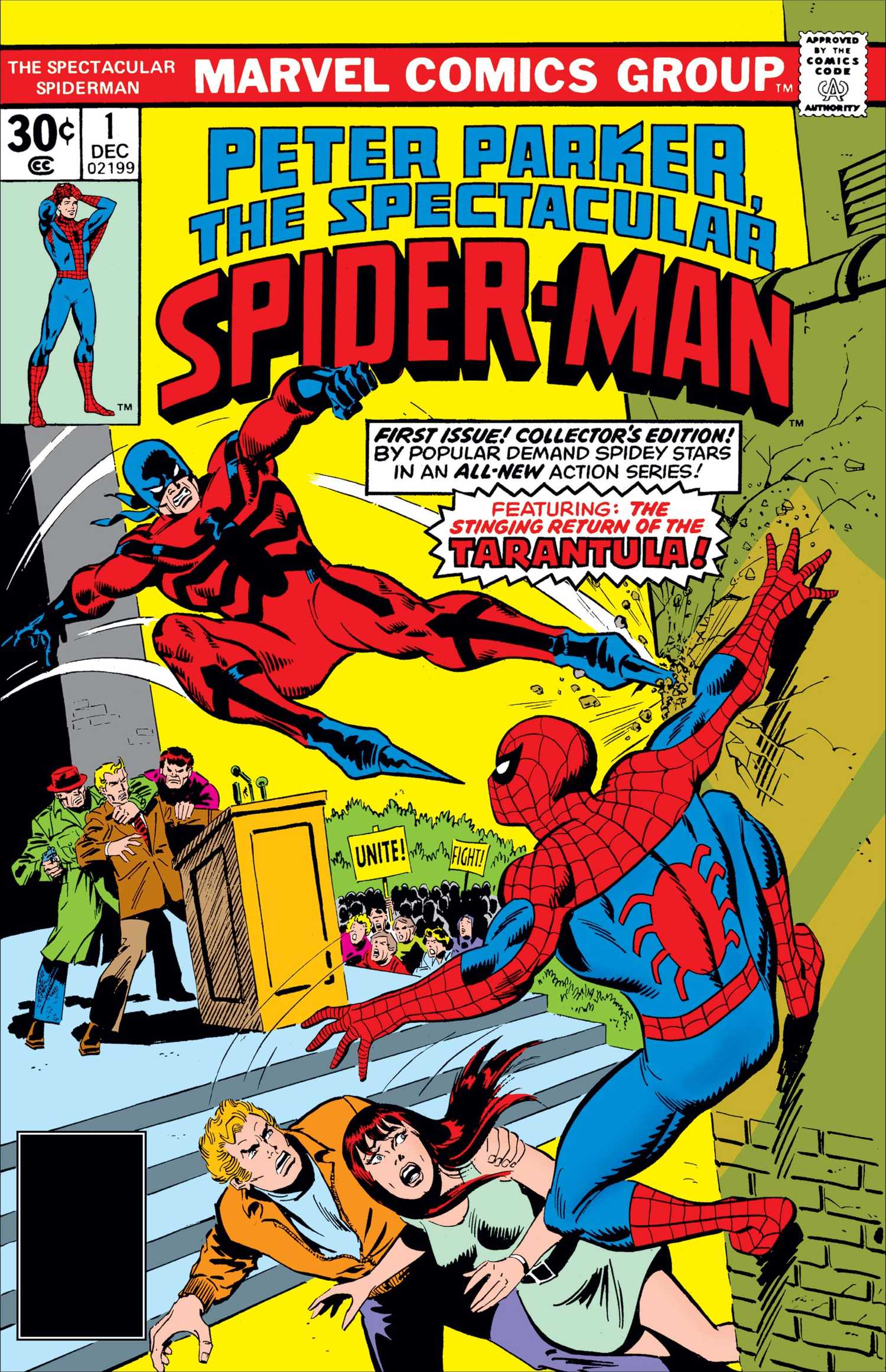 Image via Marvel
He drew the first 20 issues of the series. Around that same time, Buscema once again picked up a book his brother launched, as Buscema became the regular artist on the new series, Nova, with the third issue (after John penciled the first two issues). Again, though, Buscema was drawing issues of pretty much every Marvel comic book series here and there in the late 1970s. He returned to Captain America for another run in the late 1970s.
Buscema had two major collaborations with writer Bill Mantlo in the early 1980s, as they launched the action figure toy tie-in series, Rom the Spaceknight, in late 1979 with an acclaimed run (Buscema drew the first 58 issues of the series), and then, soon after that run began, Mantlo took over writing Incredible Hulk, at which point Buscema inked himself on the series for a while. While the punch debuted in one of his Sub-Mariner issues in the early 1970s, it was during his time on the Hulk that Buscema became most known for the "Buscema Punch," a distinctive punch that he used in many different comics, but, well, the Hulk punched SO MANY PEOPLE that it became best known for its use in Incredible Hulk...
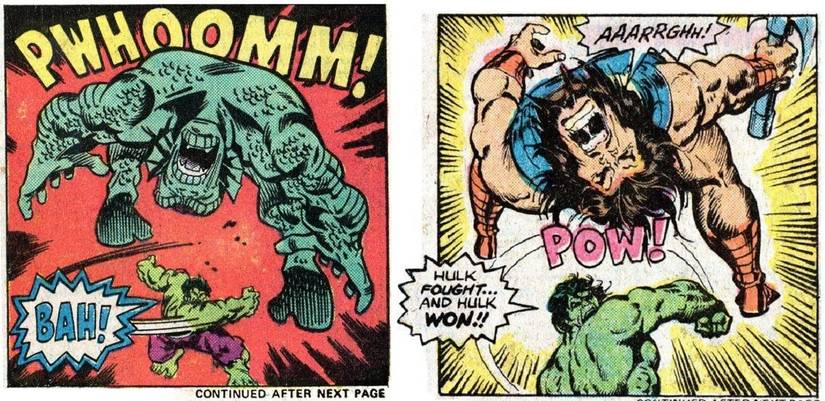 Image via Marvel
In 1983, Buscema was tapped to draw one of Marvel's highest-selling series at the time, the Uncanny X-Men spinoff series, New Mutants, which Buscema drew from New Mutants #4-17 (he was followed by Bill Sienkiewicz in one of the biggest shifts in art style on a series that they'll ever see).
In 1985, for the first time in forever, Buscema wasn't drawing ANY regular titles for Marvel. He was still drawing a lot, but they were all fill-ins, miniseries, and annuals. One of those miniseries, The Eternals, was a straight one, as it was a maxiseries whose original writer, Peter B. Gillis, didn't make it to the end of the series. Walter Simonson was brought in to finish the 12 issues out, and before the run ended, Buscema himself left.
This was because Simonson had chosen him to finish Simonson's iconic Thor run as the regular artist (as Simonson stopped drawing the book himself before the ending. Simonson had done a fill-in issue before, as well as the tie-in miniseries, Balder the Brave).
In 1987, with his Thor run over, Buscema moved over to Spectacular Spider-Man. While initially just penciling the book, he soon began penciling AND inking himself on Spectacular Spider-Man, a gig he would maintain for roughly 100 issues, including a particularly well-remembered stint with J.M. DeMatteis on the series in early 1990s (I just wrote recently about how excellent that run was).
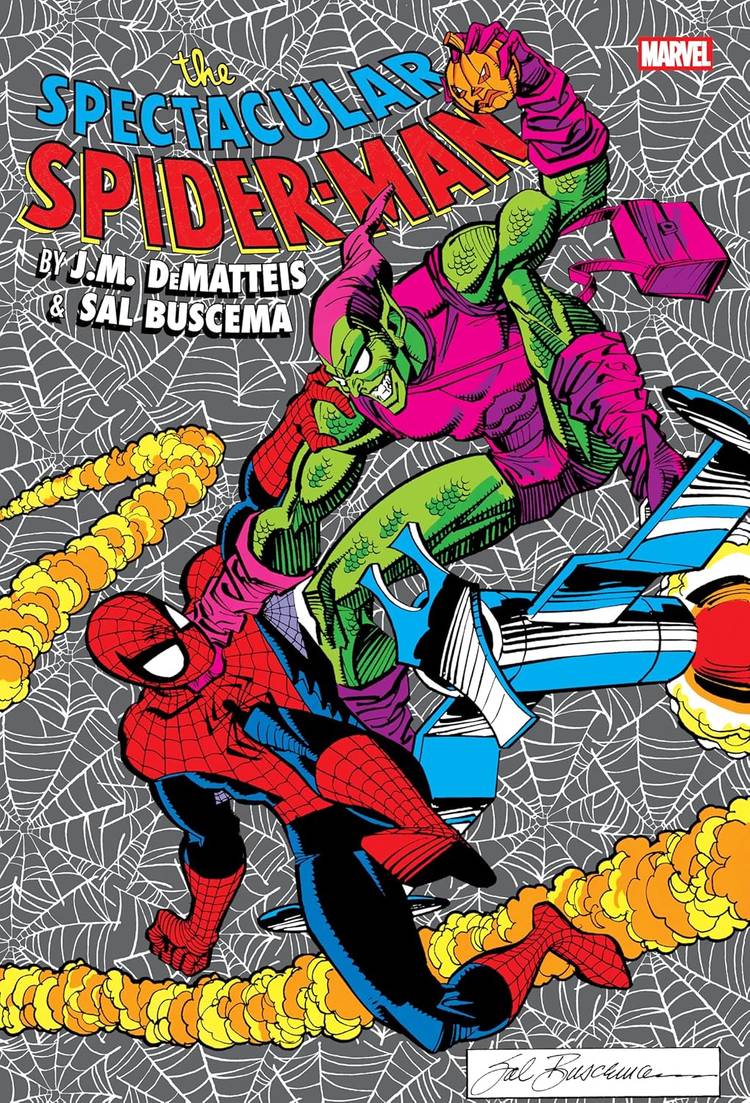 Image via Marvel
DeMatteis remembered his beloved collegue today
Sal Buscema has passed away. There's hardly a Marvel character Sal didn't leave his mark on, from Captain America to the Hulk, Avengers to Thor. Working with Sal for two years on Spectacular Spider-Man remains a highlight of my career. Not just a great artist, he was a truly good guy. Safe journeys, Sal. You will be missed.
When DeMatteis left the book, Buscema worked with some other writers, like Steven Grant and Tom DeFalco, and he then stopped inking the book, as Marvel brought in Bill Sienkiewicz to ink Buscema during the Clone Saga, in a very unusual pairing that really worked quite nicely, honestly. His run on the book ended in 1996, at which point he left Marvel entirely for the first time in decades.
He went to DC, where he did some penciling and inking work, with his one regular gig being inking Shawn Martinbrough on The Creeper in 1997. He also inked Klaus Janson on a number of issues of Batman in 1998. While continuing his DC work in 1999, he also returned to Marvel. becoming Ron Garney's inker on Incredible Hulk in 1999.
Buscema inked a few issues of Spider-Girl during Pat Olliffe'ss run on the series, and then, in 2002, became the regular inker on Ron Frenz's long run on Spider-Girl (which continued until roughly 2011 in a few different series). When that run ended, Buscema then inked Frenz on a Thunderstrike miniseries.
What that miniseries was finished, Buscema was MOSTLY retired, but he continued to work on and off for the rest of his life, often with Frenz or collaborators connected to Frenz.
Sal is survived by his widow, Joan, and their three children.
Source: ComicClubLive





 English (US) ·