

There’s been plenty of opinions and reviews of the Star Trek franchise’s latest offering, “Starfleet Academy,” and to virtually no one’s surprise progressives are the only ones who actually dig the show.
These folks must be doing so purely out of a political allegiance (again, no surprise), because not only is this show Trek-bad … it’s bad period.

Its supporters, too, are out in force on social media, going after anyone who disagrees (my personal fave: “the REICH people don’t like it”), the most common refrain being “Star Trek was always ‘woke!’”
From a critical perspective, Grok defines “woke” as “an overzealous, performative, or authoritarian form of progressive ideology that prioritizes identity politics, political correctness, or ‘cancel culture’ at the expense of free speech, merit, humor, or practical concerns.”
First, a quick background on “Starfleet Academy”: Set about 900 years in the future and about 150 years after an event called “The Burn” that destroyed warp (interstellar) travel capability across the galaxy (and helped dismantle the Federation of Planets, of which Earth is a founding member), it’s a direct sequel to “Discovery,” the last three seasons of which jumped from about a decade before Capt. Kirk’s time into this far future.
All three so-called “NuTrek” series – “Discovery,” “Strange New Worlds,” and now “Starfleet Academy” have been panned not just for being woke, but for ignoring continuity, bad writing and premises (“The Burn” being one big example), and wooden acting.
I mean, how could The Burn cripple space travel 750 years from Kirk’s era? How is it the Federation was still using the same warp travel it uses in Kirk/Picard’s time that far in the future? That’d be like us today still using horses and carts to get around on land, and wind-powered vessels on the water. Not to mention, in The Original Series and its spinoffs there were ample examples of superior alternatives to warp already established. It makes zero sense Starfleet didn’t take advantage.
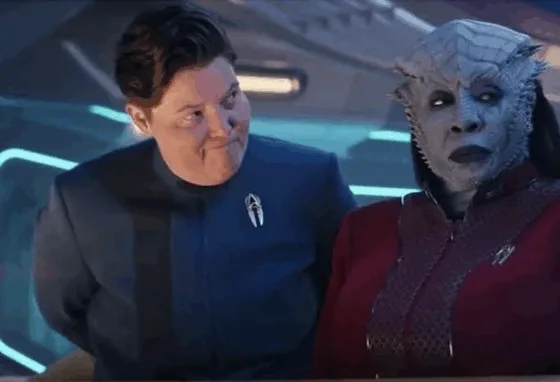
At any rate, never-hairbrushed Holly Hunter (Nahla Ake) is tapped to lead the reestablishment of Starfleet Academy, and her class/crew look as if it’s a 32nd century version of “Saved by the Bell” or early “Beverly Hills 90210” or some other silly teen-based show. And they act accordingly.

Like The Burn can be considered a middle finger not only to people’s intelligence but past Trek lore and continuity, so too can Hunter’s Ake treating the captain’s chair of her vessel (the Athena) as an easy chair in which she seems just plain bored.
The premiere even overtly establishes one of the few (straight) white men as a privileged and coddled fop, and thus is immediately a villain. Several cast members are fat. There’s a cadet in a wheelchair. Another uses sign language.
So you see? A “prioritization of identity politics … over merit … and practical concerns.”

In the film “Star Trek IV: The Voyage Home” Dr. McCoy gives a lady in a hospital a pill which regrows her kidney … and then he pulls out some gadget which instantly heals fellow Enterprise crew member. Chekov’s skull fracture – nine hundred years before “Academy.”
But somehow in the 32nd century, paraplegia and deafness can’t be fixed. Because representation. And they admit it.
Washington and Lee University Journalism and Media Ethics Professor Eric Deggans chimed in on “Academy,” saying that Trek’s Federation of Planets “has often been an allegory for America’s belief in itself,” and during The Original Series this “meant [it] was an unquestioned force for good and equitable order.”
He adds “many episodes were centered on persuading wayward alien species to just get with the program and join the Federation” – much like how American politicians “were fighting to keep countries around the world from aligning with Communist systems.”
(Ironically, a phrase often uttered on “Academy” is “fellow traveler,” whose origins come from the 1917 Bolshevik Revolution’s term “poputchik.” Go figure.)
Read the full article at The College Fix.





 English (US) ·