
Gina Gagliano | November 17, 2025
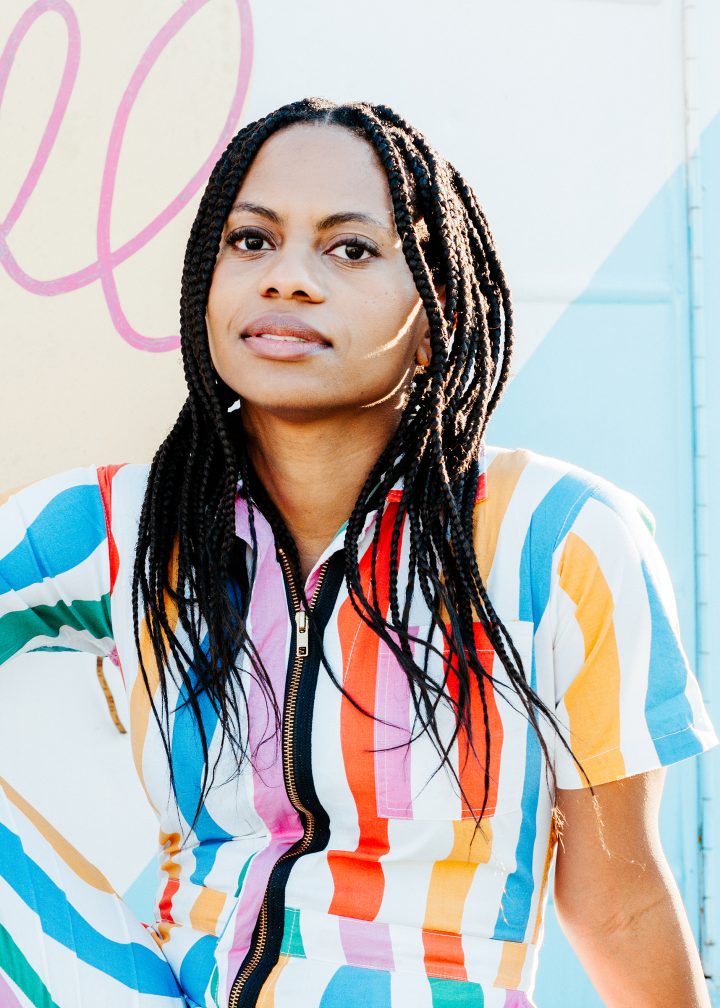 Ngozi Ukazu
Ngozi Ukazu burst onto the comics scene mid 2010s with her hit webcomic Check, Please! which combines hockey, baking, making the best friends of your life in college, and a heartwarming queer love story.
Since then she’s written and illustrated superhero comics for DC, created comics for The New Yorker, and explored another sport (and the value of art school) in the graphic novel she created with Mad Rupert, Bunt.
In this interview, TCJ contributor Gina Gagliano talks to Ukazu about all that’s led up to this moment, and about her latest graphic novel, Flip, which tells the story of a Black high school girl who switches bodies with the popular white boy who is her crush—and examines Black girlhood and self-esteem, microaggressions, and fandom.
GINA GAGLIANO: You started your comics career making Check Please!, which is a comic that I feel took the internet by storm. Can you start out by talking a little bit about that book and that whole process and that experience.
NGOZI UKAZU: Check, Please! is a queer love story about a former figure skater who joins a college hockey team, and he loves to bake.
Before it was published by First Second, Check, Please! began as a webcomic, and it started off as practice. When I started grad school, I wanted to make a webcomic to build my portfolio. But as I continued to update, readers got more and more excited, until I launched my first Kickstarter in 2015—and then a subsequent Kickstarter in 2016. That second Kickstarter was the inflection point where, suddenly there were comics journalists asking, ‘wait, what's Check, Please!?”
I'm curious about how much hockey you're still thinking about now that it's 2025. You've wrapped up Check, Please!, but are you following hockey? Are you into the new women's league? How is your current hockey knowledge?
I can't say that I've been paying attention to hockey these days! My love of hockey was a love of research, and that helped make Check, Please! authentic.
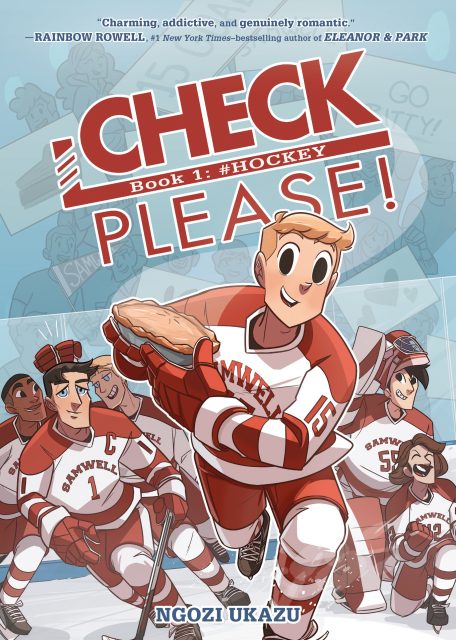 Check, Please! Book 1: # Hockey by Ngozi Ukazu (First Second, 2018)
Yeah, it is a fascinating subculture that I have now learned about in part because of your work with Check, Please!. Your most recent, independent graphic novel before this one was a graphic novel with Mad Rupert called Bunt. And from it, I gather that you have some feelings about art school.
I worked on the graphic novel Bunt alongside Madeline Rupert, my co-author. The project was our first time working back closely together as friends, and it deepened our friendship, and friendship is what Bunt is about.
Ostensibly, though, it is a warning about the perils of art school and higher education and how financial aid can be complicated, but it's also a silly story about a bunch of kids who don't want to pay for school, and they create a softball team in order to do that.
I would say my feelings on art school are now nullified. Art school is great—if you can pay for it—and you should not take out loans unless you have a plan.
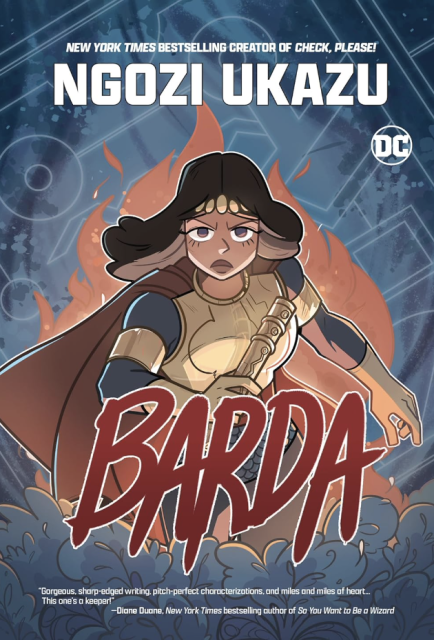 Barda by Ngozi Ukazu (DC, 2024)
You've been making some superhero comics with DC. There’s one about Big Barda, which I have here.
Yes!
The people at DC sent it over to me. And you're working on one about Orion now. How has that process been? It seems like probably a different sort of can of worms than either a Check, Please! or a Bunt.
Gina, all comics are so different, and all comics are the same!
Working with DC Comics has been a dream of mine. I grew up watching the Justice League cartoons, reading Justice League International by the all-star team of Giffen, DeMatteis, and Maguire.
When my agent and I approached DC and pitched to the DC Young Readers line, we wanted to work with Big Barda. Then, as I researched Barda and Jack Kirby’s Fourth World, I became a Jack Kirby fanatic. I really do find him to be one of the most creative and prolific minds of the 20th century.
I am not being paid to say this, but working with DC has been a blast. Once they hire you and once they trust you with their characters? They kinda sorta…let you do whatever you want? The characters become your canvas. It’s great. Writing and drawing Barda was fun, and now, working on Orion, has been…a bit more challenging, but in the best way. He’s this very stoic angry guy who is, I believe, rather misunderstood. But it's been gratifying to get to tell his story with an honest approach. An approach that is true to Kirby's vision—while also putting that young adult spin on it.
So why these two characters out of the whole DC canon?
When I pitched a Big Barda graphic novel to DC, something about that story spoke to me, the Fourth World was so interesting. And after I finished Barda, I got crazy. I mean, I was a Kirby fanatic, and I had an entire story ready for Orion.
Spoilers, not spoilers, I would love to do a Scott Free book—that is, an origin story for Mr. Miracle—as a sequel to Orion. Wouldn’t it be cool to have this trio of DC YA titles?
Can you talk also a little about the character of Barda? I've read a little bit of The Fourth World and the Scott Free and Orion books, but it seems like the characters spend all of their childhood being tortured. . . .
Yeah it’s so bad, haha.
Then they fight all the time!
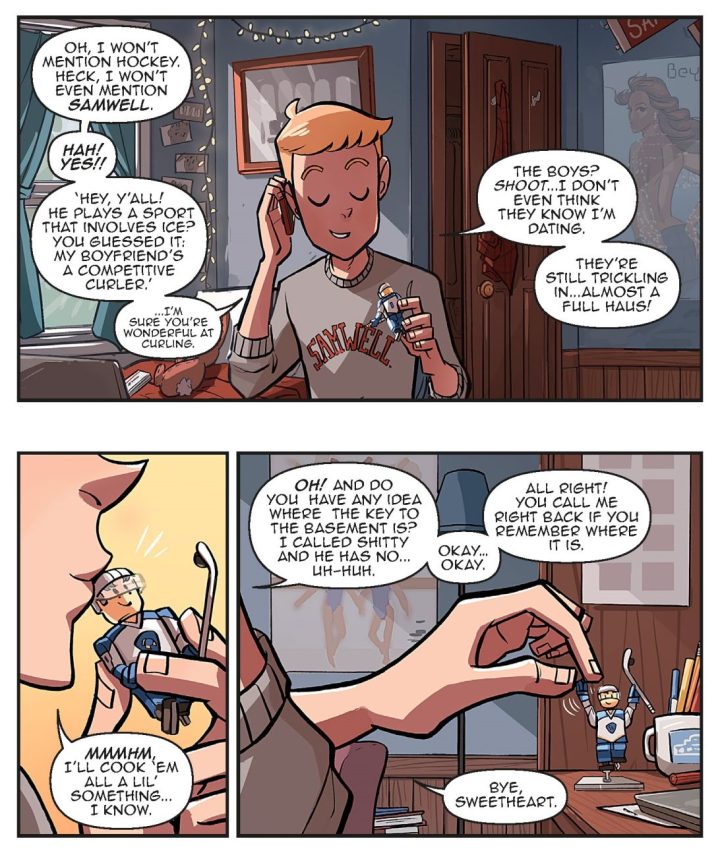 pages from Sticks and Scones by Ngozi Ukazu (First Second)
I tend to have two modes when I talk about The Fourth World. I have zero miles per hour, and 100 miles per hour. If I go into 100 miles per hour mode, I sound insane. But we're all comics nerds here. This is The Comics Journal, so maybe I should just sound insane.
Barda was born on the planet Apokolips, a realm of darkness and slavery. Because of her physical prowess, she was chosen to become a Female Fury, the elite guard of Apokolips. Apokolips is ruled by Darkseid, this tyrant fascist ruler, and the Female Furies do his bidding. And she is so thoroughly brainwashed that Barda fundamentally believes in Darkseid being all-powerful.
But there's something inside of Barda that rebels. She yearns for softness and love and connection and beauty. She suppresses these feelings until she meets a boy named Scott Free. He's a dissident against Darkseid, a freedom fighter.
I believe all good romances come from two characters who need each other. When Barda meets Scott Free, she needs his resistance and his hope. The closer they get together, the more he awakens within her her base nature, which is to be good, which is to protect people.
And that speaks to The Fourth World as a whole. With The Fourth World, Jack Kirby attempted to create a theology. It wasn't simply comics for him. The great thesis of The Fourth World is that good or evil, nature versus nurture doesn't matter. All that matters is that you try to be good, and you try to protect, and you try to believe in the moral arc of the universe bending towards justice. If you do so, you will succeed. These are characters who defy their nature or defy their environment to be good.
That's Barda's story, on a macro level.
That's great.
So as well as all this, you've also been doing comics for The New Yorker.
Well! Okay, a 180 from superheroes to droll satire.
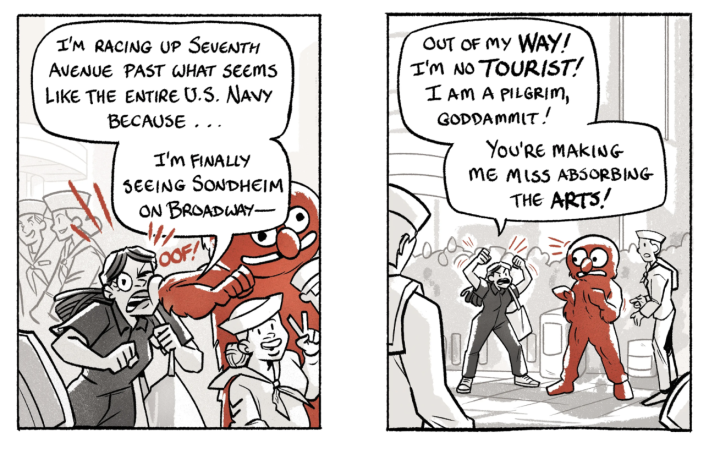 panels from "Sunday in Times Square with Elmo" by Ukazu, Ngozi (The New Yorker, 2023)
Yes, and, the most literary magazine of all comics-adjacent magazines. How has that been?
Writing for The New Yorker has been fun. But the best part of The New Yorker is other cartoonists. There are hundreds of New Yorker cartoonists scattered all over the world. Whenever one or two cartoonists meet together, there's some weird electric Venn diagram overlap of talent, silliness, and cultural knowledge that makes every single interaction fantastic. That is by far the best part of being a New Yorker cartoonist, the people that you meet.
That's great!
So you have a new book that's just coming about. It's called Flip, and it's a story about a Black high school girl who changes places with the white guy in her class, who is her crush. To start off with asking, have you seen Freaky Friday? And what do you think of that movie?
Yes, I've seen Freaky Friday.. People also like comparing Flip to Kimi no Na wa – Your Name, the anime.
The body swap trope is nothing new, and it’s not my favorite trope, but it’s fascinating. There's always that sequence when the two characters first switch, and they're trying to navigate each other's world, and are fumbling with everything. It's always played for comedy, but in Flip I add some self-reflection too.
It's not your favorite trope, but you were still like, okay, body swaps, this is the next book that I want to spend a year or two years putting together.
Hockey’s not my favorite sport; body swaps aren't my favorite trope! When I latch onto something, I latch onto it!
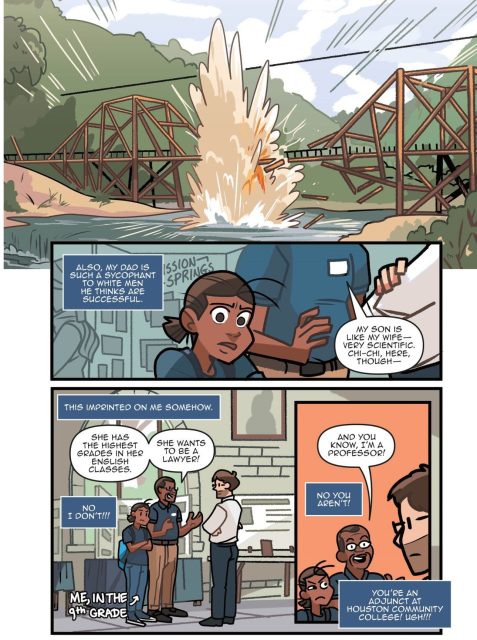 pages from Flip by Ngozi Ukazu (First Second, 2025)
One of the major themes of this book is self-worth and self-worth for Black girls. Can you talk some more about that?
Whenever you make a book, you don't know what a book is about until you're done with it. This happened with Flip. When I finished it, I understood, ‘oh, I wanted to write about a Black girl confronting her need for external validation.’ Chi-Chi, the main character, doesn't see within herself the inherent self-worth that so many of her friends and family see, and Flip is a story that asks how can that be? Why?
Self-worth is one of many self-help positivity buzzwords, like self-love, but it’s difficult to discuss being compassionate toward oneself. It’s a difficult thing to do in practice. This book addresses that in a frank way. Yes, chase self-love, but perhaps just seek out, first, self-neutrality and self-acceptance. Because that's one step towards mitigating the intense critique that we often put on ourselves.
For Black girls especially—especially those socialized in environments where most people don't look like us—you have this passive self-critique that continually occurs, because you're different.
The book is also filled – I don't know if we're still calling them microaggressions, or if we're just calling them aggressions – that Chi-Chi has to deal with, and then Flip has to deal with while he's navigating being in her body. Can you talk about including those in the story?
There was a whole sequence of events where Flip is learning how to be Chi-Chi, and she goes through all the little microaggressions that she experiences day to day. There's a moment when Flip is first talking to Chi-Chi's friends, and they don’t know he’s “flipped”, and he uses this broken form of AAVE, African American Vernacular English, because he assumes that's how Chi-Chi talks. Because she is Black, haha.
And it's a microaggression, because he just doesn't know. He literally doesn't know. He just assumes that because this is her skin tone, she talks a certain way. But I make it very clear that Chi-Chi, and her two best friends Esther, and Yesenia, are all Blackteens who all speak very differently. Microaggressions often occur because of a collapse of identity, where people look at you, and see and assume one thing.
There's another instance where the two characters are body swapped, and Flip's mom wants to touch Chi-Chi's hair without asking her. She just assumes she can touch her. And then, because Chi-Chi is in Flip's body, she can just reach out and use Flip's body as a shield to be like, ‘DON’T touch this black girl's hair.’
You brought up Chi-Chi's friends, and I want to talk about them a little more, because they're great. They're such a great friend group, and I feel like their friendship, and friendship in general, is a major theme in the book. Can you talk about that?
It was so important to me to give Chi-Chi friends who are as smart as she is, and as nerdy as she is, and also Black. You have Esther, who is this preppy, intense character – like, she's going to Yale, and wants to be a lawyer. She’s a beautiful, tall girl who is clearly wealthy, and she is super confident. Then you have Yesenia, who is non-binary, and a STEM genius, and they also are just a little bit more chill and relaxed, and openly queer. Then you have Chi-Chi, who's in the middle between both of them. I wanted to show three very different types of nerdy Black girls, because I don't think I've seen all three of those combinations together in fiction, where in my real life, I have seen that all the time.
I was pretty shocked when Chi-Chi and Flip meet the school alum who switched into someone else's body, and then never switched back. Can you talk about that? That was one of the most terrifying and horrifying things in the book.
People really get disturbed by that part! It's funny, because I didn't think too hard about that scene? I've had a lot of people ask me, ‘what happens? Do they save her?’ Spoilers: I don’t know! The whole reason why Sarah Spiegel is there—‘spiegel’ meaning mirror—is that she represents someone who never found self-love, never found self-compassion. She switched bodies with someone of whom she was envious, and never cultivated any love for herself.
And that does happen in real life. People sometimes never find that self-compassion, and it can be destructive. It can be as insidious as a disease. That scene raises the stakes narratively, but it also is an actual danger in real life if you don't find self-compassion. It can kill you.
You were bringing up some of the imagery, and I want to talk about that, and also about the color blue, which I feel like maybe is a continuum with these things, because the book is so full of blue things, from blue eyes – Flip's eyes are blue, and that's the device that you use to show when the two characters are moving back and forward from each other. He's also a swimmer, so there are all these pools all around.
Yeah.
 page from from Flip by Ngozi Ukazu (First Second, 2025)
Everyone's wearing blue clothes all the time, there are screens, there are mirrors. Can you talk about the color design and the reoccurring symbols and elements that you have there?
Blue is a color that was easy for me to work with. But this book is heavily influenced by The Bluest Eye, so I decided very early on in the creation of Flip that the eye color would be this intense blue.
On the note of other imagery, I used as much doll imagery as I can. There's a scene at the beginning of the novel where Chi-Chi goes into this weird, dark, metaphysical space. She interacts with a doll of herself, and she rips it apart. This is a direct reference to The Bluest Eye, where there is a scene where the girls get white dolls, and they don't understand why the white dolls are supposed to be pretty. They try to find the beauty inside, and they rip apart the dolls to try to find it, but there's nothing there.
I'd love to hear about the cover. So, the cover of this book is Chi-Chi, your main character, with a mask of Flip, the person that she turns into, that she's putting on or taking off. Can you talk about how you came to this cover design?
I have to give a lot of credit to Molly Johanson (First Second’s Senior Designer). It was kind of this wonderful synergy moment, where it was me, Molly, and Kirk Benshoff (First Second’s Creative Director), at the offices for First Second, in Manhattan. We were all freaking out over where the title would go, and how to approach the treatment, and we had eight different illustrations we were floating for the cover. And Molly brought this all together because we were all freaking out a little bit over where to put the title and where to put my name. I had brought Kirk and Molly about eight sketches.
I remember telling Kirk, ‘what if we try to make this a little bit like “The Girl with a Pearl Earring”? Like, that type of intimacy that's less creepy? And he immediately got it. Then Molly figured out the title treatment, the author name placement, the color scheme—and it immediately worked. We have this Black girl looking right at you with openness and intimacy.
I find it so interesting that unlike Freaky Friday, definitely my classic body swap narrative, the two characters don't have equal page time.
Yes.
Which of course makes sense, because you are talking about Flip and various things about his life, and the depression that he's dealing with, but, Chi-Chi is very much the center of the story.
I didn't want Chi-Chi and Flip to be equal protagonists, and Flip is barely even a deuteragonist. He's there to support Chi-Chi, because the story is about Chi-Chi, and ultimately Chi-Chi goes through the biggest change in the graphic novel. Knowing Flip as a character, I knew he wouldn't have any profound epiphanies about the Black female experience. And if he had, that would have felt rather trite.
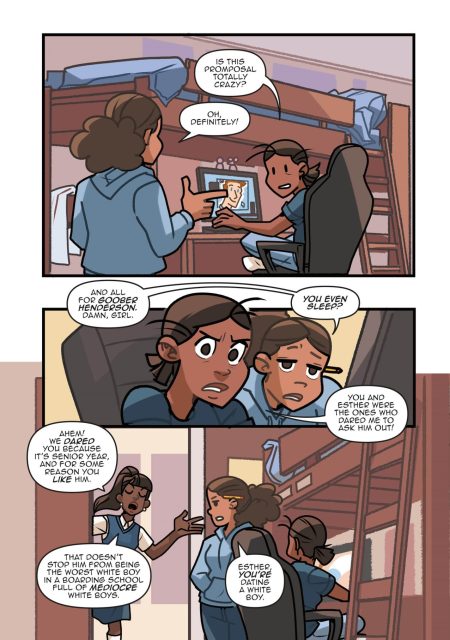 pages from Flip by Ngozi Ukazu (First Second, 2025)
The story is not for his edification.
Yeah . . . he grew! But not that much!
Also, this story is not a romance.
Yes.
Despite the fact that it starts out literally with a promposal between the two characters, that then turns into not a romance.
Yup! And again, don’t you feel that it would have been trite if it were? The only love story in Flip is the story of Chi-Chi falling in love with herself.
I'm very curious about your thoughts about K-pop, which is another central element of this book. Can you talk to me about your favorite K-pop group and what you like about them?
My favorite K-pop group is BTS. They are funny, creative, and very relatable young men. There’s another new group that I’m a fan of—even though they're not a K-pop group technically—called KATSEYE. They are so delightful. The fan ecosystem for K-pop group is so fascinating, because there are so many marginalized identities in these fandoms. In Flip, Chi-Chi and her friends are huge K-pop fans, and there are so many Black teens and young adults who love Korean pop music. It's interesting to see how Black fans interact with something that has appropriated Black culture, but is distinctly not Black. It's this interesting interaction and perhaps a bit of a reclamation.
Do you have a favorite BTS song?
Love “Idol.” They hit the American scene with that song back in 2018 and it has some vigorous choreography in addition to a unique message.
You talked a little about fandom in your new book, and it's an essential element of this graphic novel, because Chi-Chi is a giant K-pop fan, and a whole element of this novel is wanting to go to the concert, and the plans for that. Fandom is also something I feel like is an essential part of the experience with Check Please!, where there's a whole huge fandom of people who not only are excited about the books, but have shirts and all this other merch. There's fanfiction! Can you talk a little about fans and fandom and your thoughts and experiences there?
Fandom is a space where people can grow, they can find friends, and they can express themselves. And like to create works that people can be fans of. I don't know if there will be a huge fandom for Flip, because the main ingredient for a fandom is that you need lots of characters so that you can ship them. But I enjoy the experience of being in fandom. It's where a lot of my creativity has flourished. So fandom is an important thing to me, and a cool thing as well.
I also want to ask you about video, because there's a lot of different video things that you're doing with your work. Check Please! is entirely told in the form of a video diary. In Flip, everyone is making videos for each other all the time, from the promposal at the beginning, to the thesis project, to the K-pop fan videos. And you've been talking in this interview also about getting on TikTok and doing videos yourself. Can you talk about video, and why that's interesting, and also translating it into comics?
Characters using video in comics is a fun narrative device, because it's automatically visual, and it allows the character to put things within their own frame – so it’s like they're paneling their own comics. Characters can use video and film as a tool to navigate the world and express themselves while letting the audience see through their eyes.
So this is a YA graphic novel, which Bunt was as well. Barda is part of the DC teen comics line, First Second published Check, Please!, which has a lot of adult readers, but also was kind of a YA graphic novel. Can you talk about YA authorship and teens, and why you're kind of thinking about and writing in this space?
YA stories follow characters at an interesting inflection point in their lives. They aren’t quite established adults, but they certainly are more independent than young teens. Discovering one’s own identity and how one relates to their community and the world always makes for fascinating stories.
We’ll see if I venture into telling stories for other audiences. I might move into the adult space, or maybe even to middle grade!
We covered a whole lot in this interview, from webcomics to co-authored projects, to superhero comics, to The New Yorker comics, to original graphic novels. Have all the processes for these felt very different, or are they just comics at the base of them?
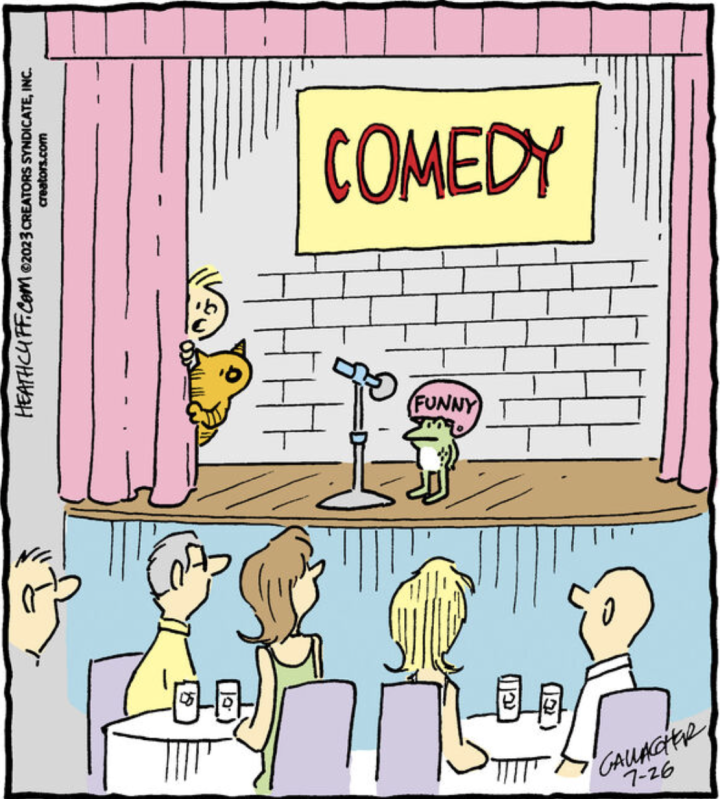
At the end of the day, they’re all comics!
What are you reading that's inspiring you now?
Okay, here are a few things that have inspired me in the last month or so.
I read The New Yorker a lot because, surprise, it's very good writing. I read an essay called ‘Always Inadequate’ by Vivian Gornick, which was a short vignette that illustrated how different people deal with feelings of not measuring up.
Oh, and, Heathcliff! I’ve been learning about Heathcliff and why it is the comic strip we have today.








 English (US) ·