
Kristian Williams | June 9, 2026
In June of 2020, Popular Mechanics ran an article offering step-by-step instructions for pulling down a statue. Though it was a pleasing gesture of solidarity for racial justice protests then unfolding around the country, I'm not sure anyone actually needed the instructions. Crowds seemed to have worked out for themselves how to topple white supremacist monuments, even if they ultimately fell short of toppling white supremacy itself. In some cases local governments, sensing the inevitable, decided to get ahead of the mob action and remove the statues in a more orderly and less spectacular fashion.
Most of the excised statuary were representations of long-dead Confederate generals, imperialists, slave traders, and the like. One notable exception was the Thompson Elk statue in Portland, Oregon. This life-sized bronze elk had stood atop a granite plinth which originally doubled as a watering trough for horses. Positioned in the middle of Main Street, between Chapman Square and Lownsdale parks, in the summer of 2020 the elk found itself in the very center of Portland's riotous demonstrations. Rather than being targeted by protestors, it was ,if anything, revered.
However, the fires repeatedly lit in the trough degraded the stone base. Fearing an imminent collapse, the city government preemptively removed the statue for safe storage. It was almost immediately replaced by a homemade homage, welded together out of scrap metal. Though its appearance was somewhat ghostly and even a bit sinister, the "Nightmare Elk" became an emblem of both resistance and resilience, a symbol of "the city's intrepidly creative spirit." During the summer of unrest, it was repeatedly stolen by right-wing assholes, and each time replaced with another DIY approximation.
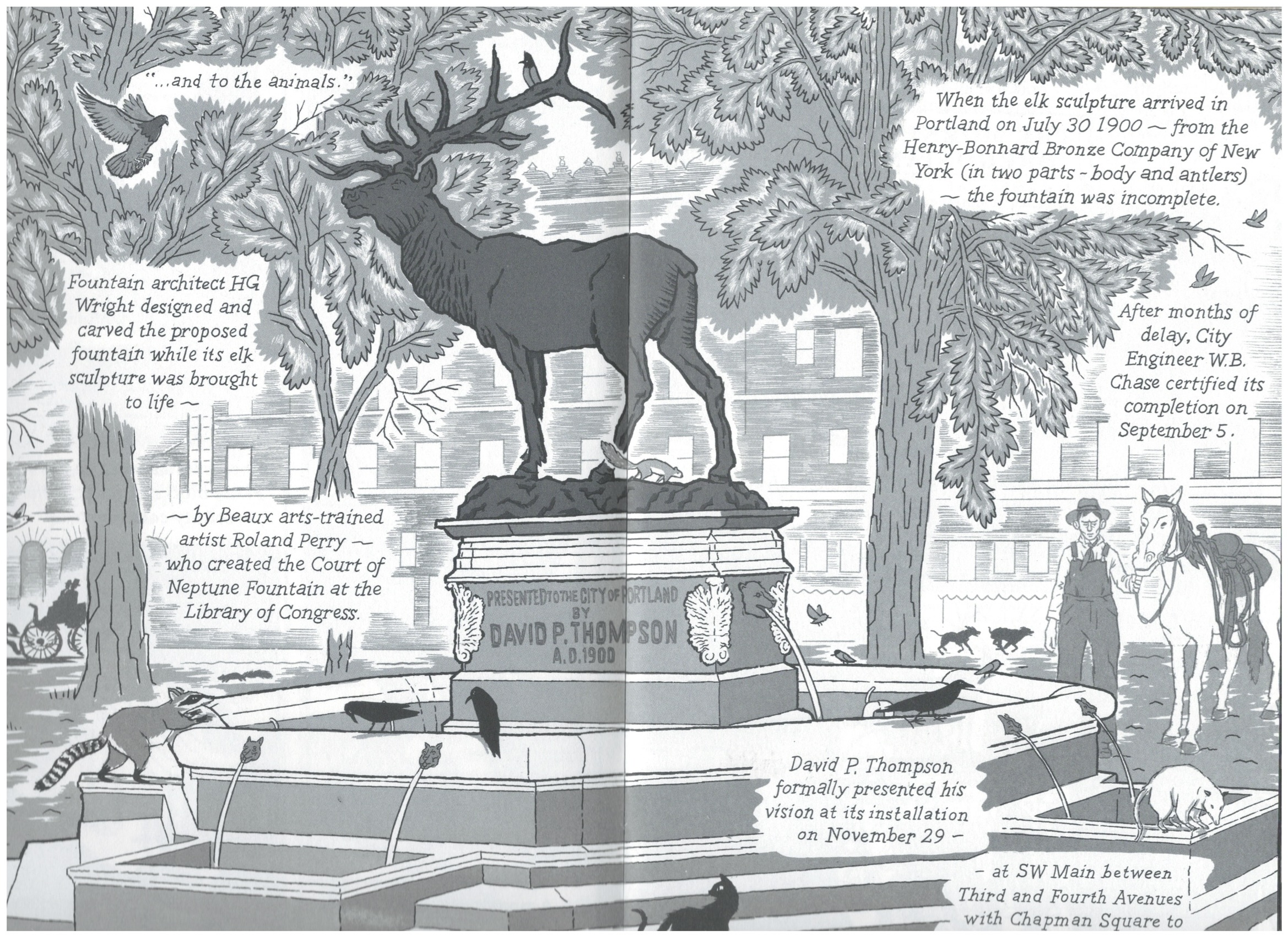
Under persistent public pressure, the base of the statue has now been restored — even using stone from the original quarry — and this April the Elk itself returned to its proper position. To mark the occasion, T. Edward Bak has released The Peoples' Elk, a graphic history of the statue. The short comic begins with a description of the pre-settlement Willamette Valley, where actual elk roamed free, then proceeds to a short biography of industrialist, philanthropist, and two-term mayor David P. Thompson, recounting his decision to donate a statue/fountain/trough to the city. The story concludes with the events of 2020 and the removal and ultimate restoration of the elk. Bak's prose is clear and concise, and his illustrations display a surprising range — cute and playful on one page, poignant and stirring on the next, but always beautiful.
The Peoples' Elk offers a peculiar look at the city's history, fixating on one specific spot and the events occurring there: the initial creation of gender-segregated parks, gay cruising and police crackdowns, and wave after wave of protests, including most recently the Occupy Portland encampment, a series of fascist-versus-antifascist street fights, and the one hundred nights of protests after the police murder of George Floyd. Unfortunately, though, a failure to describe the surrounding geography leaves these events feeling a bit mysterious and almost gives the impression that they occurred where they did because of the elk. Instead, it just happens that the elk is situated between two parks, and these parks are bordered by the Portland Police headquarters, a federal courthouse, the main offices of the city government, and (until recently), the county courthouse; City Hall and the the Edith Green-Wendell Wyatt Federal Building are one block further south and well within sight. Likely the comic's creators simply took this context for granted, and for a local audience such explanations would indeed be unnecessary.
However inadvertently, Bak's narrative, by omitting the surrounding geography, seems to attribute the site's attraction to the elk itself, as though its majestic presence is enough to consistently summon crowds and the momentous events they embody. That is not true, of course; it is just an accident of history and geography that a bronze elk stands amid the literal halls of power. Still, the very distortion of this view may tell us something of how we humans create meaning, how we assign unique value to specific features of the places we live, how we make something sacred. The elk did not attract the crowds, but perhaps it inspired them. Why else would the assembled multitude light a fire beneath the statue, then mourn its absence, replace it with a crude symbolic replica, and at last celebrate its return?









 English (US) ·