NOTE: This article was posted in 2014. It is reprinted here, without change, and has not been updated.
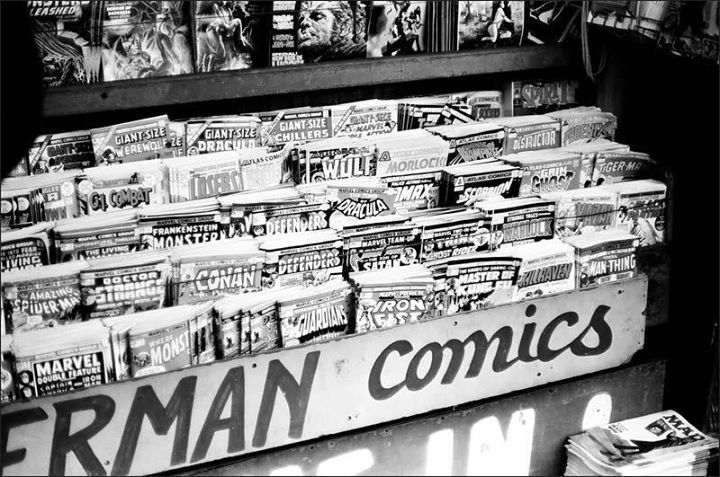
My comic book reading is much different now, as is the business. The days of long-term numbering, casual cameos, and generalized hammy fun are long gone, replaced by an environment that uses miniseries primarily as “event books” to separate you from more money than your regular pull-list, or as storyboards for movie ideas. You really have to turn to the independent publisher, or Vertigo/Icon, to find the kind of innovation and risk-taking that Marvel and DC displayed in the 1980s with books like Watchmen, Dark Knight Returns, Longshot, etc.
And so turn I have.
But the world of indie books is vast, and my experience with it cannot possible be all-encompassing. Whereas I’m fairly sure I read 90% of the Marvel miniseries output of the 1980s—and probably 75% of DC’s—I can’t even find a comprehensive list of all the indie minis from that era, or any era. Plus, it’s really from the early 2000s to now—not the 1980s—that indie publishers really have been able to shine.
And so, there are my 10 favorite non-Marvel, non-DC miniseries, without a “year” or “decade” limitation…If I missed any of your favorites, please drop me a comment and I’ll certainly track them down and check ‘em out.
One more thing: I know that Vertigo and Wildstorm are DC imprints, and Icon is Marvel. But they’re also not DC or Marvel. So they’re here. So there.
10. Black Hole (12 issues) (Kitchen Sink Press/Fantagraphics, 1995)
Picking number ten is so hard. It means I have to make cuts. Some notable ones: Warren Ellis’ one-shots from Avatar Press under the “Apparat” imprint, which I discounted because they were really one-offs, not miniseries. Also, Ellis and Ben Templesmith’s “Fell,” which wasn’t intended as a limited series even though it only ran for seven issues. And a whole bunch of Grant Morrison because he can’t appear more than twice on the list—it just wouldn’t be right. I couldn’t include Punk Rock Jesus because it’s too recent to have had a lasting impact on me, even though I think I’ll be revisiting that book soon. I also eliminated Garth Ennis and Carlos Ezquerra’s “Just a Pilgrim,” because it’s a little too similar to another Ennis miniseries that did make my list. And this one killed me: I couldn’t include Butcher Baker, the Righteous Maker, by Joe Casey and Mike Huddleston, even though it was basically flawless.
So why Black Hole? Because, more than the others mentioned above, it is a truly different kind of book. In twelve issues, writer/artist Charles Burns created an entire world of horror and darkness. In short: An STD mutates teenagers into … Really horrifying creatures. It confronts sex, conformity, revolution, alienation—everything most people first turn to comic books to help them escape from. It’s comics-as-art, in the truest sense.
9. Joe the Barbarian (8 issues) (Vertigo, 2010)
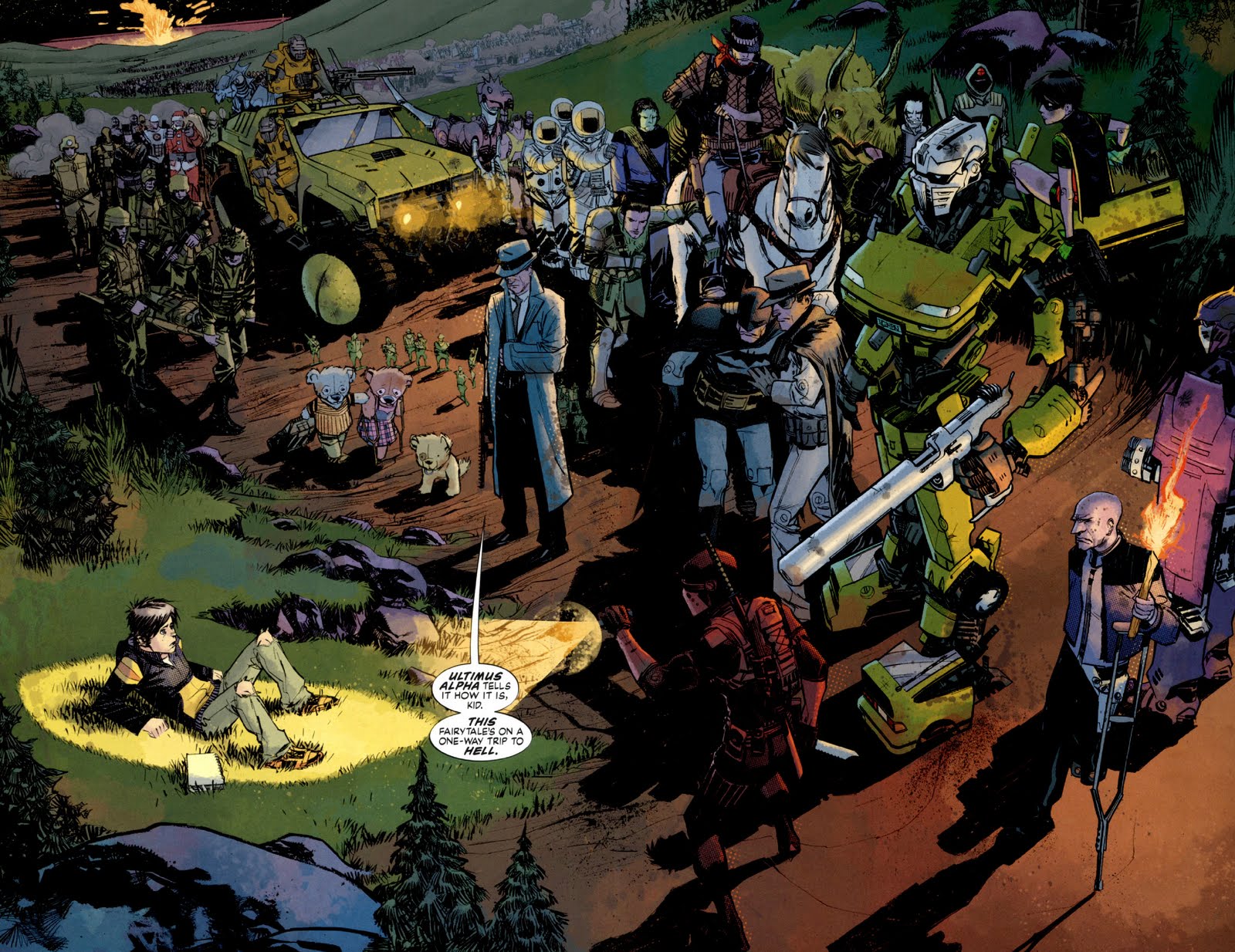
Grant Morrison and Sean Murphy’s absolutely brilliant and perfect update of the “March of the Wooden Soldiers,” in which toys come to life and a child in desperate need of love, support, kindness is transformed into a hero. I’ve written about this book. A lot. If you trust my judgment even in the slightest bit, you need to buy this. Today.
And if you like it, or like the concept of childhood toys involved in dark battles, check out The Stuff of Legend—another great book with a similar concept.
8. Whiteout: Melt (4 issues) (Oni, 2000)
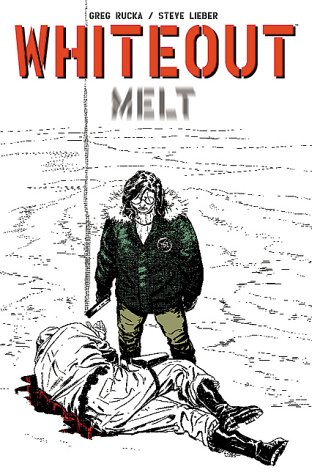
There are several creators who could probably come close to filling out a “great miniseries” list all on their own. Ed Brubaker for his work on Criminal and Sleeper. Grant Morrison for a ton of great ideas, some of which are on this list and others like Happy and Seaguy that just didn’t fit. And Greg Rucka. Whiteout: Melt, by Rucka and artist Steve Lieber, won the Eisner for best mini in 2000. It’s a police procedural that takes place in the Antarctic, and spawned a sequel. It’s typical Rucka, which is to say that the writing is tough and crisp, and the brilliant art—black and white in a snow-covered wasteland–pushes it on to this list ahead of other great work he’s done (like Stumptown).
7. Locke and key (multiple miniseries) (IDW, 2008)
Has IDW ever done anything good? Yes. Locke and key is more than good—it’s great. A set of five tightly connected miniseries written by Joe “I’m trying not to advertise that I’m Stephen King’s son” Hill and illustrated by Gabriel Rodriguez, the book tells a horror story of magical keys and the use—and misuse—of Godlike power, but it does so by focusing on human beings. As a result, we get the rare example of an intimate magic story—one that relies less on spells than on human nature as the source of its drama. More importantly, it’s completely unpredictable—this book will keep you guessing all the way through, with a series of small mysteries that get unlocked every few issues culminating in a big, bad, interconnected explosion. Fantastic.
6. Demo (12 issues) (AiT, 2003)
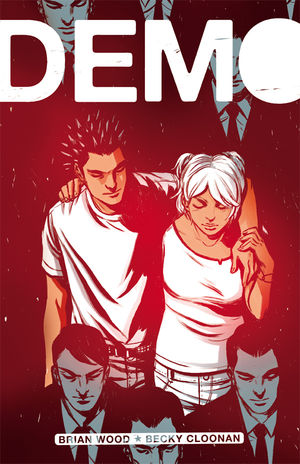
Although it returned under the Vertigo banner for six issues, it was the original twelve, Eisner-nominated stories by Brian Wood and the great Becky Cloonan that warrant inclusion on a list of the greatest miniseries of all time.
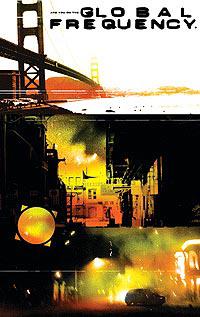
First of all, like Warren Ellis’ Global Frequency, the book was a series of short stories—perfectly suited to a mini-series. But unlike GF, the Demo stories didn’t pretend to interrelate. The common theme was that it was about young people getting super (or supernatural) abilities, and what it does to their relationships with family, friends, etc. In other words, it was a series of character studies. If you’ve ever imagined what it would be like to be a superhero, this is essentially that story. And every issue being a self-contained story meant that the reader got to imagine what came next. Wood never revisited these characters, even though a strong argument could be made that Demo should be the first volume in a series about young heroes coming together.
Maybe, someday?
5. Criminal: Last of the Innocent (4 issues) (Icon, 2011)
Criminal is actually a series of miniseries, some of which tie together, some don’t. This volume specifically is one of the greatest comic books of all time, and it has an Eisner award to prove it.
Ed Brubaker and Sean Phillips continued run with these noir titles are not only the best—yes, the best—noir comic books ever, they’re also the books that really led the charge in the noir revival of the mid-2000s. Often imitated, but never made better.
4. Global Frequency (12 issues) (Wildstorm, 2002)
Warren Ellis writes twelve standalone stories, each by different artists, and each with a cover by Brian Wood (yes, that Brian Wood). Artists included Jon Muth, Glenn Fabry, Steve Dillon, Lee Bermejo, and Gene Ha. Truly great innovations. I wrote about this book already here.
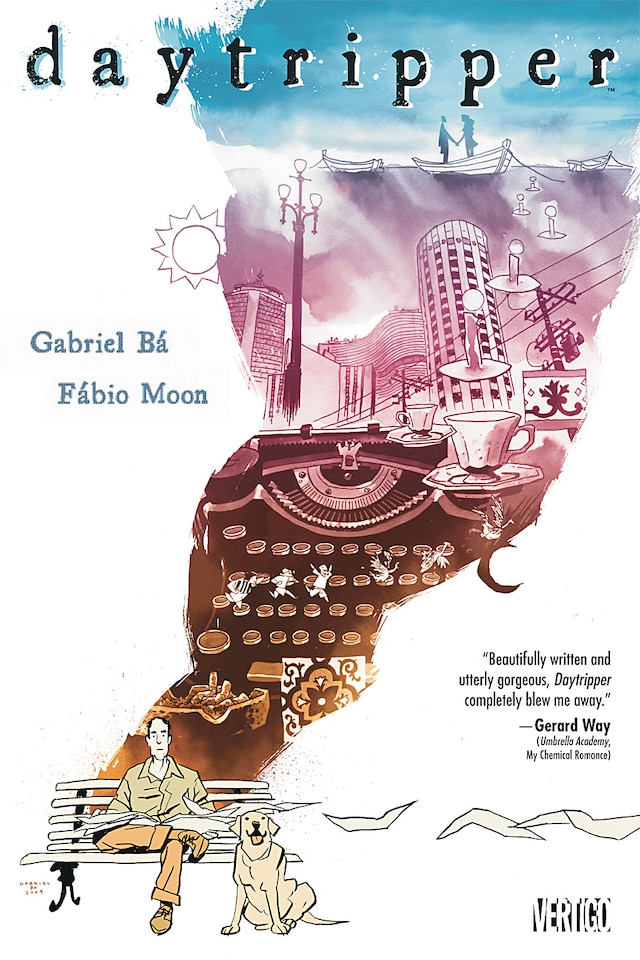
3. Daytripper (10 issues) (Vertigo, 2010)
Gabriel Ba and Fabio Moon’s absolutely breathtaking story of an ordinary man’s loves, fears, and dreams is one of the only comic books that actually made me cry. I mean, I didn’t bawl or anything, but I welled up in a manly way.
The trade was a #1 New York Times bestseller and the book won the comic award trifecta: An Eisner, an Eagle, and a Harvey. It deserved, and got, all of the awards. It’s one of the few books I regularly loan out to non-comic-book readers, who every time come back and ask me for another. (At which point I usually turn them on to Terry Moore.)
2. Crossed (10 issues) (Avatar, 2008)
I’m almost ashamed to have this on my list, but I have to confess that I have read this book at least five times. It’s basically an attempt by Garth Ennis and Jacen Burrows to create the most filthy, violent, profane and disturbing comic book possible without crossing the line into pornography. And they succeeded. The book has spawned a half-dozen “Crossed Universe” books that are, without question,* inferior to the original. But it’s by reading these follow-up books that I really appreciate what Ennis and Burrows were doing, because when someone else does it feels like pandering, but the first Crossed series didn’t do that. It was smart, and even sensitive, while it portrayed horribly violent rape in a (very darkly) humorous light.
*The one exception is the Web comic Crossed: Wish You Were Here, which truly has a clear vision and purpose and rarely uses violence just for shock value. It’s still not as good as the original, but it’s definitely a quality comic book.
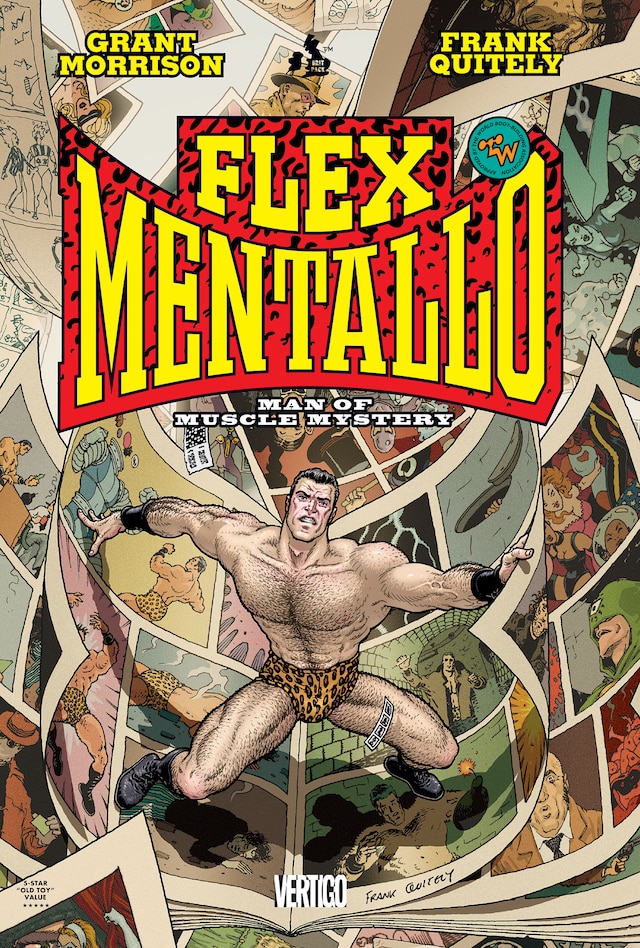
A book inspired by a comic book ad. You know, the one where the bully kicks sand in the face of a skinny nerd. Grant Morrison and Frank Quietly’s hero who can change reality by flexing his muscles is as weird as it sounds. And as brilliant.
Flex is the perfect chart-topping miniseries because it speaks to serialization and the disposable nature of the medium itself (yes, like much of Morrison’s work, it’s very meta).










 English (US) ·