
Matt Seneca | May 14, 2026
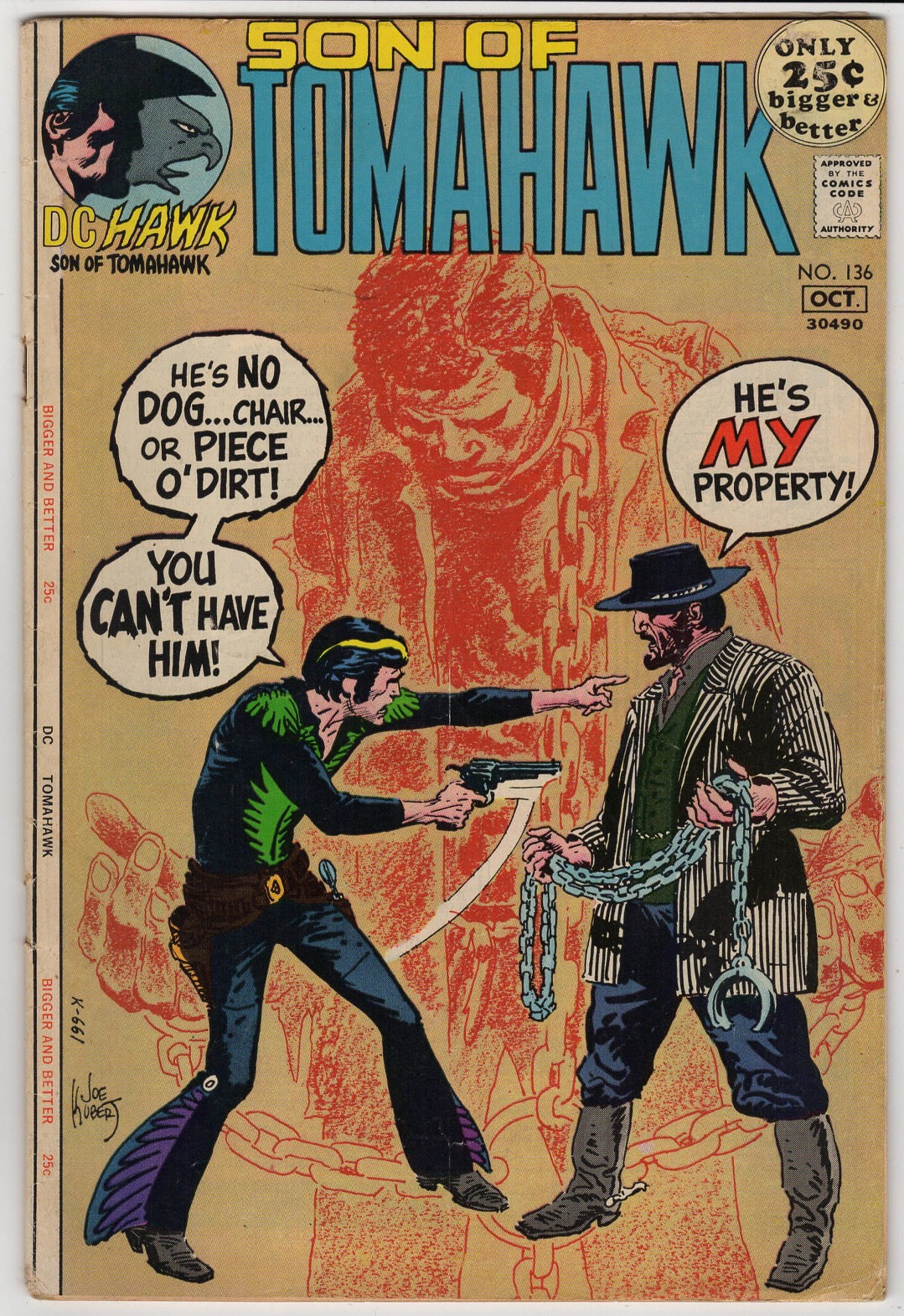
NOTE: This essay was originally published in early 2021, as part of a zine also containing reprints of the comics discussed below, and an original comics sequel by the author. Now, 5 years later, DC Comics has reprinted Son of Tomahawk in full, as part of the anthology book DC Finest Western: The Hangman Never Loses. I would like to offer my strongest possible recommendation of this book to anyone interested in the comics medium; and the words that follow, in hopes that they might lead seekers to the treasure they discuss.
1. Out of the wilderness
As the 1960s ended, a forcibly pacified nation was silent no more. Inspired by the Civil Rights movement’s community action against racial injustice, the American Indian Movement began its AIM Patrols in 1968, autonomously monitoring police and judicial abuses in Native communities. In Seattle and Minneapolis, 1969 saw the local Indian population’s establishment of independent Indian Health Boards to care for a population abandoned by state and federal governments. On Thanksgiving Day of ‘69, fourteen AIM members occupied the uninhabited island of Alcatraz in San Francisco Bay — once the carceral state's most dreaded stronghold — to found a community that would house a population of hundreds and last well into the coming decade. A few months later, Native activists in Seattle occupied decommissioned military base Fort Lawton. During the Alcatraz occupation, historian Dee Brown published Bury My Heart at Wounded Knee, an unlikely bestseller that confronted white America with the systematic slaughter that had won them the West.
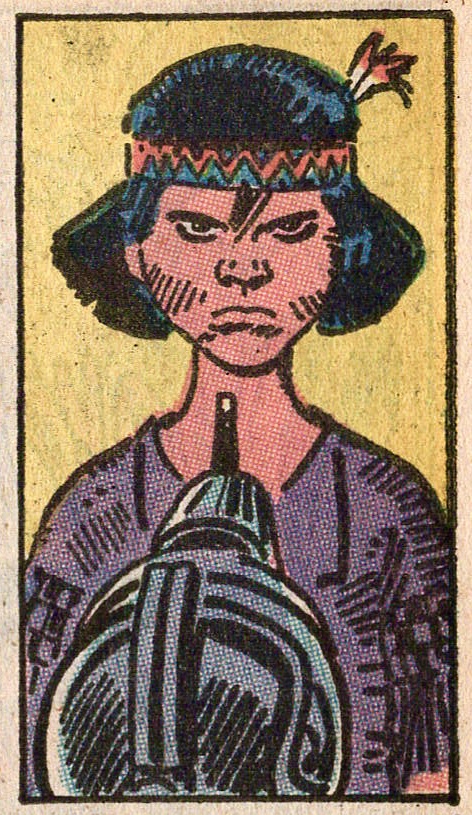 Signs the world was changing appeared in peculiar places. The letter column in DC Comics' April 1970 issue of frontier-adventure book Tomahawk, which starred a gang of white woodsmen in the Revolutionary War carving out a "civilized" frontier by blasting through hordes of nameless Native characters, included a remarkable question from one Kenny Chambers of Port Couitiam, British Columbia, just across the Canadian border from Seattle. "Why are the Indians always the villains?" Chambers asked in a beautifully brief, direct letter. "Why don't you show how cruelly we treated them?"
This two-line message was more than a flash of light in the darkness of racist mid-century America. It was an unlikely herald of things to come. Within a year, the regressive Tomahawk would become Son of Tomahawk, a searing examination of American history as a chronicle of racism and violence, as well as an aesthetic high water mark for comics. Son of Tomahawk is a remarkable thing, one of comics’ earliest rebukes to a long history of casual, unexamined white supremacy, undertaken by three disillusioned white creators during a period of intense conflict over racial apartheid’s place at the heart of American culture. It is a rare gem of quality in a form with a history of mediocrity, a peak of both content and execution — one that was not recognized as such in its day, and has since been forgotten by history. Big revolutions open the door for little revolutions, and this wonderful comic book was one of the unexpected ripples that the 1960s’ mass struggle for racial equality pushed up from the depths.
Longtime Tomahawk editor Murray Boltinoff endeavored to reply to Kenny Chambers’ letter with tact, pointing to recently published tales featuring "good Indians" straight from noble-savage central casting. But in speaking for Tomahawk, Boltinoff, an unquestioning custodian of a racist order forced to confront a challenge to the myths his job upheld, was made incoherent by haste. "They are a proud race and have every right to be," the editor demurred, "but when some battled us, our only choice was to fight back."
This, of course, was a knee-jerk echo of manifest destiny, the credo justifying savage extermination of entire nations by a "superior" invading white society. The dominant culture’s belief in the inevitability and righteousness of white western expansion was and still is fed to American youth like pabulum, in school and by mass media, an excuse for genocide that's become a pillar of U.S. culture too commonplace to bear remarking on, often too insidious to even notice.
Boltinoff was known as as a man of retiring temperament, one not much suited for his DC editorship, surrounded as he was by stronger personalities constantly engaged in power struggles and personal vendetta. Indeed, his mildness perhaps explains his stewardship of Tomahawk, which in the late 1960s was nobody's idea of a hot property. Beginning its run in the Davy Crockett- and Daniel Boone-crazed late '40s, by the time Tomahawk faced down the end of its second decade in print it had been left behind by the zeitgeist and set adrift in the bedeviling currents of comic book trends. Where once its hero had starred in well-produced if cliché tales of frontier action, recent years had seen him slogging through encounters with giant apes and backwoods dinosaurs, or queasily rubbing shoulders with colonial-era superhero Miss Liberty.
Boltinoff had recently modernized the comic, replacing its longtime cast of solid, workmanlike creators — artists Fred Ray and Bob Brown, writers France Herron and Bill Finger — with a new team, who gave the stagnant book a jot of life. Arriving in 1968's Tomahawk #119, artist Frank Thorne and writer Bob Kanigher sliced away the fat, creating panels and word balloons that read like the tersely melodramatic, character-driven action comics DC and crosstown competitor Marvel's superhero lines were finding peaks of popularity with. There was energy on Tomahawk's pages again, life-and-death stakes, protagonists whose low morals or cowardice stood between them and heroism, and illustrations that made it all feel like it was happening very close to you, the reader.
But weighing down Thorne and Kanigher's take on Tomahawk in corniness and cliché was the outlook editor Boltinoff espoused to Kenny Chambers in his letter column. This contented, unexamined view of frontier history had sent America’s Western cinema and TV tailspinning into first a stupor of predictability, then irrelevance and fading visibility by the '60s' end. U.S. comic books — forever a few months to a few years behind wider cultural trends — were some of the last mass media holding the line for the Western in its outmoded traditional form: culturally ignorant and proud of it, colonialistic and imperialistic, baldly racist. In the words of DC Western artist Nick Cardy, "they were old hat."
The American comics industry as a whole was experiencing its first generational turnover in the '60s. The early practitioners of newspaper strips and advertising art who'd jerry-rigged the form together out of economic desperation in the Depression era, now slowly gave way to a generation of young creatives who'd grown up reading — and wanting to make — comic books. Both DC and Marvel wooed the '60s youth culture with mod or psychedelic graphics and dialogue that read like what it was, middle-aged professionals of the New York publishing industry setting themselves on fire in vain attempts at hipster slang. It was mostly trendy gloss, the same kind of faddish sucker bait comics had always used to separate kids from pocket change, but in recent years the content had made somewhat more meaningful gestures toward the world its readership lived in. Spider-Man had been caught up in campus unrest, Superman's pal Jimmy Olsen had gone undercover to bust a slumlord, and the Green Lantern was confronted with his failure to address racial injustice in the same month that Kenny Chambers' letter to Tomahawk hit the stands.
These Very Special Episodes of superhero comics were hugely popular with an older segment of readers that would eventually take over creating the books themselves, but they ultimately all ran up against the limits of their genre. No matter how high their intensity was ratcheted up, superheroes were fundamentally escapist entertainment, not a form that could consistently bring readers into thought-provoking contact with the world they already inhabited. To do that, an enterprising publisher would need a concept that lived closer to ground level, and some hungry artists on a long leash.
The first indication Tomahawk might be such a venue came one issue after Kenny Chambers' letter. Beneath issue #128's cover by hot young artist Neal Adams (fresh off familiarizing Green Lantern with wokeness), lay Thorne and Kanigher's introduction of freed slave Healer Randolph to Tomahawk's band of Revolutionary War Army Rangers. The story is a hedged bet in every way. Randolph is the classic, comforting cliché of a Black character who decides to Be the Bigger Person and move directly from the service of one white power structure to another. He aids the Rangers as a medic by combining African "jungle lore" with know-how from the doctor whose emancipation of Randolph is lauded, while his decades of continuing slave ownership go unexamined. Troubling too is Randolph's steadfast refusal ever to bear arms in a war zone — proof perhaps of high morality, but also a bending of the knee to the racial paranoia of a white America in which the Black Panther Party was armed and active. Black superheroes who roughhoused and punished lawbreakers with jail time were acceptable; a Black war hero with a gun fighting kill-or-die battles, even for American independence, evidently was not.
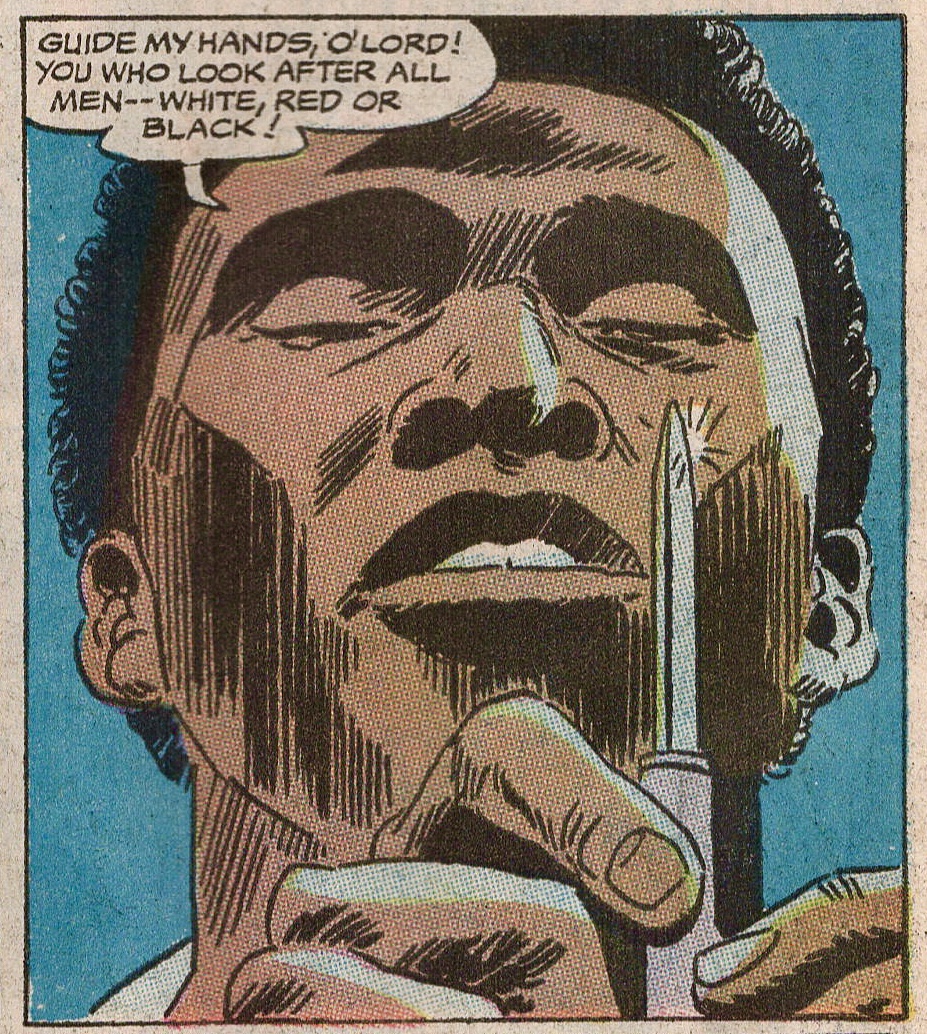
But there were also signs that this was something more than a big company's desire to give readers a story about how “everyone’s human” — not an uncommon theme for corporate comics of the time, as motivated by the reality that Black kids had their own dimes to spend as any better angels. Kanigher was more willing than his contemporaries to baldly depict racism among the ranks of his heroes, with the Ranger nicknamed Wildcat four-square against the induction of a "singin' minstrel" who heals by "rattlin' dry bones" into Tomahawk's group. In contrast to the we're-all-brothers message of feel-good unity purveyed by other mid-century comics pushing racial reconciliation, Kanigher conjures racism as a gnawing hatred that goes deeper than simple misunderstandings or surmountable prejudice, roping off both perpetrators and victims from polite society.
Thorne holds up his end of the bargain, giving Randolph a quietly heroic visual treatment shrouded in smoke and starlight. Thorne also expands on his dignified portrayal of Tomahawk's many Native characters with drawings of Randolph that depict physical difference from whites and Indians without lapsing into racial caricature. This was a bigger deal than it sounds for a white commercial cartoonist in 1970. Perhaps mindful of the bigoted drawings of Black characters that stamp nearly all early comics with an ugly blemish, hero artists of the '60s and '70s often drew their Black characters as whites with curly hair and left the depiction of their Blackness to the colorists, an odd graphic representation of the kind of well-meaning "color blindness" that still prevents true social equality. There is none of this in Thorne's work — a victory only in its dismal context, but nonetheless worth noting.
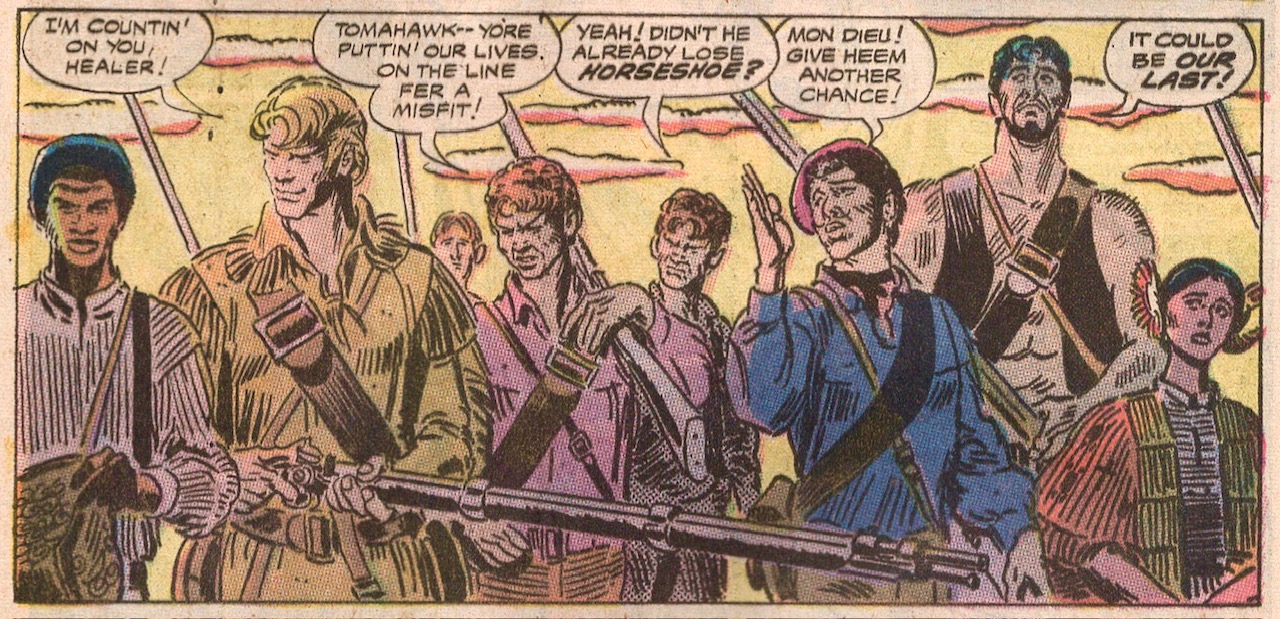
Healer Randolph appears sparingly in the following two issues of Tomahawk, successfully assimilated into (or subsumed by) an otherwise all-white fighting unit. A scene in issue #130 of the Rangers bivouacking at a farm worked entirely by women is instructive: a shot of a communal dinner neatly crops Randolph out of a frame depicting the whites at table, and a post-dinner dance between Rangers and farm girls finds the medic a Black dancing partner who appears in one panel only, perhaps to keep readers from wondering too much about her own emancipatory status. Then Randolph was gone, never to appear in any comic again: a minor footnote in a still-lacking trudge toward equal representation, and a good character, maybe, but one who didn't stick around long enough for anyone to find out for sure. Murray Boltinoff, the editor who'd scrambled to answer Kenny Chambers' letter and backed the still-unusual introduction of a Black hero, was gone after issue #130 as well.
Tomahawk itself would only last 10 further issues. Thorne and Kanigher, however, did not go quietly.
2. FIRE FOR NEXT TIME
After Boltinoff's departure things could have gone a number of ways. Tomahawk was never a bestseller, and it lacked a subscription service to connect it with the audience of enlisted military men that formed a significant reader base for DC's non-superhero books. There must have been a temptation to call it a day after a two-decade run of 130 issues of wildly varying quality. But Thorne and Kanigher were kept on, and a third major creative voice joined them for the title's final sprint. This key addition was editor Joe Kubert, whose presence would elevate and transform Thorne and Kanigher's book: from Tomahawk the interesting historical curio, to the retitled, re-imagined Hawk: Son of Tomahawk, a masterpiece of American comics.
While Thorne and Kanigher were knocking out the 12 Boltinoff-edited issues of Tomahawk that gave Son of Tomahawk an extended overture, Kubert was busy providing said overture with a fascinatingly harmonious counterpoint. Almost anything interesting that happened at DC from the mid-1950s to early '70s can be traced back to the long-running anthology series Showcase, in which new characters and concepts debuted every issue, with sales and reader response determining their potential as continuing series of their own — something like a comics version of TV pilot episodes. For a while in the late '50s and early '60s, nearly every issue of Showcase was a hit, presenting superhero after superhero that would live on into the present day: the Flash, Green Lantern, the Teen Titans, Aquaman, and more. But by 1969 the hits were fewer and farther between, and with their superhero line expanding to baroque levels, Showcase became a venue for DC to test the popularity of other genres without fully committing to any. Teen humor, jungle action, war, espionage, and a parade of Western heroes all came and went, with only one, Nick Cardy's comedic cowboy Bat Lash, able to cross over into his own short-lived series.
A connection between many of the failed experiments Showcase hosted in the late '60s was DC's increasing willingness to give its creators a spotlight and let them stretch out beyond the boundaries of their regular work on continuing superhero titles. Marvel was making a grab for DC's place as top comics publisher in large part by building their top creators up into media superstars whose iconic status rivaled the characters they worked on: Stan "The Man" Lee and Jack "King" Kirby were bankable commodities in themselves, something new and unexpected for corporate, buttoned-up DC, which only grudgingly began crediting artists at all in the mid-'60s. But there was no arguing with the balance sheets, and in 1967 DC kicked star artist Carmine Infantino upstairs to the post of editorial director — the first time in recent memory that an artist rather than a writer had been given such power. Infantino made Showcase a book where DC's better artists were given space to play with ideas they'd been germinating, often without a writer's oversight. Career DC company men like Kubert, Cardy, and Mike Sekowsky cut loose on Showcase in alternating two- or three-issue story arcs, clearly relishing their brief respites from the grind of superhero monthlies. These comics might have been commercial duds, but they present some of the more interesting work of their creators' careers, with the effort and passion poured into them clear from a brief flip through most issues' pages.
Talented, popular with fans, and newly minted as editor of DC's war comics line under Infantino's artist-empowering regime, Kubert was an obvious choice for a solo turn in Showcase. In collaboration with Infantino, he created a Western feature called Firehair, a clear precursor to Son of Tomahawk. Firehair is the tale of a white boy, captured as a baby by a tribe of Blackfeet Indians who massacre his family's wagon train for encroaching on their homelands, raise him to adolescence as a member of the tribe. The narrative centers on its hero's inability to find a place to belong, with its first issue showing Firehair put to rout by racist townspeople when he attempts to investigate the white world, and its second focusing on his unsuccessful attempt to mediate between Indians and an unscrupulous white gold miner. (Both issues' plots would later be restated — if not outright copied in places — as Son of Tomahawk stories.)
Firehair went deeper than the typical comic book Western. It clearly states Kubert's interest in cultural exchange and anti-Indian racism in the Old West, and it has much basis in historical fact. Narratives of captivity among Indians by white writers constituted a minor literary genre in the late 19th and early 20th centuries. Famed Comanche chief Quanah Parker — son of an Indian father and a kidnapped white mother who lived for decades among the tribe — was only one of Firehair’s many real-life analogues. Kubert's depictions of racism lack the caustic bite of Kanigher's, but they too identify race hatred's place as the determining factor in white-Indian relations, making it the axis Firehair's plots turn on. The book's artwork is stunning, with Kubert's ink-sodden, expressionistic artwork softened by beautiful gray wash tones and scaffolded with Indian design motifs running between the panel borders.
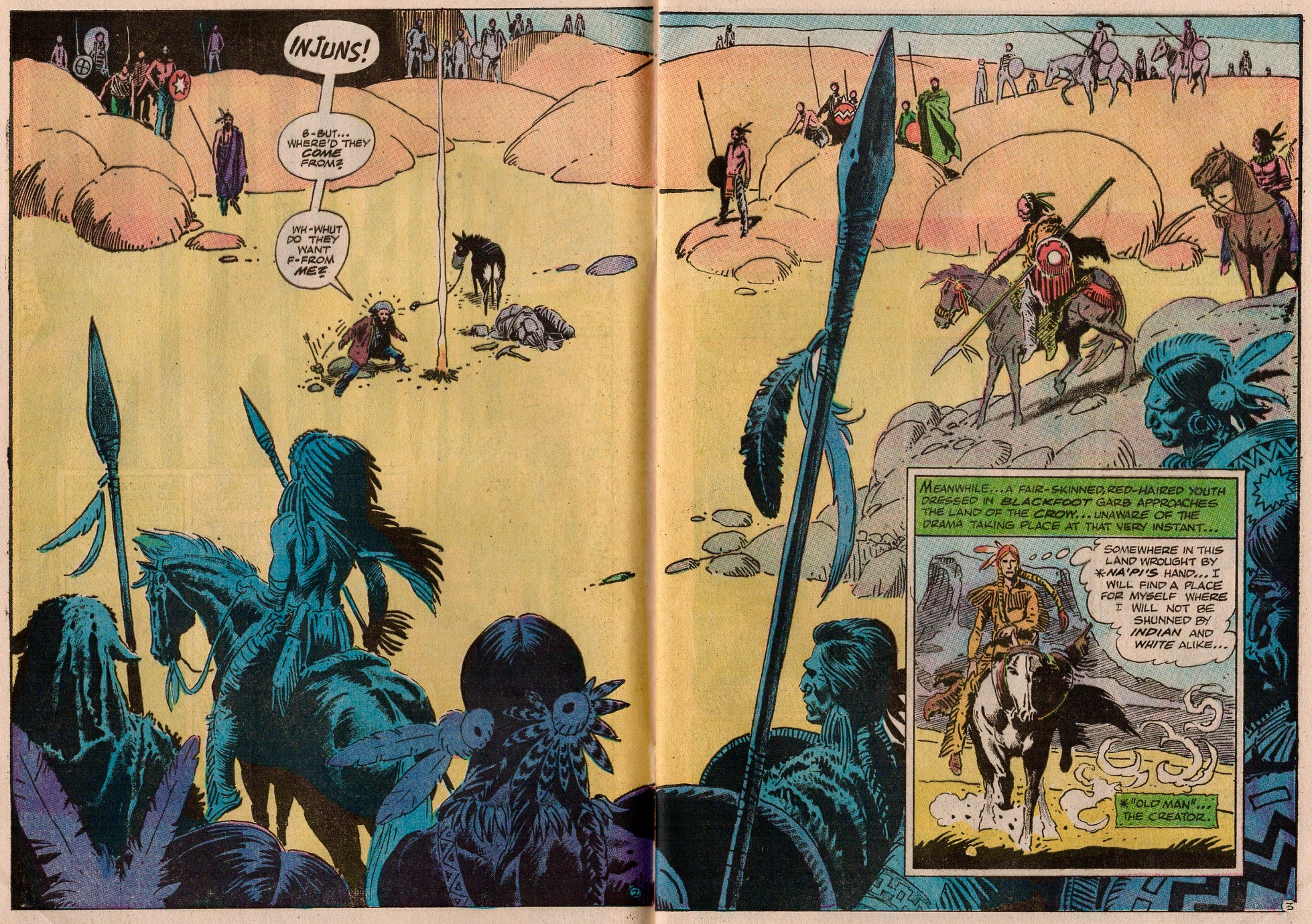
Kubert had a passion for Native protagonists and history. Leaving Son of Tomahawk aside, with Kanigher he'd previously created an Indian WWII hero, the regrettably named Little Sure Shot, and he would be one of the thousands of Americans who devoured and was duly rocked by Bury My Heart at Wounded Knee. But the third and final issue of Firehair in Showcase is tentative and disappointing, abandoning its established theme of cross-cultural conflict for an ill-advised foray into Indian mysticism and the supernatural, concluding with the whimper of a cliche "it was all a dream" ending. Still, readers loved seeing Kubert leave everything on the page in Firehair, and the book’s letter column is filled with unambiguous praise. Ever the company man, Kubert's responses are hedging, reminding fans of his character's Showcase tryout that "Firehair's destiny is one that will be decided by you, the readers!"
In reality, it wasn't quite that simple.
3. GOOD, BAD, AND UGLY
Kubert's takeover of Tomahawk’s editorship in December 1970 made him the third point in a potentially volatile creative triangle. Kubert, by far the best remembered of Son of Tomahawk's creators, was an American original. The son of Jewish immigrants from Poland, possessing a formidable work ethic common to first-generation children of the Depression era, he was one of the first young creators who targeted work in the comic book field as a professional dream unto itself. Beginning as a studio assistant for MLJ (now Archie Comics) at the unbelievable age of 11, Kubert was drawing feature stories for million-copy print runs before he reached his teens, and packaging complete comic books by professional staff as a contractor for publishing companies before he was 20. An Army stint in the Korean War years toughened a man who was already plenty tough, but Kubert was also a consummate pro — even in his dotage as one of American comics' elder statesmen (and the founder of the first accredited U.S. comics school), he averred that he had treated every one of his thousands of published comic art jobs the same regardless of genre or script quality—- as work to be taken seriously and completed professionally. "I’ve tried, with every story, every job I’ve done, to do the best I know how," he said. "I think that’s half the pleasure of doing this stuff."
Kubert was far from an unfeeling art machine or a steely-eyed hack, however. Proud (and talented) enough to avoid many of the degradations the midcentury comics industry heaped on freelancers, caring enough to create and then teach for decades at a school designed to educate and protect the next generation of professional cartoonists, Kubert's passions are as visible in his biography as his panels. His late 1960s to mid-1970s DC editorship was an opportunity to place his thumb on the scale and guide the medium in a considered direction. Kubert came to his editorial position at DC in 1968 from the more prestigious and lucrative world of newspaper comic strips due to a feeling that his work with The French Connection writer Robin Moore on Tales of the Green Beret — a violent Vietnam War strip — "had become a flag-waving propaganda effort." He kicked up his heels with DC as well, recommending Bury My Heart at Wounded Knee to Son of Tomahawk's young readers, refusing to wear a suit or necktie to the office, and memorably printing, then answering a letter from a neo-Nazi in his war comic Our Fighting Forces with threats of physical violence.
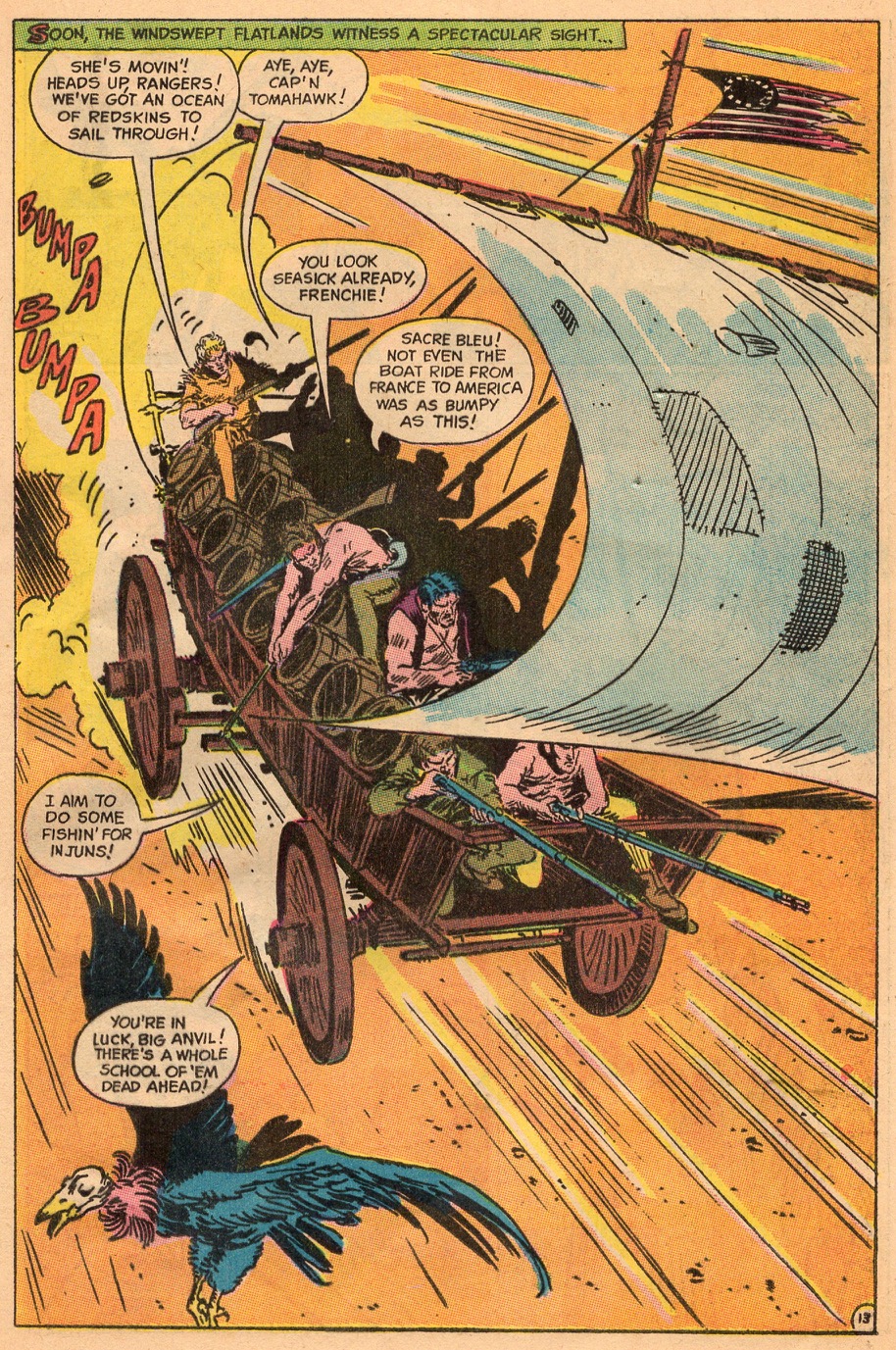 In an awkward twist, Kubert took over editing Our Fighting Forces, along with the rest of DC's war line, from none other than Bob Kanigher. Kanigher and Kubert had enjoyed a long and fruitful collaboration on war books for over a decade, with Kubert drawing and Kanigher both editing and writing most of his own scripts. The pair's work on gritty WWII feature Sgt. Rock still stands as the best of DC's war comics, with Rock's supporting cast, "Easy Company," providing a blueprint for Tomahawk's own motley crew of Rangers. But at some point in the late 1960s, Kanigher either "got pretty close to a nervous breakdown" (Kubert) or did indeed suffer one (DC freelancer Mike Esposito, among others). Kubert, a longtime friend and collaborator of new boss Infantino, was handed the reins of Kanigher's books, and soon enough, Tomahawk as well. Kubert put his stamp on the book instantly, changing it into Son of Tomahawk with his first issue. "Bob and my relationship has always been excellent," said Kubert, and what could have been an awkward situation seems to have been resolved amicably once Kanigher returned to health, with Kubert the editor buying as many scripts from Kanigher the writer as he could run, much as Kanigher the editor had favored Kubert over other freelance artists.
Kubert may not have had problems with Kanigher, but DC was stuffed to the gills with talent who did. Frequent DC war artist Russ Heath called Kanigher "very intense," and described an editor whose relationships with his staff shaded into cruelty and sadism. "With a lot of people, he tried to find a weakness and exploit it, because then he could maneuver that person better," Heath recalled. Kubert described future Mad Magazine caricaturist Mort Drucker "literally shaking like a leaf after an editorial critique." Kanigher seems to have reserved a special animus for former employees of EC Comics, a sci-fi/horror publisher whose beautifully illustrated shockers had aroused the envy of the field and the ire of the infamous Senate Subcommittee on Juvenile Delinquency in the mid-'50s. Bernard Krigstein, a leading light at EC and perhaps the most talented cartoonist of his generation, was blacklisted from DC by Kanigher, who when asked about their conflict said, "There are no two sides. There is only one. Mine. I was there." EC hand George Evans went looking for work from Kanigher and was told "We don't need you or want you here!" and Esposito recalls that EC's superstar artist Wally Wood was once so enraged by Kanigher that he threatened to throw him out the DC offices' 20th-floor window.
Kanigher's efforts to cut down and immiserate his artists went beyond his office's walls. In the mid-‘50s the editor busted up an early attempt at a comic book freelancers' union, attending an initial meeting and then turning around and informing his employers as to its particulars. The problem at the root of everything seemed to be one of basic disrespect, tracing back to a willful misunderstanding of the importance of pictures above words in a visual medium. Describing his speech to the would-be cartoonists' union, he thundered: "I described the group for what they were: illustrators of the written word. The word, the thought, always came first. They weren't artists. There are no artists in comics."
But Kanigher had come down in the world since his tyrannical heyday. In 1970, he was another aging freelancer peddling scripts, and outside of Kubert, who recalled, "Bob was having a bit of a problem getting writing work," many potential clients must have relished turning him away now that the shoe was on the other foot. Perhaps Kanigher was chastened, perhaps not — his post-retirement interviews are as cantankerous and hectoring as can be imagined — but he could display a softer side. Beautiful young freelance colorist and illustrator Liz Berube, in a tantalizing bit of history unmade, turned down the editorship of DC's subsequently canceled romance line because she was intimidated by the wolfish boy's-club atmosphere at the publisher. But she singled out post-nervous breakdown Kanigher as "a nice man" who was "more with the times" and assisted her in putting together a professional portfolio.
Kanigher's scripting reached new heights in this period. Perhaps it was increased empathy brought about by the fading of his own personal star, or perhaps it was that even this unpleasant figure could see America's treatment of race in the early '70s was bullshit. But his work leaned more and more heavily into questions of racial discrimination and conflict, culminating in Son of Tomahawk.
"I never met Kanigher," said Son of Tomahawk artist Frank Thorne, a family man who worked out of his New Jersey home rather than commuting to the DC offices, and whose DC employment came about only after Kubert took on his editorship of the war line. Prompted by an interviewer in 2011 as to whether the "legends" of Kanigher's appalling behavior were true, Thorne punted: "Don't know any, but he was a damn good writer." It was Kubert with whom Thorne had a special relationship. Within a few months of taking over the DC war line, Kubert plucked Thorne from rival publisher Gold Key, where he had designed a beautiful world from the ground up for the post-apocalyptic fantasy book Mighty Samson. "It was a mystical kind of thing," said Thorne. "We were both from humble beginnings. His father was a butcher, and my father was an elevator operator. He was never an influence, but for some reason, my work looked like him. It was almost magical. Everybody said, 'Kubert did this, didn’t he?'”
Kubert's supposed lack of influence on Thorne is called into question by the look of his work on Son of Tomahawk, and by the legendary (and legendarily irascible) artist Alex Toth, whose crisp, minimalistic, design-heavy drawing strongly influenced Thorne's early work. Of Thorne's time on Son of Tomahawk, Toth remembered: "I repeatedly warned Frank: 'For Christ’s sake, get the hell away from Kubert. He’s not doing you any good ... You did nice, clean, hard-lined stuff, and it’s been detrimental to your work.' He confessed: 'Yes, Joe Kubert and his style are hard to resist.' So, yes he had the influence, and he liked it. Well, good luck." Toth's dissenting opinion aside, Thorne blossomed during his time on Tomahawk and Son of Tomahawk, going from a talented if somewhat conventional cartoonist to a master whose style synthesized the best of Toth, Kubert, and DC stablemates Russ Heath and John Severin, reaching into history for poster-like title pages designed in the style of comics maestro Will Eisner and gorgeous panoramic shots that echo Garrett Price's early Western newspaper strip White Boy.
But Thorne's most notorious work lay in the future. Once Kubert wound down his DC editorship to found the Kubert School in 1976, Thorne jumped to crosstown Marvel, where his work on sexy Conan the Barbarian spin-off Red Sonja was lauded by a fanatical cult audience. Reinventing himself on the fly, Thorne dove into two burgeoning comic book subcultures of the time. He became a fixture of independent comics publishing, where he promptly ripped himself off with a series of increasingly humorous and explicit Sonja lookalike series. And he embraced the culture of fandom, doing more than perhaps any other creator to establish cosplay as a cultural force, creating Sonja-inspired costumed dramas in which Thorne and a series of buxom, scantily-clad models performed for comics conventions, public access TV — and eventually, the Playboy Channel.
Having found a pleasurable and lucrative aesthetic niche, Thorne doubled down on porn for venues high and low, becoming one of Playboy's most reliable gag cartoonists while creating a steady stream of unrepentantly outre porn comics. His notoriety as a smut merchant crested with the 1995 seizure of his book The Devil's Angel in Oklahoma on (quickly dropped) charges of child pornography, placing the impressively bearded senior citizen in good company with NWA, Dungeons and Dragons, the Dead Kennedys, and outlaw cartoonist Mike Diana as victims of the '90s' farcical culture war on youth-corrupting media. Until his passing at age 90, still a contented New Jersey family man, Thorne continued to bat out soft porn images that read more like the charming product of a bygone era's erotic imagination than transgressive obscenity. His career arc is one of those bewildering, loopy zigzags best described as "only in comics".
Thorne, Kanigher, and Kubert all blazed significant trails, and all have been subjects of many a retrospective interview and critical dissection. Yet about Son of Tomahawk itself there is almost nothing. In a 1989 interview, Kanigher was reminded he worked with Tomahawk and replied "With who?" before shutting down further questioning, shrugging "That I don't know. If Kubert was the editor then it was Kubert's responsibility ... and I had nothing to do with it." Kubert's own interviews tend to focus on his own masterful artwork, and when they do shade into his editing, his well-remembered WWII books are the inevitable topic. Thorne has gestured vaguely to the importance Son of Tomahawk played as a stepping stone on his journey toward bespoke pornography, but is more apt to mention lusting after Kubert's redheaded wife than any specifics of the book's creation.
This is understandable, if regrettable. Son of Tomahawk is a ten-issue blip of 12- to 15-page stories for a soon-to-be canceled magazine in an unpopular genre of a then-discounted medium, by journeyman creators who hopped from project to project scores of times over decades-long careers. Given the reality of commercial comics production in the early '70s, Thorne, Kanigher, and Kubert were probably as concerned with hitting deadlines as they were with doing anything deeper.
But Son of Tomahawk is also a forgotten masterpiece that speaks as clearly and forcefully today as it did more than half a century ago, to topics as polarized and urgent then as they are now. With so little firsthand material on the motivation and reasoning behind the strip, we are left to guess for ourselves, squinting back into the past from a vantage point where little is sharply in focus. The comics themselves have retained their own voice, the ability to tell us what they really mean independent of their creators' authorial intent. They are virgin soil from the faraway shores of the past, still waiting to be tilled. Who knows what we might grow from them?
4. BLOOD IN
 Hawk, Son of Tomahawk is the story of half-white, half-Indian youth Hawk Haukins' adventures in the pre-Civil War American West; and of his family — aged patriarch and former Revolutionary War hero Tomahawk, Hawk's Indian mother Moon Fawn, and his kid brother, called both Young Eagle and Little Eagle before Kanigher settles on Small Eagle. Being a story of family, Son of Tomahawk is also about inheritance: the older generation's responsibility for making the world handed down to their children, those children's acceptance or rebuke of it, and the way this reaction is received in turn. Tomahawk — himself referred to throughout DC's publishing history as Tom Hawk, Tom Haukins, and Thomas Hawke — instantly becomes a more powerful symbol here than he ever was in his own youthful adventures. As a hero of the war that birthed America, he is not just the father of Hawk and Small Eagle, but of everything we see on these pages. This is a comic about the West as America's inheritance, and the weight put on a founding father by its passing down. It is about America not as manifest destiny but as a choice, one long since made, and that choice's unforeseen consequences.
Thorne and Kanigher conjure the West as a frontier where society has been born but civilization is yet to arrive, with existence ruled by two ironclad facts of life: racism and violence. These two American original sins background everything that happens in Son of Tomahawk. Each of the book's ten issues is about violent fighting; race is a motivating factor in nine of them. But this is not a fascistic story of racial conflict as inherent to a tribal, warlike species. It is, again, about family, and the power of family bonds not just to heal the wounds of racism, but to create a future free of them. If the squabbling, murderous, racially sundered West is the bad child Tomahawk is guilty of having birthed, his son Hawk – a product of love that bridges race difference — is the bright and hopeful opposite side of the coin, a biracial hero whose person melds two conflicting halves into one harmonious whole. Hawk's biracial identity is almost a superpower — something exalted and beyond the ability of his own time and place to understand, a cure for what ails society and a path down which a dark age might journey into the light.
Hawk's burden as living hope for a brighter tomorrow weighs as heavily on him as the creation of a fallen present does on his father, and Son of Tomahawk's final theme is one of destiny. Hawk wrestles to find a place in the white society overtaking the wild frontier he was born in. He repudiates and embraces his Indian side by turns, never certain of its precise place in the making of the man he is. He emulates his father both in his desire to keep pushing the frontier west, and in his understanding that he is responsible to the family homestead, that he must shepherd his kin through the danger surrounding them and into the multi-cultural future his person represents. He embraces the violence of his era without question, and while he cannot embrace its racism, he is blind to his own specialness as a symbol of the best way out of it. Kanigher renders a Shakespearean figure, wracked by inner conflict as perilous as his environment, and like Prince Hamlet, Hawk is paralyzed with indecision.
Issue by issue, Thorne grounds Son of Tomahawk's action in an evolving landscape, as the muted, foggy gloom of early spring blossoms into an arid Western summer before over-ripening and giving way to the howling snows of winter. The ten issues do not form a linear, building story, but a scattered collection of related anecdotes that deepen the book's core themes by restating them from different angles. The series is a surprisingly realistic non-arc of drama, with quickly rising and falling actions orbiting a loose group of people and problems. Son of Tomahawk's greatest strength and greatest weakness is its stubborn refusal to present one definitive storyline or dominant groove.
Issue 1 (numbered #131, continuing from Tomahawk in a classic case of insular and confusing comic book practices) opens midstream in red-meat Western action, with Hawk rescuing a young woman from the clutches of the Judge, a psychotic outrider speaking in random, unexplained legalese. Hawk gets in over his head and is only saved from a hanging by father Tomahawk, whose reputation as a fearsome warrior of yesteryear precedes him. Hawk and Tomahawk give the rescued maiden a tour of their frontier homestead, Echo Valley, and introduce their biracial family unit. Kanigher foregrounds both the girl's shock and her acceptance, quickly positioning the reader alongside the Haukins clan in opposition to the tenor of the times.
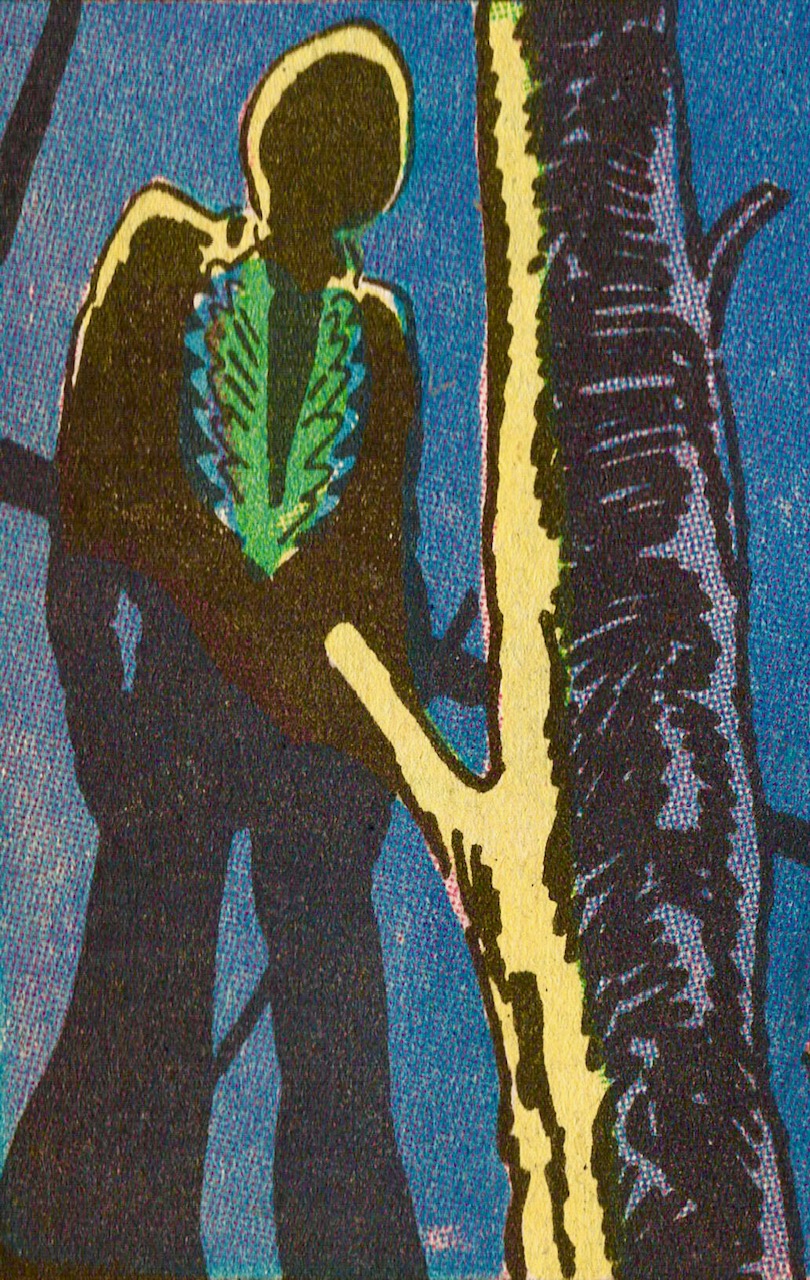
The conclusion sees Hawk take sole responsibility for defending his homestead from the still-at-large Judge. This drama would repeat itself frequently, with son and father trading off turns abandoning the family hearth to fight battles they deem to be their own — Hawk, it is implied, doing so here for the first time. An "injun trick" to draw out the Judge with a moonlit scarecrow dressed as Hawk is as hokey as comic-book plotting gets, but it's given an absolutely majestic treatment by Thorne — indeed, perhaps Hawk's most iconic panel in the entire series isn't actually a drawing of the man himself, but of his scarecrow doppelgänger bathed in shadow. Hawk seizes victory in a hail of bullets that establishes the book's mortal stakes — few Son of Tomahawk issues end without at least one death by gunshot. Tomahawk narrates Hawk’s triumph from cover on a nearby hill, appealing to readers of a series who had just been slapped with a very new and different kind of comic after 130 issues of tested formula. "Looks like my son Hawk rushes in where angels fear to fly! Figured he'd need my help... but... he did all right by himself!" If Tomahawk approves, reader, what's stopping you?
Tomahawk's very presence in his son’s book is a funny thing. From the 1770s of the Revolutionary War era, Son of Tomahawk jumps seven or eight decades to what appears to be the 1850s of the Gold Rush and Bleeding Kansas. The Tomahawk of old, a strapping warrior of perhaps 30, is reimagined by Thorne as a spry but severely emaciated old buzzard — a dramatic change to be sure, but a serious understatement when one considers that he ought to be pushing his 110th birthday! This is never commented on in the text, but readers upset by their childhood hero's sudden dotage would dog Son of Tomahawk's letter columns until the end.
Hawk himself is another bold Thorne design: introduced in extreme closeup, with aquiline Indian features, olive skin, and piercing sapphire eyes, he sports long sideburns and a dark pageboy haircut shot through with a Bride of Frankenstein-esque streak of blonde. Thin as a blade, suited and booted in a black one-piece garment of bellbottom chaps and wide-collar top embroidered with a winged Indian design, a few buttons usually undone, he resembles the heroin-wasted Jimmy Page of imperial-era Led Zeppelin more than any cowboy hero. Thorne's character design does more than anything else to date Son of Tomahawk back to the early '70s — a bit of comic-book flash and dazzle to brighten up the book's grave proceedings.
In Thorne's 1968 debut issue of Tomahawk, editor Boltinoff gave a chunk of the letter column over to the book's new artist to introduce himself. Thorne averred that he was "so fascinated by (the) Revolutionary War, I must modestly admit I'm an expert." The proof is in the print: Thorne handled Tomahawk's colonial-era forts, forests, and firearms with gimlet-eyed accuracy, lending weight and realism to even the goofiest of the Rangers' exploits. Thorne's expertise gave his Tomahawk's high points a bracing, you-are-there feel unusual in any comics. But his fight scenes, bathed in expressionistic color and warping the panel boxes into asymmetrical shards of impact, speak to a side of Thorne's artistry underfed by his documentary approach. Thorne also filled in Tomahawk readers on his youthful exploits as a touring jazz trumpeter and stage magician; here was a personality in search of big moments, a spotlight.
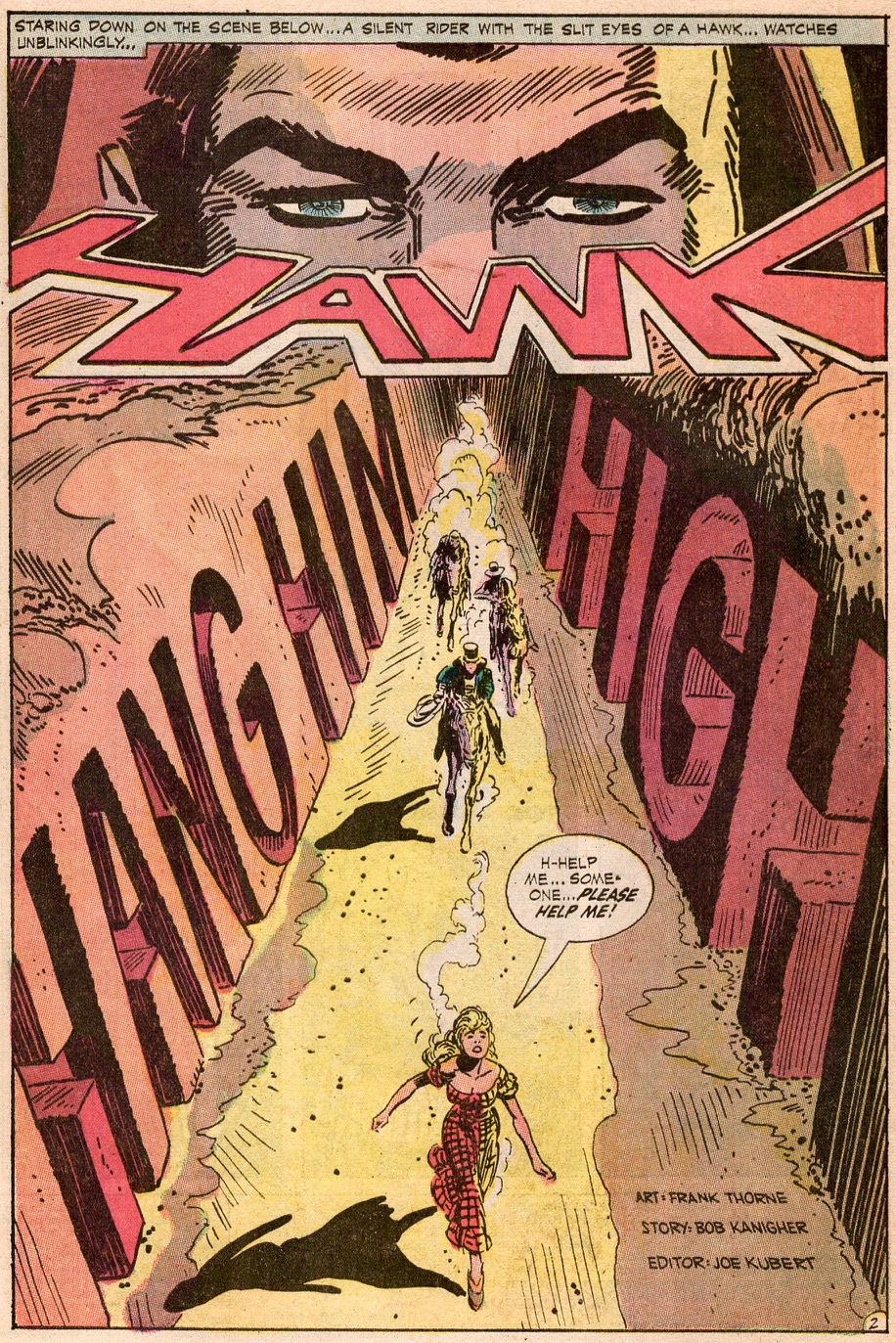
Son of Tomahawk is a pyrotechnic visual experience from page one. Page-tall, razor-thin panels in blazing red and orange give way to an iconic credits page, Hawk gazing stoically down on the crevice of a slot canyon, the issue's title — HANG HIM HIGH — carved 30 feet tall into the rock walls. Son of Tomahawk's family cast, more diverse in race, age, and gender than the motley crew of enlisted white men that made up Tomahawk's Rangers, are given an instant sense of lived-in character by Thorne's rendering. Where Tomahawk's camera usually remained mounted on the ground, capturing everything in steady observational style, Thorne's Son of Tomahawk is full of dramatic angles and psychologically revealing poses that sell the increased intensity of the new book. And the backgrounds are as good as the action: with slashed rendering lines perhaps unconsciously picked up from his new editor Kubert, Thorne conducts a master class in texture, creating a world of knotted wood, burning sand, sheer rock, and hard-packed dirt that makes the fingertips thrill in anticipation of contact.
Issue 2's focus swings from Hawk to his family in a neat restatement of Firehair's "Indians in the white man's town" plot. Mother Moon Fawn and Hawk's kid brother Small Eagle are routed from their shopping by local bully Hard Rock before Hawk steps in, challenging the town rowdies to an "Indian style" fistfight, one man alone roped to all his challengers at once. It's a badass star turn given a rousing smack by Thorne, but from here the focus shifts to Tomahawk, who laments white society's encroachment on the land he's spent decades of rustic idyll on. "Seems like civilization's crowdin' me! Town springin' up only 22 miles from our spread... don't they know a man needs a whole square mile ... all for himself? Just to take a deep breath?" Moon Fawn rebuts her husband's outburst by identifying the germ at the root of society's ills: "Country big! Room for all if ... live as brothers!" But the message falls on deaf ears, as Hawk takes his mother's words as a spur to violence: "Rattlers like Hard Rock won't let us! They aim to turn America into their private jungle! We'll just have to yank their poison fangs!"
The issue has striking echoes of George Stevens' 1953 film Shane, perhaps the deepest and most thoughtful of the classic studio Westerns, and a direct influence acknowledged by Kubert. Shane's gunslinging bad guys rout virtuous farmers from their town, just as is done to Small Eagle and Moon Fawn. But the movie's arch-villain Ryker, played by the grizzled Emile Meyer, delivers an old cowboy's lament in his own defense that is similar to Tomahawk's, bemoaning the transformation of the West from a half-continent-wide cattle drive to parceled-out civil society of exactly the kind that the hard men who first struck out for the frontier were unfit for.
Kanigher sharpens the bitter tone with the reintroduction of two cast members from the old Revolutionary War-era Tomahawk: the wisecracking Stovepipe, so named for his towering top hat, and Big Anvil, the hulking powerhouse of the Rangers. Longtime Tomahawk readers' loss of their beloved Rangers was the topic of many an indignant letter to Kubert, but one can't imagine this was the consolation prize readers wanted. Stovepipe has been reduced to an itinerant snake oil salesman, driving a creaky wagon advertising "magic elixir", while Big Anvil, "skull creased by a cannonball back in the war of independence" is now a graybearded monolith dandling a fluffy white rabbit, barely capable of speech. The two trace Tomahawk to his homestead just in time to fight off Hard Rock’s revenge incursion, but more resonant than the fighting is a basic message shared with Shane: violent men may be heroes when the wolf is at the door, but they soon become pariahs once the world is safe for society.
Kanigher and Kubert's reintroduction of classic DC heroes in diminished, uncomfortably realistic form was novel for its time, but would see no end of use in later years. In the mid-1980s, Alan Moore's Watchmen and Frank Miller's Dark Knight Returns would bring DC massive critical and commercial success using the same toolbox brought to bear on Stovepipe and Big Anvil here. A raft of imitators followed, and the theme of faded heroes battling infirmity and irrelevance in a changed world has never left commercial comics since — the continuing characters who haven't seen some kind of revival in this vein are less than those who have. Kanigher and Kubert were ahead of the game, intuiting a way of making comics that would be ignored in its time, then repeated by creators unaware of the footprints they were standing in. Stovepipe and Big Anvil would not appear again, but they weren't the last Rangers brought back for a final bittersweet bow.
Having established a potent cast and set of themes, Thorne, Kanigher and Kubert immediately restated them. The broad plot outlines of Son of Tomahawk #133-34 are more or less identical to the previous two issues. First Hawk leaves home to battle a racist villain before violence can engulf his family, then Tomahawk grapples with the return of a shockingly changed Ranger comrade. But by this point the creative team is fully locked in, and issue #133 kicks off the book’s golden age.
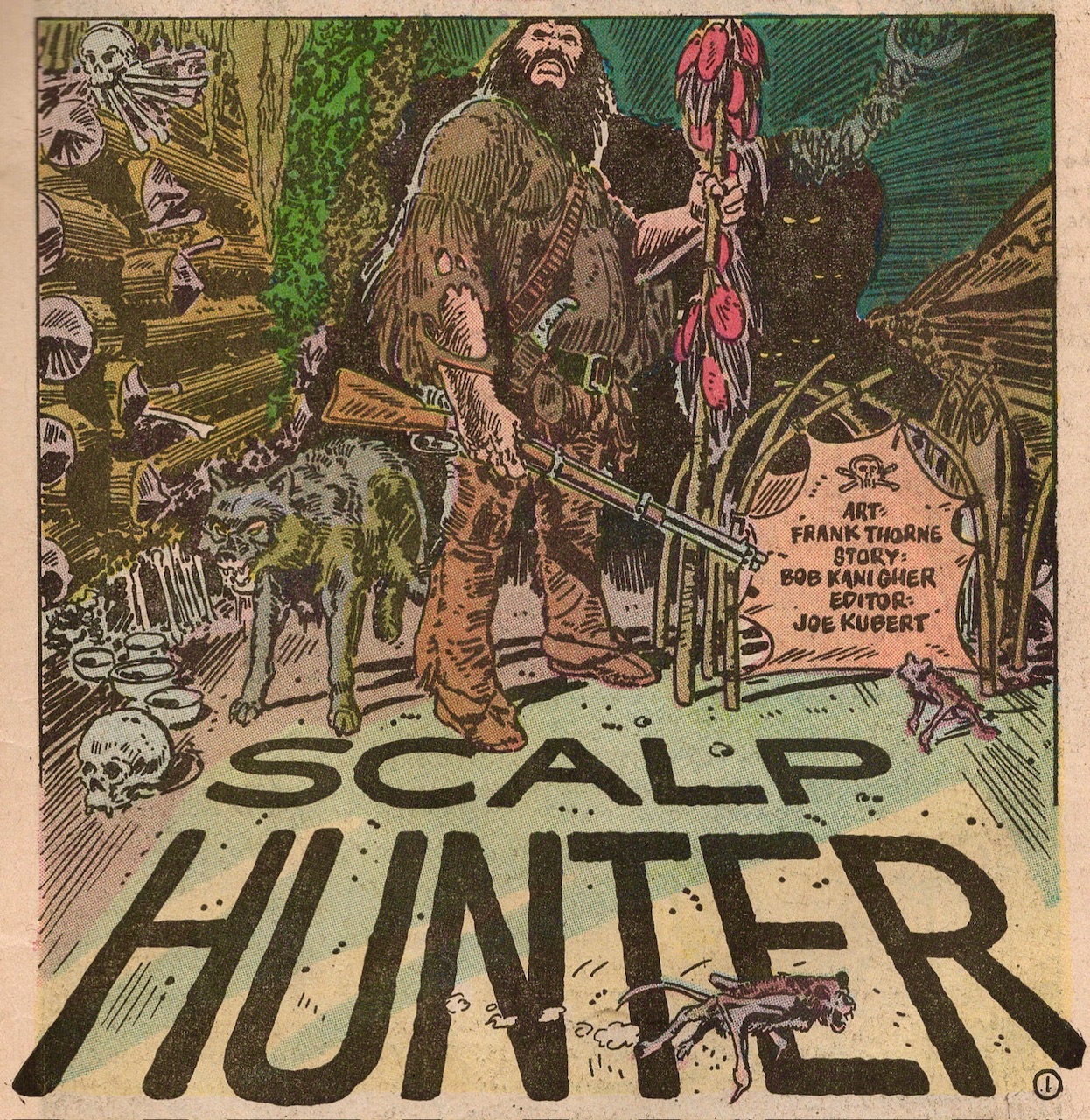
"Scalp Hunter" pits Hawk against his comic's most compelling villain: a serial killer of Indians who forces our hero to confront his Native heritage in a way that life on a farm run by his white father never prepared him for. The issue opens with what would become a recurring motif, like a TV show theme song: Hawk and Tomahawk in widescreen panorama riding the wild countryside around Echo Valley. The two pass the shack of the massive, bearlike Scalp Hunter, revealed in one of Thorne's best title-page splash panels: clad in pocked and greasy buckskins, brandishing a spear laden with Indian scalps, surrounded by bats, a wolf, a fanged skull, stretched hides, and fetishes of bone that could double as Texas Chainsaw Massacre set dressing. This kind of character and presentation might have been out of bounds for commercial comics even one issue previously; but a January 1971 relaxation of the Comics Code, the mainstream publishers' pact of self-censorship, permitted ghoulish content unseen since the days of EC Comics — the grindhouse publisher that ironically aroused the loathing of none other than Bob Kanigher.
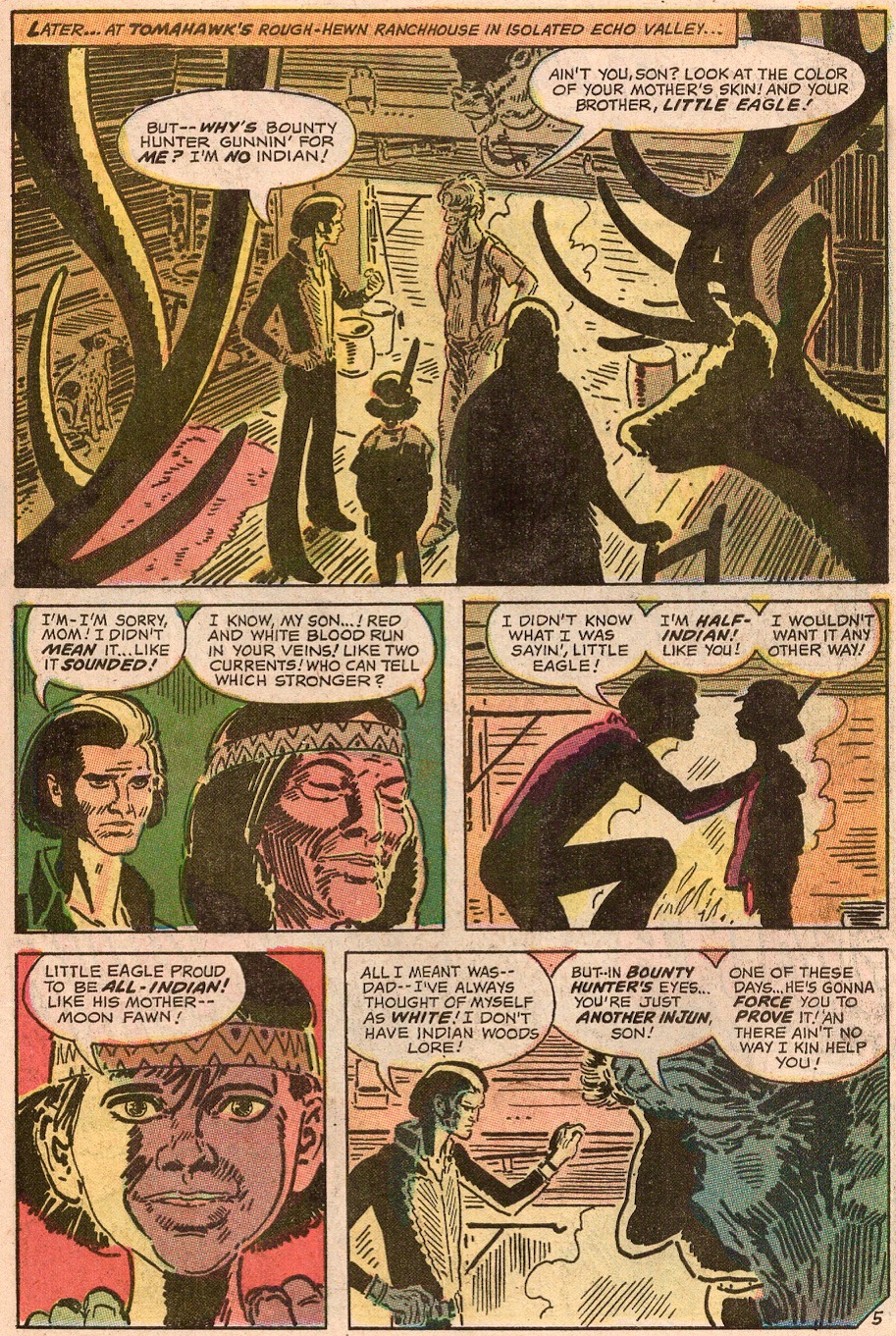
Hawk's visceral reaction to Scalp Hunter's mocking laughter sets him on a collision course with both the villain and his own identity. Back in Echo Valley he delivers a powerful monologue on biracial experience. Framed between the antlers of hunting trophies in a masterful Dutch angle, standing before a roaring fire that reduces him and his entire family to ink-drenched silhouettes, Hawk bares his soul in his most personally revealing moment. "I'm no Indian!" he insists, surrounded by a hearth and planed timber floorboards that support his argument. Each member of Hawk's family rebuts him in turn. Tomahawk simply points him to "look at the color of your mother's skin!" while Moon Fawn, by now the series' voice of wisdom, muses "Red and white blood run in your veins! Like two currents! Who can tell which stronger?" Hawk, ashamed, apologizes to his mother before taking his young brother by the shoulders. "I didn't know what I was sayin'! I'm half-Indian! Like you!" Smiling, Small Eagle tells Hawk he is "proud to be all-Indian!"
Drawn by Thorne as favoring his mother, still tied to her apron strings and free of the looming shadow cast by his father's past heroism, Small Eagle embraces his Indian identity without question. But Hawk has lived long enough to know that he must forge an uncharted middle way alone. "All I meant was … I've always thought of myself as white! I don't have Indian woods lore!" Hawk was raised within the dominant culture of his country, and he might even be able to pass as a white man at times, but he can't deny his own knowledge of his other half, and it is this more than anything that leaves him open to the racism he will face throughout his life. Tomahawk sends him off to battle, reminding him that outside his family "you're just another injun, son! Ain't no way I kin help you!" This frank discussion of race and its impact on both social life and individual identity, not in black and white but shades of gray — or pink, if you like — was simply unprecedented in comics.
Hawk rides out at dawn to face Scalp Hunter, reasoning once more that a fight in open country will keep violence from his family's doorstep. Captured quickly by his foe, he is stripped and given a running head start into the mountains, with only a knife to go against Scalp Hunter's .44. The desperate chase gives Hawk a chance to draw on stereotypical inborn Indian powers for the first time, as he moves through the foothills without leaving a trace and weathers a night on the freezing summit before his final confrontation with Scalp Hunter, who commits suicide rather than be beaten by an Indian. Hawk returns to Echo Valley in full possession of his own identity: he too now feels all-Indian, though his following in his father's footsteps as a heroic presence on the frontier continues. Hawk's turn toward his Indian side comes at a cost to the reader, if anyone: embracing the silence and stoicism that characterize his race in white-created media of the 20th century, Hawk becomes a more powerful warrior as the series goes on, but he never again opens his soul to us the way he did standing before the fire in this issue.
5. COLOR BLINDNESS
Son of Tomahawk issue #134 sees Thorne and Kanigher in tight collaborative rhythm. The art handles more narrative and characterization than ever, Kanigher mines personal experience for a searing script, and the issue builds to a symphonic climax. It begins with desperate townfolk from nearby Howling Forks beseeching Tomahawk for help after a band of marauding outlaws murders the sheriff and promises more death to come unless they're paid off. Tomahawk refuses out of hand, unwilling to invite a fight that isn't his: "I come a long, hard road ... to this quiet valley! And I ain't about to chance losin' it ... fer the sake o' yer town's money!" For a while, Tomahawk managed to outrun the society his war created. Now that he can no longer run, he stands in continued refusal of it, but only for a panel. Then, as night falls, in a masterful silent page by Thorne, he slips past his sleeping family, arms himself with a Revolutionary War long rifle and the Indian axe that provides his namesake, and gallops off to face his fate.
High in the mountains, Tomahawk tracks the bandits to their hideout, where he finds a familiar face in charge — Cannonball, his old Ranger friend and second in command. While Tomahawk's postwar fortunes were idyllic, with a beautiful bride and vast parcel of virgin land to call his own, Cannonball's have turned for the worse. In a sequence that forcibly calls up images of post-editorship, post-nervous breakdown Kanigher struggling to find work as a freelance writer, Cannonball goes door to door in fruitless attempts to stay in the soldiering business. "Old soldiers may never die ..." he muses, "but they're sure forgot when they ain't needed!"
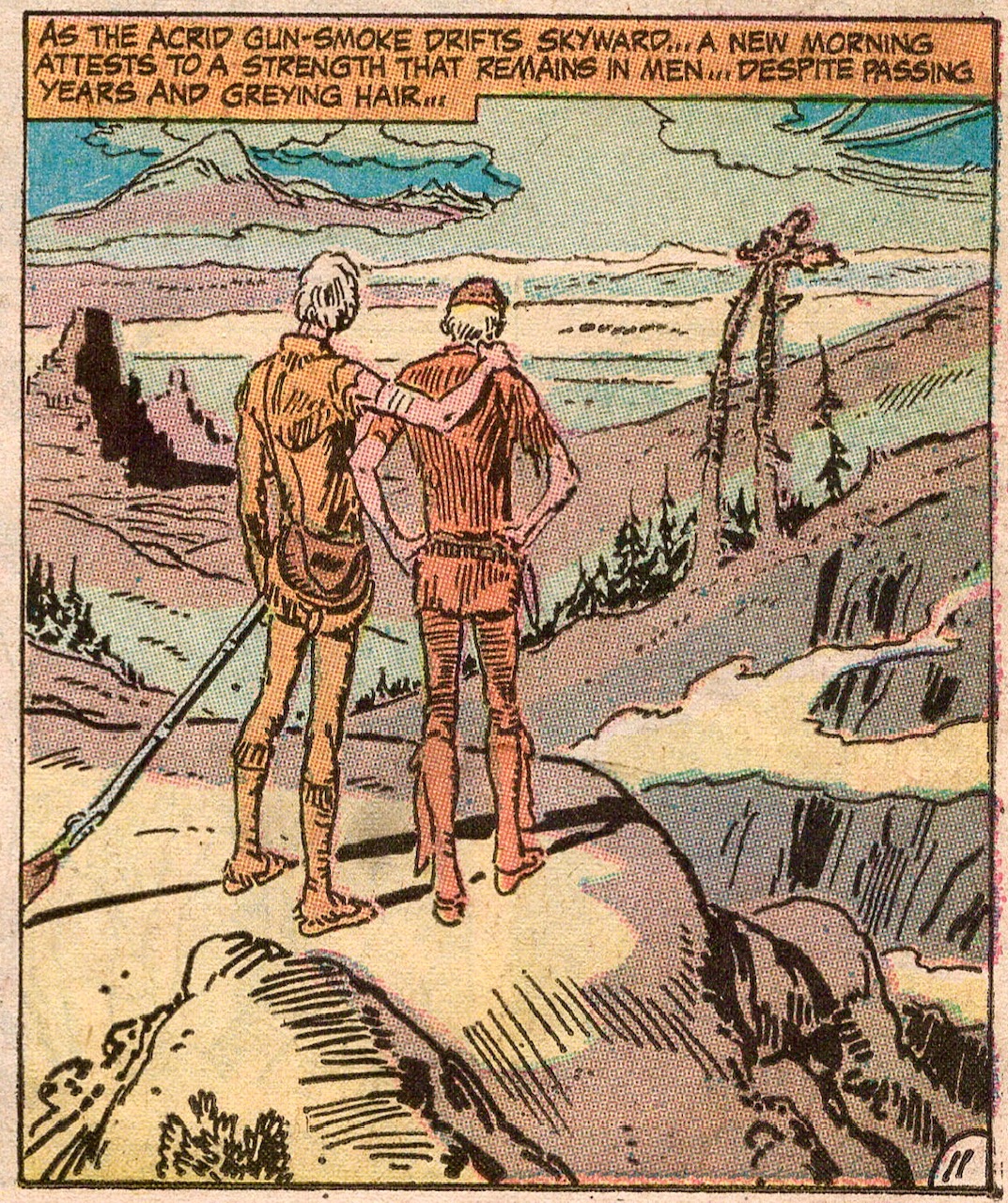
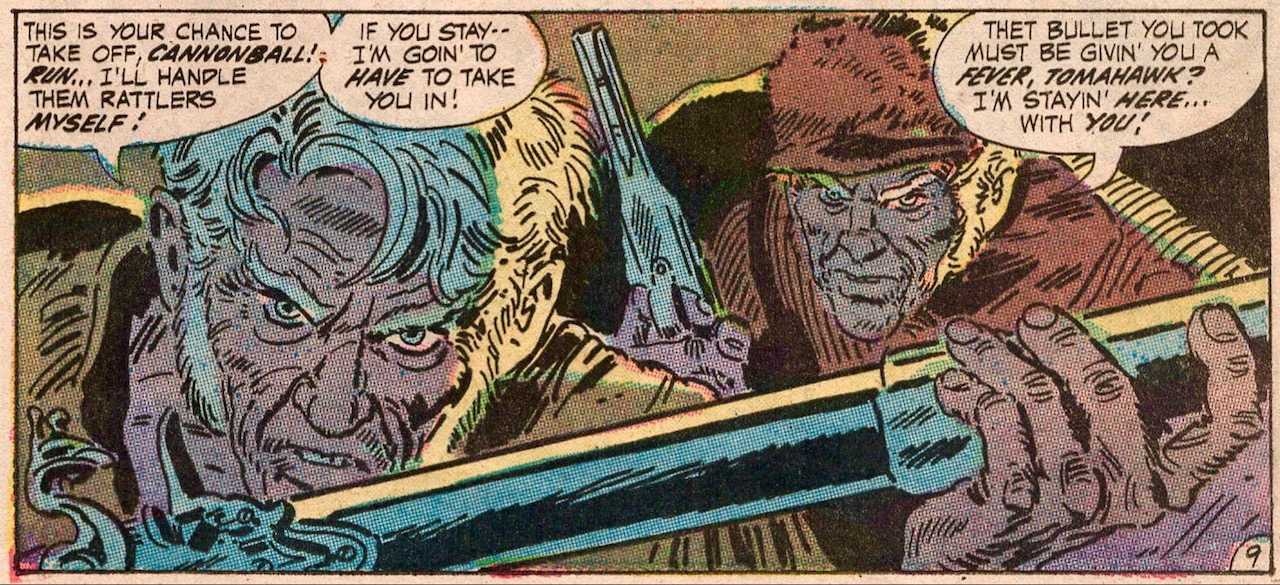
Tomahawk's attempts to reason the bitter, vengeful Cannonball out of his new career in frontier terrorism are interrupted by the gang of "young guns" recruited for the former Ranger's killing spree, all too willing to add their waffling leader and his old buddy to their body count. The two heroes desperately scramble up a mountain peak, taking bullets as they go, until the rising sun behind them blinds their pursuers, who are instantly gunned down. Thorne gives the battle a near-Olympian treatment, foregrounding first his two protagonists' spindly, aging forms against the crags of rock, then the slow arrival of sunlight, through which one can almost hear brass notes of triumph blowing.
The issue concludes with Tomahawk and Cannonball holding each other upright in a half-embrace, looking down through billowing clouds and scrub timber onto Echo Valley, parting once more as comrades in arms. Thorne's drawings of the comic's natural world have fully blossomed by now, and in his best panels he creates the Western genre’s platonic ideal, combining mountains, desert, plains, and forest into a landscape that doesn't exist in reality, but is sculpted from all the different settings of great Western films into one stunning whole. This kind of imaginative synthesis is one way in which drawings are able to simply outclass the photographed real world of cinema as visuals.
Thorne's majestic sunrise sequence in issue #134 is only the clearest evidence yet of something a quick look at any Son of Tomahawk issue shows: this was then and is still today a remarkably well-colored comic. In Tomahawk issue #125, Murray Boltinoff fielded a letter praising the inspired color work of the series with an unusually thorough explanation of DC's coloring — some of the earliest documentation of the process. Color chores, Boltinoff revealed, "are assigned by Jerry Serpe, boss of the bailiwick, to one of a number of his staff, who discusses the treatment with the editor .... Every man in the Color Dept. is a qualified expert ranging from appearing in one-man watercolor shows to winning photography prizes."
Until the late 1960s, comic book coloring was a slapdash and almost totally non-aesthetic process. Pen-and-ink artists' painstakingly limned pages were sent out to literal color factories, chemical plants where drawings' open spaces were indiscriminately filled with red, yellow, blue, or crude admixtures of the three in a process more akin to rubber stamping than craftsmanship. Though it inadvertently created an iconic pop-art look, the traditional mode of comic book color was ill suited to the ‘60s’ new breed of more realistic, fine-lined artists — former Tomahawk cover illustrator Neal Adams chief among them. Adams' expressive, ultra-detailed work forcibly demanded more sensitive treatment than DC could give it, and while yanking the editorial old guard's chain about it was an exercise in futility, a few guys who actually drew comics themselves had recently ascended to management level.
Armed with a recent discovery that Marvel was using a greater swath of the available color wheel than DC ever had, opening up a treasure chest of earth tones and dark hues with their use of pale, almost subliminal "tone yellow" as a mixing agent, Adams recalled: "I went to Joe Kubert, who was an editor at DC, as well as the great artist he’s always been, and I said, 'You know Joe, we here at DC, we don’t have tone yellow.' He said 'Really.' I said, 'Yeah, you think we would.' And he said, 'Well, (we're) probably saving money.' And I said, 'Well, okay that’s probably true, except that Marvel has got tone yellow.' He says, 'Let me see.' So, I pull out a Marvel comic and show it to him. 'Yeah,' he says. 'Darn. I wonder how they can afford it?' I said, 'Yeah, I mean it’s Marvel, Joe.' So, he said, “Okay, I’ll go see Jack.” Jack Adler, DC's head of production and himself an innovative colorist, was apparently as chapped as anyone at the company that notoriously penny-ante Marvel had challenged DC's top standing among publishers — and got Adams his extra colors. Adams quickly repaid the favor with a string of gorgeous Tomahawk covers, swimming in deep tones of sunset and desert, before departing for the bright lights of a legendary run on Batman.
The paintbox Adams opened arguably helped DC's non-superhero books more than its cape-and-cowled headliners. While superheroes could shine in the bold neons of pre-tone yellow coloring, the rich browns, dusty pinks, and arid oranges that were the main new additions to the color chart were perfect for Westerns, especially one as attuned to landscape as Son of Tomahawk. Thorne would have been an eager beneficiary: while colorists weren’t credited until the late '70s, obscuring who did what in the mists of time, Thorne had colored his own work on the Perry Mason newspaper strip earlier in his career, and would provide Marvel's production department with intricate "color guides" for Red Sonja a few years later. Thorne's hand-painted cartoons for Playboy are of a piece with Son of Tomahawk's colors, sensitively shaded in pastel gradations of pink and brown. Given that Thorne was an artist who did everything — pencils, inks, even sound-effects lettering — in an industry where division of labor was more common, it seems safe to assume that he was at least somewhere close to his book's fine color jobs. Tomahawk and Cannonball's sunrise mountain ascent, with deep purple and blue gloom sliced by delicate ribbons of the telltale tone yellow, is one of many Son of Tomahawk sequences that testify to greater attention and effort being paid to this book's colors than was — and still is — the norm.
Neal Adams' expansion of DC's color wheel wasn't the only shakeup at the company. Son of Tomahawk's next issue, #135, would be its last in the 36-page format it had used since 1954. With DC's disbelieving fury at being surpassed in sales by Marvel at fever pitch, and inflation gripping the national economy, the company had kicked its cover prices up from 12 to 15 cents early in Thorne and Kanigher's pre-Hawk run on Tomahawk. Even a three-cent markup was a bitter pill. It was after all a 25% increase in an industry whose consumer base was dominated by kids and their few coins a week of allowance money, whose retail partners were newsstands and general stores with limited space for comic books and a profit margin of perhaps a few pennies per sale. Despite a rising fan culture that would soon create dedicated retail storefronts for comics, this was not an industry set up to accommodate the connoisseur's choice. Kids with spare change in their pockets went for quantity over quality reliably enough to steer the publishers.
Nevertheless, in the summer of 1971, DC again increased prices, from 15 to 25 cents per comic. Carmine Infantino, making the best of a bad situation, used this opportunity to open the vaults. DC's books expanded from 36 to 52 pages, backing up new stories with reprints of the best work from the company's past. From today's perspective, this was an objectively good thing. Just about any DC comic from the 52-for-25 era has something in it worth reading, regardless of the feature strip's quality (or lack thereof). Many of the old strips reprinted at Infantino's direction are brilliant in their own right, and a great number of them have not been printed again in the 50 years since. If a market for connoisseur comics didn't exist at the time, Infantino's hat tip to the medium's history did its bit to create one.
In 1971 and '72, however, it was a catastrophe. In a masterstroke of collusion and sabotage, Marvel matched DC's ten-cent price hike for one month, then throttled back to 20 cents, while offering their distributors a 25% increase in profit margin. The result was total victory: kids wanted more of the cheaper Marvels, newsstands stocked more, and the newsstands' suppliers made money making money, with a bigger cut of the increased sales. DC barely outpaced Marvel sale-for-sale in 1972, after belatedly slashing their own prices back to 20 cents, but they never would again. The damage was done, and books were canceled en masse. DC was scarred for decades by the experience. As late as 2010, the company created a defiant marketing campaign around their "drawing the line at $2.99," while crosstown Marvel raised their books' prices to $3.99, outsold DC handily, and laughed all the way to the bank. Son of Tomahawk would not make it through to see the end of the wonderful and disastrous 25-cent era.
6. HOME TIES
Son of Tomahawk #135 once more retools an old Kubert Firehair story, spinning the tale of a white man with gold fever and Indians who take none too kindly to the strip-mining of their lands, with Hawk in the dangerous middle space between them. The story delivers what has seemed inevitable from the beginning: Hawk's departure from the family to seek his fortune. The fortune sought is firmly economic in nature — after rescuing a wizened peddler from two highwaymen, Hawk is gifted the old man's catalogue, a printed window into a luxurious world that could not be further from agrarian life in Echo Valley. Dreaming of fine clothes, expensive liquor, and beautiful women, Hawk gives in to the capitalist logic creeping westward. He departs from his birthright with plainspoken honesty: "Everythin' I want costs money! There's nothin' in this valley! I'm goin' out to make my fortune — and live like a king!" Tomahawk, amused, knows better than Hawk himself what kind of man he has raised. "When you do, son — let me know what a king's crown is worth?"
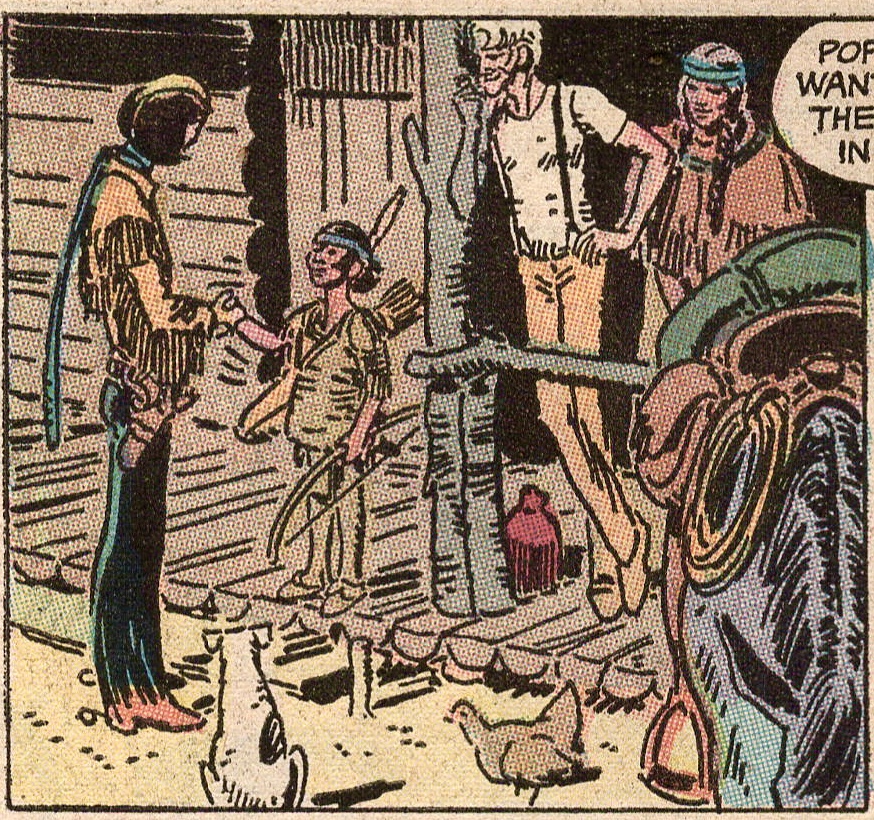
Thorne sends Hawk off with what might be the emblematic panel of the entire series, a wordless wide shot of the family gathered in farewell on their wraparound porch, dogs and chickens scratching in the farmyard dirt, mother and father smiling on as Hawk shares a goodbye handshake with Small Eagle, who has disdainfully declined a hug, smirking "Braves do not hug like women!" It's a beautiful drawing, so plainspoken that it achieves iconic status, a cartooned cousin to Norman Rockwell's classic canvas "Breaking Home Ties", which treats the same subject with similar gravity. Then Hawk is off, finally beginning the great adventure every young man dreams of in his heart — and one readers used to typical Westerns starring lone riders must have hoped for too.
This being a 12-page story, the adventure leaps into saddle alongside Hawk within two panels' ride. In nearby Howling Forks, our hero's “old friend” Jess (about whom we have not read word one until now) has stumbled across a comic-booky windfall: a dying prospector's map to the secret mother lode of gold hidden in "Ghost Mountain". The gold inevitably lies beneath an Indian burial ground, and soon a party of aggrieved elders arrives. This is standard-level drama from Kanigher, but Hawk coming full circle from the issue's opening, now one of a pair of robbers looking to strip the aged of their property, is a nice touch. Ever his father's son, Hawk instantly does the right thing and disarms the greed-mad Jess, who goes after him with a pickax, bringing down the scaffolding on which ancient Indian mummies rest and sealing his own doom as a falling spear nails him clean through.
The action scene is a rare lackluster performance by Thorne, who fails to ground it in space or create strong impacts. Perhaps the grisly manner of Jess's death forced the artist to pull punches. At any rate, what stands out is the racial character Hawk and Jess' dispute immediately takes on, with the white villain vowing to "bury you with your redskin brothers" the moment the two cross purposes. Chastened, Hawk makes his peace with the Indian elders, returning the gold to their mountain and then trudging home to a family proud of what their son has learned about the price of wealth. In an uneven issue, Kanigher and Thorne firmly establish that their book has a different focus than the typical Western, and indeed the typical heroic narrative. Hawk will not go out to find his own frontier, gaily abdicating responsibility for the society that he and his fellow countrymen have built as he rides away into the sunset like so many other media cowboys. He is of his family, and cannot and will not escape it as the chickens come home to roost. He is, after all, the son of Tomahawk.
Son of Tomahawk's first letter column appears in this issue immediately following the feature story. It was unusual in the extreme for any ‘70s comic to go five issues without answering the mail, implying that the book was teetering between continuation and cancellation with the brass wary of making promises to readers that could not be kept. Indeed, the comic formerly known as Tomahawk was not necessarily winning its audience's hearts and minds. Two letters in the initial column bemoan the disappearance of the youthful Tomahawk and his Rangers, while only one argues in the new setup's favor. This letter is a good one, however, with frequent correspondent Daniel Gheno of Santa Barbara identifying exactly what makes Son of Tomahawk special: "Finally someone has the guts in the comic book field to show the bitter hatred white men held toward the red man."
Joe Kubert, answering his first mailbag as editor of the book, must have been pleased that at least some readers were picking up on what he was doing. Even more gratifying must have been the unanimous popularity of what Kubert the artist brought to the title he oversaw. The column long titled "Let's Talk with Tomahawk" had switched over to using the title and logo of Kubert's old Firehair lettercol, "Smoke Talk," and Firehair himself had found second life as an undercard to the Hawk stories headlining Son of Tomahawk, appearing as a backup feature in 4 of the book's first 6 issues. Firehair slots in perfectly with Thorne and Kanigher's work, as another youthful hero caught halfway between the white and Indian worlds.
Kubert's second run of Firehair stories are, if anything, even better than his first. The extreme brevity of the six-page strips forced Kubert, never one to waste a panel anyway, into an elliptical mode of storytelling. Big showpiece images fill in entire scenes, and action detonates with a jolting speed that feels truer to life than even the most meticulously choreographed fight scene. In an homage to the biggest influence on all action comics pre-1975 or so, Hal Foster's Prince Valiant (itself containing sequences of early white/Indian contact), Kubert's Firehair backups are completely free of word balloons, with both narration and dialogue occupying caption boxes. This is a risky formal maneuver, but it gives Kubert’s already iconic drawings even greater power, silent and glowering with the feel of the mythological. The stories themselves continue the tale of a boy becoming a man in a world with no place for him, as Firehair finds friends but no home first on a Mexican rancho, then in a village of Mandan Indians. The Mandan story ends in legitimately shocking fashion, with Firehair and the tribe's braves returning from a religious vison quest to a bloodbath when a nearby fort of drunken Union soldiers overrun the Mandan wives and elders on a campaign of rape and pillage. The reeling soldiers are no match for the furious braves, and Firehair and band leave none alive in a grimly illustrated revenge sally.
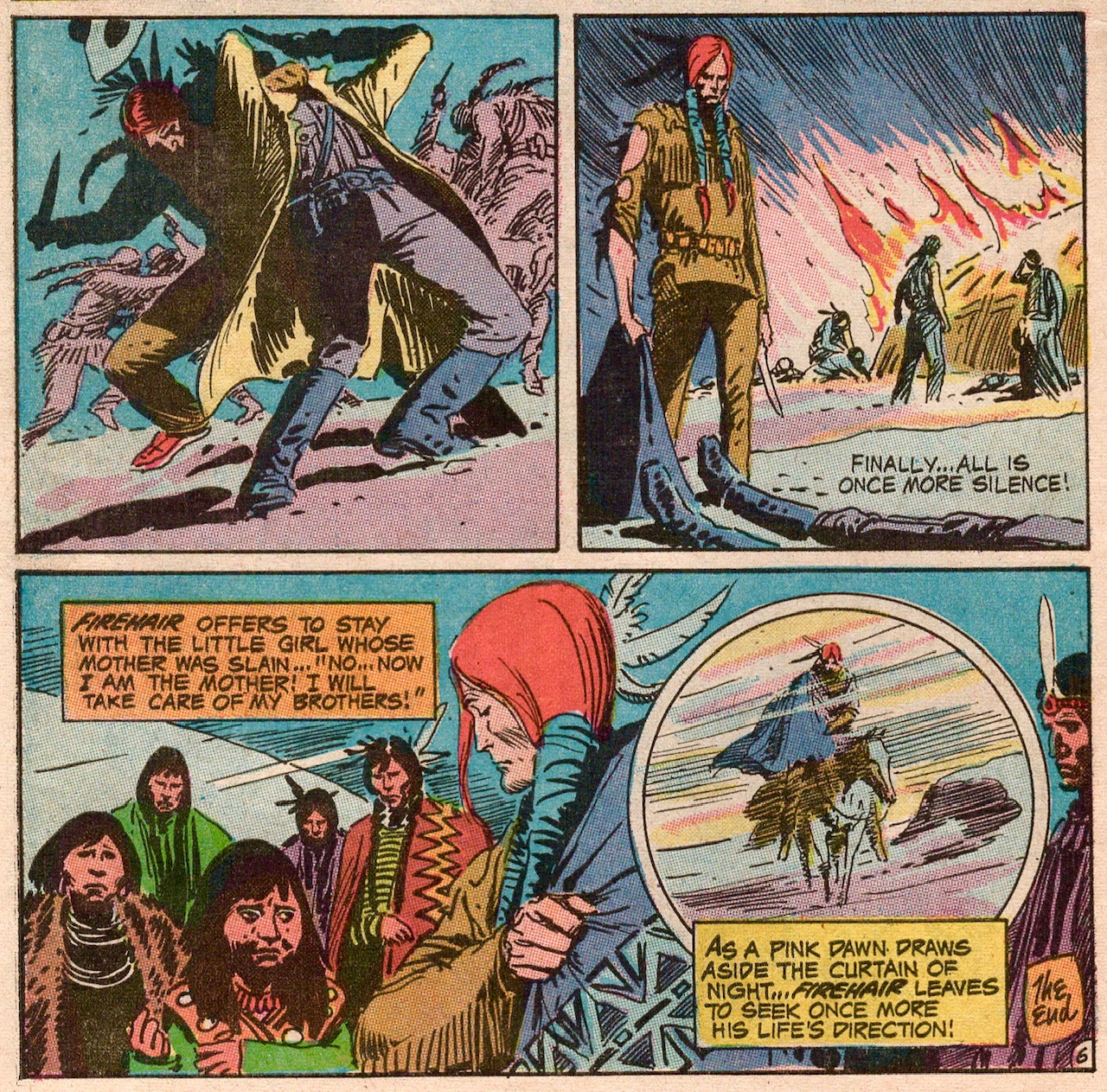
The return of Firehair was greeted rapturously by Tomahawk fans. A funny recurring theme in the letter columns is the constant outpouring of unconditional love for the backup strip, while Hawk himself is a more divisive figure. In a way, this speaks to the sensitivity of the book's readers: while Kanigher's strident, didactic writing slams hammer blows down on pressure points that American media then and now shrinks away from, Kubert addresses similar themes in a more meditative, liquid way. If Hawk is a novelistic treatment of race and identity in the Old West, Firehair is its poetic counterpoint, providing brief illuminations of the same topics that neither beg questions nor strive for answers as Kanigher is wont to.
Kubert's final bow on Firehair, in Son of Tomahawk #136, is fittingly his strongest work on the character, catching his hero between conflicts in a flowered arroyo, first attempting to break and then freeing a majestic black stallion that may or may not also be a god. It sums up everything the comic offered its adoring readers: beautiful art, lyric storytelling, the romance of solitude, a lost Native sense of the spiritual, and rousing action as only Kubert could deliver it. In a final similarity to Son of Tomahawk, Firehair was a shooting star, one that blazed quickly but brightly over the horizon of commercial comics before disappearing, leaving a vivid impression only in the memories of the few lucky enough to witness it.
After the final Firehair issue of Son of Tomahawk, the book feels somehow different. Perhaps Kubert the editor had less effort to expend on a book that no longer featured his own art, perhaps the missing tension of counterpoint takes something away from Hawk's adventures, perhaps word of impending cancellation was growing louder and all involved made the business decision to temper the extra passion that so elevated their comic. But before that, in Hawk's first 52-page issue, Son of Tomahawk reached its pinnacle.
7. DARKER THAN YOU THINK
Thorne and Kanigher's searing look at race conflict in America's early days was nothing if not in earnest; leaving aside their direct confrontation of prejudices still very much accepted in their time, the idea that a mainstream comic book might gain an audience by demonstrating antiracist credentials in 1971 was absurd on the face of it. Comics were an unserious children's medium with a sideline to a decently sized but hardly mass audience of adult collectors, oddball college students, and enlisted men; Roots and its illumination of the vast mass audience for nonwhite-focused media were still years away. For all this, any story attempting to seriously take on race in American history needs to deal with the elephant in the room. Son of Tomahawk's pre-Civil War setting made it inevitable that the book must either eventually address slavery or ultimately fail, charging hard at uncomfortable questions about America's past while shrinking away from perhaps the biggest one. Once again, Thorne and Kanigher rose to the occasion.
"A Piece of Sky" in Son of Tomahawk #136 pushes Hawk and Tomahawk out of the spotlight. The book had focused on solo adventures of one or the other before, but here both Haukinses fade into the background while a different American family carries the narrative. "A Piece of Sky" stars runaway slave Jason, his pregnant wife Mary, and eventually, their newborn baby. The comic opens in familiar fashion, with the Haukins men riding the range together — here tracking a hog run off from Echo Valley. Life in the wilderness has caught up to it by the time they track it down, a carcass framed by prickly pear cactuses, ribcage bleaching under a sweltering sun. "Guess he just couldn't stand bein' penned up ..." Tomahawk muses, "even if it meant killin' hisself to be free!" No sooner is the hog located than a cloud of dust is kicked up by Jason and Mary, who cross our heroes' path with slave hunters hot on their heels. Hawk and Tomahawk stand the tracking party down at gunpoint, growling through gritted teeth that the hunters' pursuit has taken them across state lines and into free territory.
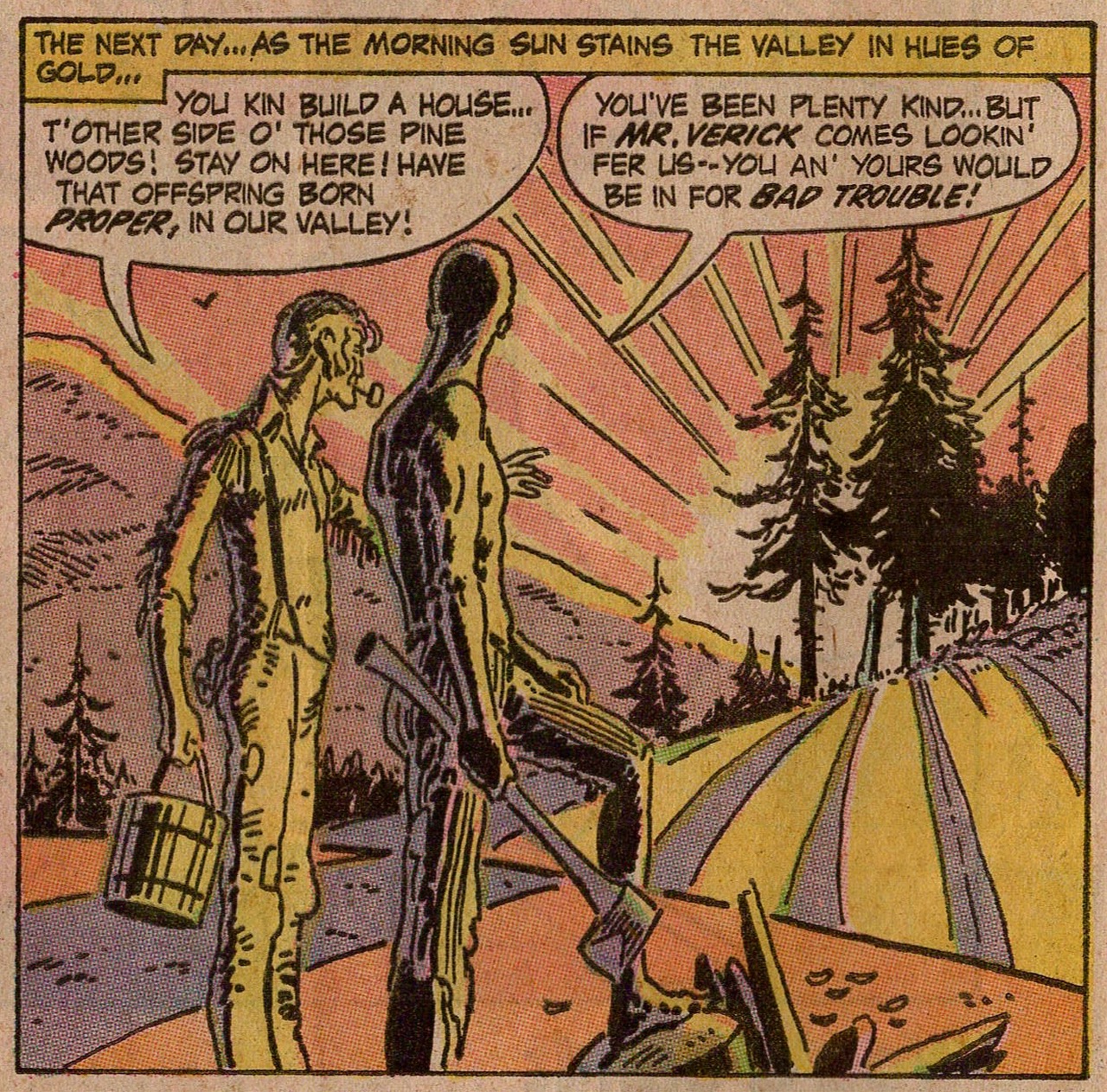 Jason and Mary's former owner swears revenge, but the runaways are taken into Echo Valley, where a spontaneous exercise in community building begins. In the most optimistic sequence Son of Tomahawk ever presented, Jason and Mary are pried out of their slave collars, fed and boarded, and then invited to build their own homestead on the sprawling Haukins lands. Backgrounded by Thorne's beautiful drawings of Western nature at the height of summer's bloom, bathed in golden sunlight hues from Neal Adams' tone yellow pallet, it's a sentimental vision, but one that avoids corniness with sheer moral purity. A shot of Tomahawk and Jason shoulder to shoulder, looking down into the wooded valley where Jason plans to build his home, is as dazzling and hopeful a vision of Americana as one can imagine. Tomahawk, the white patriarch who's groused every issue about society closing in on his farmstead, founding father of a racist country and the symbol of so much that's gone wrong since 1776, redeems himself now. The war hero finds a truly heroic role here — instantly offering up his parcel as a homeland for victims of the society he so abhors. He abandons land ownership to begin a collective farm. He further integrates his biracial family unit by embracing a new family, one as ill-treated by America as any Indians. By far the oldest person in Echo Valley, he must be cognizant that soon will come a day when the stewardship of his hard-won home will fall entirely to nonwhites, but he does not care.
Of course, it doesn't last. Like Moon Fawn and Small Eagle before him, Jason has a trip into the town of Howling Forks turn violent, as a gang of racist louts outnumber him and are only held off by Hawk's revolver. The man-to-man fight scene that follows echoes Hawk's own Howling Forks fight scene in issue #132 down to the last detail — a neat bit of choreography by Thorne that points up the cycle of violence Kanigher's scripts present. Another cycle completes itself as Jason and Mary finish building their home just in time for their child's birth, and their old master returns to either reclaim or destroy the people he once held as property. A tragic ending shrouded in smoke and blood, framed by prickly pear cactuses, provides a counter to the shining moments of racial harmony and a better future seen earlier in the issue. In Son of Tomahawk's America, nothing is redeemed, nothing is fixed, and heroes only win until they lose. It has to be that way because racial violence is the engine this comic runs on, and next issue comes after this one — but it also has to be that way because that's the way it is.
"A Piece of Sky" feels like Thorne, Kanigher, and Kubert's thesis. Here, they say, is a beautiful land and a mixed rabble of people both brave and venal, with seeds of greatness strewn about here and there, mixed in with the seeds of destruction. As in the history being drawn from, to focus on the little triumphs — perhaps the personal victories and overcomings of, say, one mixed-blood family way out in the deep country — is to miss the forest for the trees. America's history is written in ruthlessness, desecration, and bodies black and red. To forget this in a story of the country's making is to lie — to keep telling the same lie some Americans have always told themselves. In this remarkable little comic book with as tragic an ending as the medium had ever hosted in 1971, for three veterans of the exploitation and indignity that 20th century comics charged all workers as a toll of entry, that lie had lost its savor. It tastes no sweeter now.
8. MINESHAFTS
Issue #136 is a high point for Son of Tomahawk in more than content. "A Piece of Sky" is in many ways the furthest the book would go — there is the darkness of its story, but it's also Thorne and Kanigher's frankest address of racism as systemic and all-consuming, as what makes life in America a hopeless endeavor. Additionally, it casts its focus as far from the Haukins clan as their comic would get, expanding the world of Son of Tomahawk to its outer limit. Part of the disappointing feeling that hovers around Hawk's never fully leaving his family circle isn't just that it robs his character of what would have been a compelling story arc, it's that Thorne and Kanigher have created such a fascinating book that one can't help but long to see more of the world their stories exist in. But it was not to be, and the brief glimpses we are given have a silver lining: they make imagining what could have been much sweeter than all but the best actual comics are. It's easy to long for a definitive 50-issue run of Son of Tomahawk, one that would have exhausted concept and characters by wringing out all that could be had from them, but instead we have this tightly wrapped bouquet. The grass is always greener ...
At any rate, if Son of Tomahawk #136 convinces the reader that this book is capable of doing anything, being anything, issue #137 is an immediate step back into safety. Thorne and Kanigher had teased longtime Tomahawk and Ranger fans with appearances of the faded hero's old cronies in surprising new forms, but this is a proper flashback issue for the peanut gallery, filling in the tale of Tomahawk and Moon Fawn's courtship. It's solidly the weakest issue of the series, a cliche story of a brave Indian maiden who is first rescued by, then rescues, the strapping white stranger who wins her heart. Disney's Pocahontas is both a subtler and more rousing treatment of the same story. The intensity and depth of Son of Tomahawk are swapped out wholesale for the fresh-faced naivete of Tomahawk here, and the result is disappointing.
The rote material is made more frustrating by a framing sequence set in present day Echo Valley, where Tomahawk and Moon Fawn reminisce while Hawk rides into town to fight a rival for the affections of a pretty girl. With the elder Haukinses' romance one big cliché that any reader could fill in the details of, never seeing Hawk himself in a romance feels like a missed opportunity for Kanigher to deepen an enigmatic and somewhat unknowable character. It's especially tantalizing that the pretty blonde Hawk eventually drives home to meet the folks is a carbon copy of the girl he rescued from the Judge and brought home in the debut issue. Are Hawk's romances aspirational, a chance to join the white world? Is he solidifying his own identity by chasing a Platonic image of European beauty? Could a pretty Indian girl (or a Mexican or Black one for that matter) ever turn his head? None of these questions are answered, but I will opine that Kanigher's failure to return Hawk to the runaway slave Jason's young widow Mary and her fatherless baby boy, living just over the hill from the Haukins spread, is an oversight that really stings.
Hindsight starts to hurt the book here, as we hit its final stretch of issues and realize that no matter what, we're not going to see all the stories we want to. A letter in issue #137, amid the usual mixture of praise for Hawk, longing for the Tomahawk of old, and rapture for Firehair, contains the first mention of a major factor in the book's demise: its lack of a direct-mail subscription service. In a period when Marvel's cheaper books were crowding DC's less popular titles off the stands, here was a clear request for an obvious fix. Kubert replies that "subscriptions are in the process of being initiated," but the book was also in the process of Being Canceled, and time would end up running out too quickly.
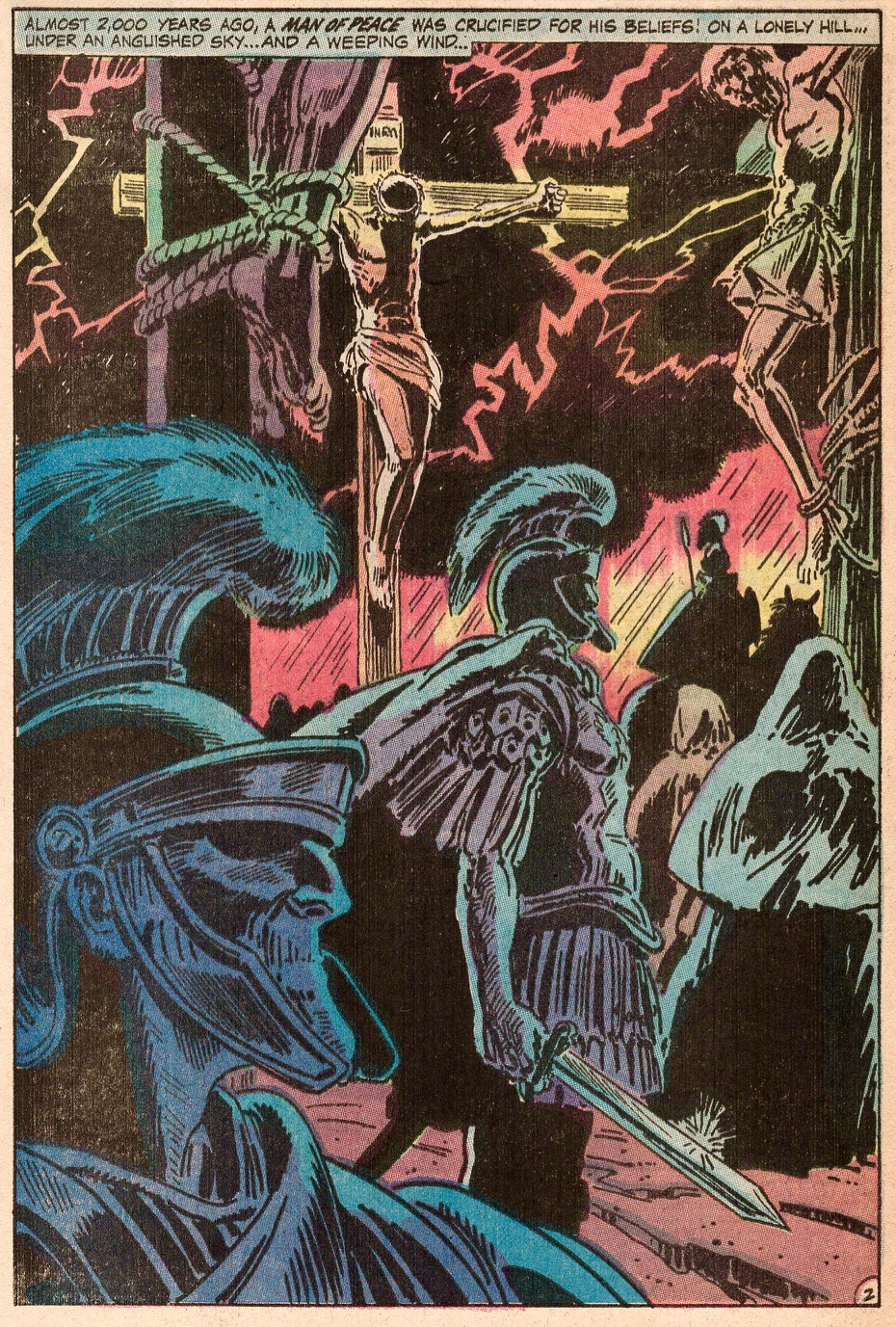
In any event, Thorne and Kanigher roared back with issue #138, an extra-length Christmas special that leads our heroes to the brink of race war. As the book opens, winter has fallen, and through the crisp and silent night are led Moon Fawn and Small Eagle, bound at the end of a rope in "a frozen death walk ... leading upward to a looming hill of doom!" This opening cliffhanger slams into the most audacious moment of the entire series, as Kanigher's narration turns with the page: "Almost 2,000 years ago, a man of peace was crucified for his beliefs! On a lonely hill ... under an anguished sky... and a weeping wind..." The caption overlooks an utterly majestic splash page of the Crucifixion drenched in angry reds and gloomy purples, lightning crackling above spectral Roman centurions, the Savior looming over all in deep shadow. It's as good a drawing as Thorne ever did, a mix of comic book bombast and Renaissance history painting randomly thrown right into the opening of a children’s Western comic. In a testament to Thorne and Kanigher's skill, this feels far from hyperbole, instead fully earning its place in the comic as a hugely dramatic opening flourish. If one needed a page to illustrate just what the ambition powering Son of Tomahawk looked like, here it is, an all-timer.
It gives way to a flashback of Moon Fawn and Small Eagle leaving Echo Valley for Indian territory, on a holiday visit to their tribe of origin as Hawk and Tomahawk sharpen their shooting aim. Tomahawk and his wife take their leave of each other with monologues that perfectly express their differing characters. Tomahawk bemoans the industrialization of the frontier across a treasure trove of Thorne's patented landscape drawings, while Moon Fawn gives thanks for the natural world at hand, beaming up at sky and snow. A reunion with Grey Elk, Moon Fawn's father, follows. Flashing classic Indian Wisdom, Grey Elk has no trouble seeing that Small Eagle represents the best way out of the West's omnipresent racial strife: "Here is living proof that Indian and white can live together ... half Indian ... half white ... a whole person!"
Not everyone agrees, however. Mother and son are kidnapped by renegade braves on their way back to Echo Valley, setting in motion a chain of revenge murders between white and Indian that escalates to fever pitch before Hawk and Tomahawk can even hear of what has occurred. Desperate to save their family and prevent a bloodbath, our heroes stand down the two mounted militias that have gathered on a snowy plain, promising to save Moon Fawn and stop the violence before dark. Grimly riding straight into a trap laid upon a hill topped with crosses, the Haukins men shoot their way to triumph, restoring peace just in time for a mixed-race Christmas celebration held for townsfolk and tribe alike at the Echo Valley farmstead. The well-worn contours of the plot are given real bite by Kanigher, who reminds us of what a powder keg the Haukins clan live balanced over, and that no matter what small victories are won on these pages, the sweep of history itself means that they're only pauses on the way to the inevitable. For Thorne's part, quite aside from his bravura Crucifixion and perfect handling of Tomahawk's lament, this issue probably contains more sheer work than any other. The empty white space of the snowy landscape is offset by furious mark-making that gives this issue's cast of hundreds a loose, tattered feel, crackling with energy.
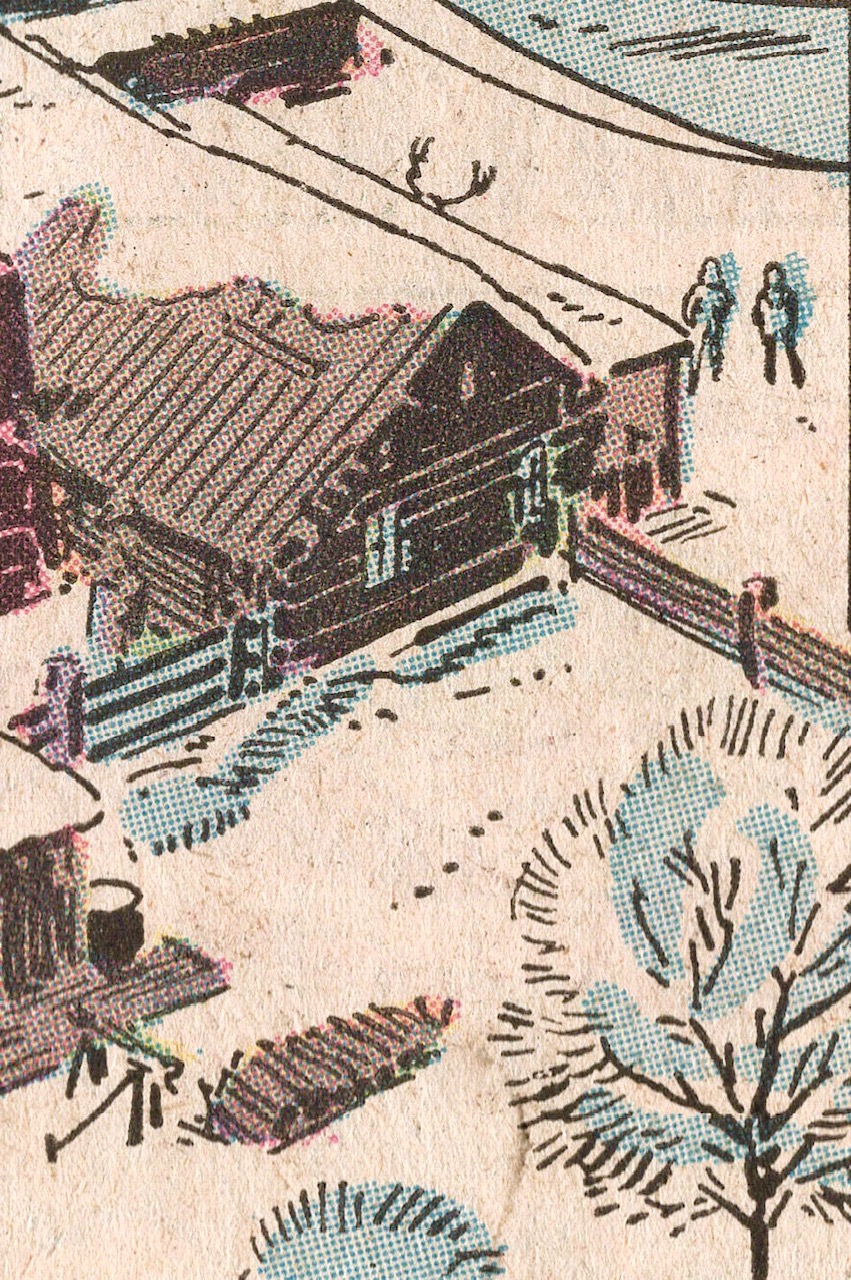 Winter intensifies in issue #139, an outlier for the series and also one of its strongest entries. "Death Council" strands Hawk and Tomahawk far from family and home, alone in a conflict driven by money rather than racism. It's an opportunity for Thorne and Kanigher to play their star characters for all they're worth, setting aside weighty themes and ensemble cast to knock the hell out of a simple, noirish Western setup. A driving blizzard forces the range-riding father and son to stop in a derelict mining village for a night, but their entry takes them past a scattering of frozen corpses and into the offices of the town's mayor, who along with his town council has massacred the citizens to stake sole claim on a mother lode of gold buried beneath it. Along with a by-now-standard Blonde In Distress, Hawk and Tomahawk narrowly escape into the dark shafts of the mine, where a deadly game of gunslinging hide and seek ends when the Haukins men and their rescued damsel ride a mine cart to safety as they cave in the shaft and the entire town standing over it with TNT, burying the murderers alive.
There are no real metaphors or deep themes here beyond a glancing condemnation of greed. It's just two veterans of genre comics riffing on a terse setup, two great characters, and an overwhelming atmosphere. Thorne's scribbled, gusting pen lines scream across panels filled with white and misty ice-blue, figures gnawed down to ivory silhouettes and gestures exaggerated to compensate. The transition from blank, snowy space to the inky blackness of the mineshaft is a great visual story idea from Kanigher, and getting a whole issue of Hawk and Tomahawk's back and forth dialogue without interruption is a treat. One wonders if Kubert, knowing his book's sales were right on the brink, hadn't mandated a more conventional issue after the weightiness of the previous few; but "A Piece of Sky" had received more praise than any other Hawk story — and for the right reasons, with one letter declaring it "the first time in comic book history a story has achieved such a high emotional content describing the pre-Civil War era." If Son of Tomahawk didn't have enough readers — one letter in #138 characterizes buying the book as a sacrifice due to its increased price point — it still had good ones, the kind any editor hopes for. At any rate, Thorne and Kanigher cutting loose on a simple story with plenty of grit is a joy.
9. BLOOD OUT
Issue #140 brings Son of Tomahawk to a close. In a fast-paced story where meaning swims below the surface, we see Hawk on the wrong side of a racial clash, siding with white against Indian and paying the price before long. The story opens with wordless action, as Hawk sneaks into an Indian encampment under cover of darkness, slits an entry into a teepee, and steals away with a bound and gagged white woman slung over his horse. The appearance of a rescue is shattered as soon as the gag is removed — the woman, Annie Douglas, protests that she is no kidnap victim, but the lawful wife of the Indian Brave Bear, to whom she is desperate to return.
As Hawk fights tooth and nail to pacify the woman — first on horseback, then swept up by a river’s swift current — the backstory emerges. Taking Annie, a runaway orphan who has been ostracized by white society, for a kidnap victim, a posse of whites assemble in Howling Forks bent on bloodshed. Tomahawk intervenes, volunteering his son for a solo mission to bring her back without violence. In a neat bit of storytelling Thorne centers Hawk’s emotions, showing his shock at his father enlisting him without consent, then his swaggering acceptance, brow raised and mouth creased with a smile. It’s easy to see Son of Tomahawk’s setup as fundamentally static, returning characters and setting to the same baseline before throwing them into a new plot every issue. But moments like these show the evolution of Hawk as a character, and his relationship with father Tomahawk in particular. Over ten issues, a trust and mutual respect as fellow warriors has grown up between the Haukins men — a subplot that ends here with all the rest.
Annie Douglas is another new wrinkle, a young female co-lead far from the quiet blondes in need of rescue flitting around the edges of previous issues’ panels. A strawberry-haired hellcat who fights the bewildered Hawk to a standstill while giving him an equally furious tongue lashing, Annie hints at Thorne’s future. She bears a strong similarity to the ginger-tressed, fiery barbarianess Red Sonja, and the issue’s extended action beats force Thorne into compositions centered around a lithe, writhing female figure that foreshadow the porn comics which give the PG-rated Son of Tomahawk’s artist his claim to fame today. As Annie struggles, Hawk is faced with an impossible choice — forcibly return the girl to town, or let her free and risk a massacre. The action crests as the pair rest for the night and Annie’s husband Brave Bear tracks them down, letting Thorne cut loose with a fight scene where Hawk and Brave Bear get body-slammed in turn onto the blazing coals of a campfire. Hawk is beaten, but Annie begs her husband to spare his life as she is taken back to his — and her — tribe. Hawk, half-Indian but still very much a product of the white world, is left shaking his head at her decision, one both Brave Bear and later Moon Fawn predict he’ll come to understand one day.
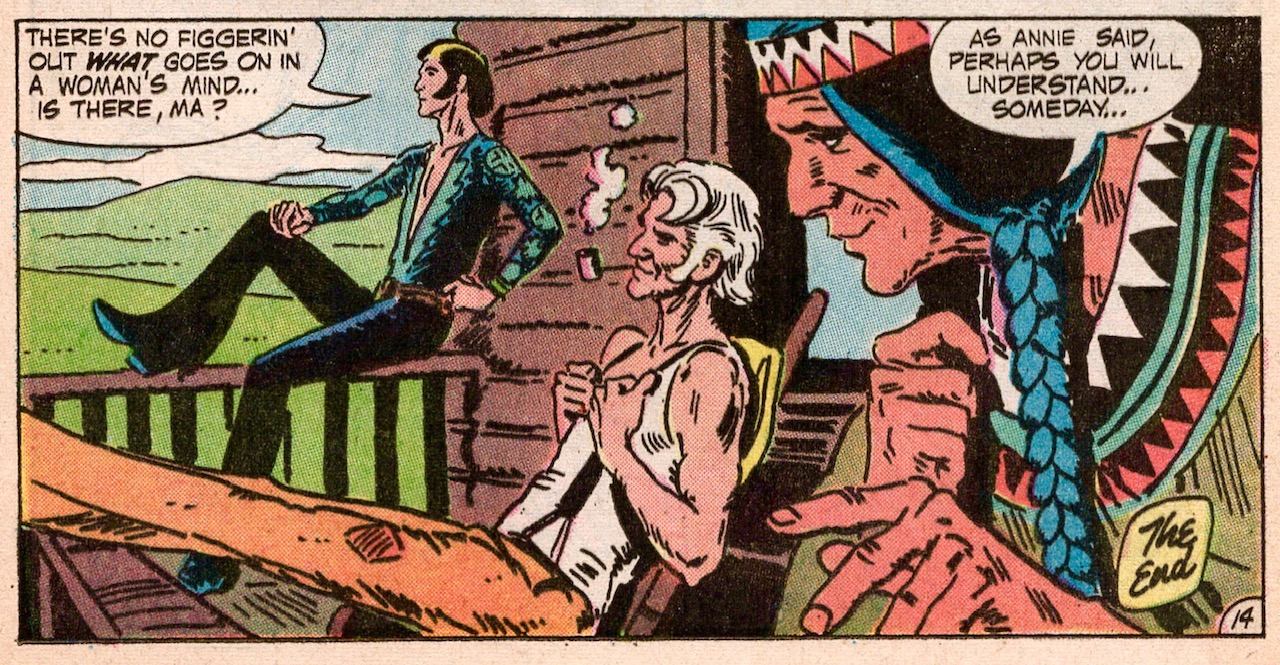
And that’s it for Son of Tomahawk, which concludes with an iconic shot of Hawk, Tomahawk and Moon Fawn relaxing on the porch in Echo Valley, rolling hills and billowing clouds in the distance. This issue again makes one long for a proper romantic subplot featuring Hawk, whose attraction to a repeating image of idealized white femininity is complicated here: he may be able to move between white, Indian, and Black comrades-at-arms with ease, but he cannot fathom a white woman who chooses to do similarly. But that’s far from the only untold story this issue hints at. Hawk is not quite as gung-ho for the adventure Tomahawk assigns to him here as his father thinks, and one senses a conflict between two generations of Haukins men brewing. The classic teenage lament “I didn’t choose to be born” seems like one that must rattle around somewhere within Hawk: his father has bequeathed him not just a sprawling farm, but a violent life in a violent land that paints a constant target on his back thanks to Tomahawk’s building of his family across a race divide.
There are so many more stories to be told: one senses Hawk really will have to leave Echo Valley one day for his own adventures in westward expansion — what would they entail? Small Eagle’s own young manhood is not far off, and his total identification with his Indian side sets him on a very different course than Hawk’s — will either remain on the farm? Would Small Eagle dare to live his life among the Indians in a post-Civil War world that gave the traditions Moon Fawn has handed down to him little chance of survival? How would the Civil War itself affect the Haukins family? Could the brothers find themselves on different sides of a tragic clash in the Indian wars that forced the great tribes of the Plains onto reservations? What about the inevitable extra-sized issue featuring the Death of Tomahawk? And Hawk’s taking up his father’s place as head of a family, giving us the Son of Son of Tomahawk?
These are passing fancies, silly exercises in wishful thinking that may never have come to pass even if the book had lasted many years. Commercial comics, after all, tend toward formula, and part of what makes Son of Tomahawk feel so unique is that true family sagas where generations pass by and give way are rarely attempted. It’s a testament to the power of what Thorne, Kanigher, and Kubert did that such possibilities feel so real, so close at hand, so easy to imagine. Realistically, however, there was probably no chance. Comics is littered with books full of potential created by artists who lost focus, or were swapped around on jobs with other freelancers, or were prevented from doing what they wanted by the bosses, or simply couldn’t pull it off. Runs like Son of Tomahawk’s — ten issues of brilliance where everything aligns and it feels like they could have gone on forever, if only, if only … these are as good as it gets.
It’s better to look for comics like this than it is to wish in vain for more. Kubert spent the next four decades knocking out jobs that stand up well alongside this one — many of them war comics written by Bob Kanigher. After Son of Tomahawk he took Thorne and Kanigher along for a dazzling run on DC’s latest acquisition, the Tarzan line of comics, with Kubert writing and drawing the main book, Thorne doing art for Korak, Son of Tarzan (“I seemed to get sons of characters, of the famous characters,” Thorne mused in an interview), and Kanigher scripting Korak and Rima the Jungle Girl. Kanigher hung on as freelancer for a few years longer, writing scripts for oddball books like Rima and the urban vigilante Ragman, most of which are the kind of unexpected little gems that comic book back-issue bins exist to host. For Thorne the best was yet to come, and while the wave of porn comics he sent sweeping across the decades isn’t the kind of water one wants to bathe in for too long, it’s remarkable to see such a consummate craftsman bring his skill to bear on material so far beyond the mainstream pale.
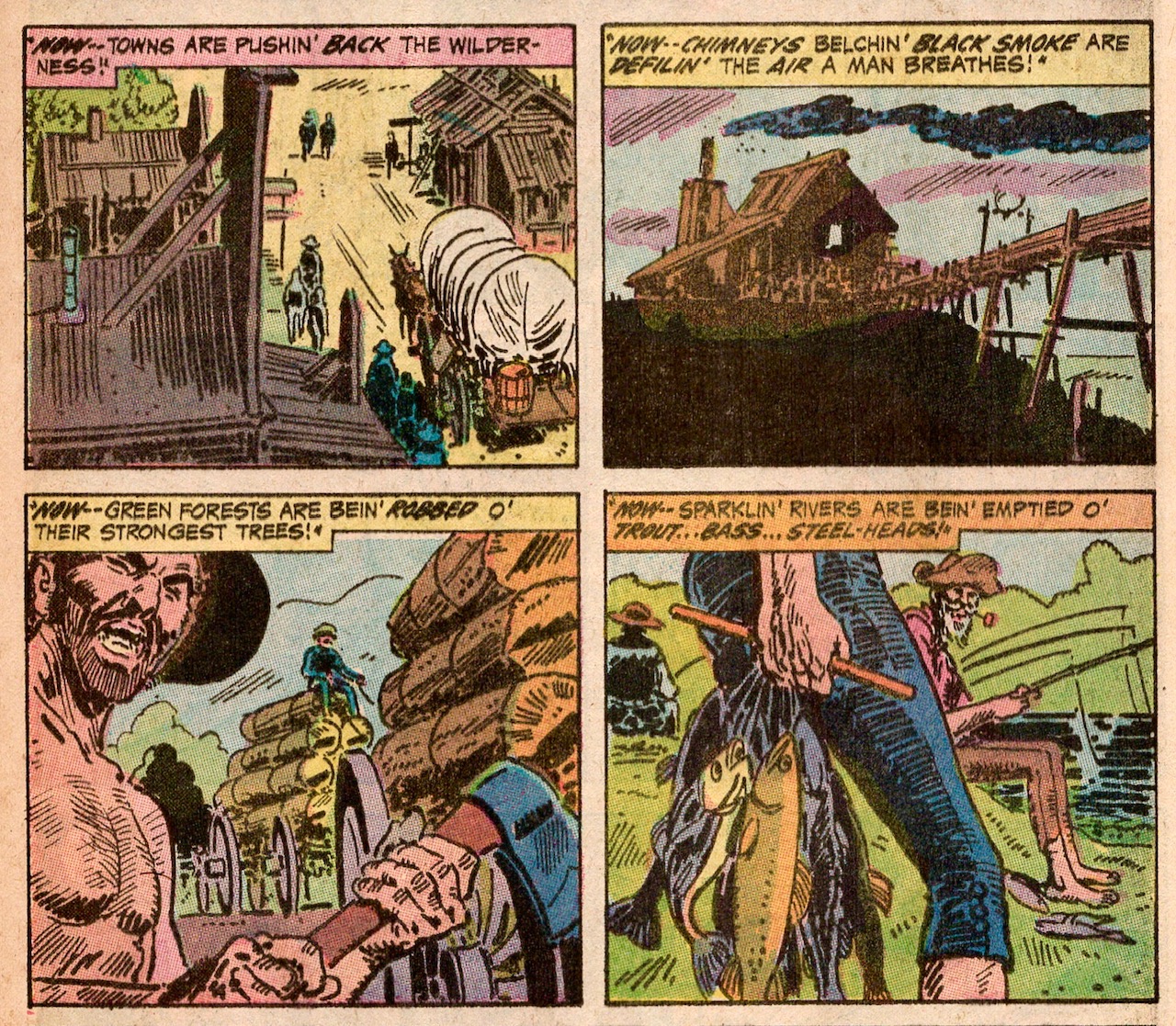
Son of Tomahawk didn’t last or sell enough to be a direct influence on anyone, really (aside perhaps from the great Spanish cartoonist Jordi Bernet, who illustrated a memorable 2000s run on DC Western Jonah Hex in a style as close to Thorne as can be). But it has a family resemblance to a few other high points in comics history, both forgotten and well remembered. The 1930s newspaper strips White Boy and Little Joe, both of which were ignored for decades before recent reprintings, bring the maturity and nuance of Son of Tomahawk to similar stories of boys becoming men in a multicultural West. Another Depression-era newspaper strip, Gasoline Alley, and the samurai manga Lone Wolf and Cub, are acknowledged classics of the comics medium that could not differ more greatly from each other, but both share the seriousness and intensity with which Son of Tomahawk treats father-son bonds. Over a long career, underground cartoonist Jack Jackson took on the bloody and lamentable history of the Indian wars in a furious series of nonfiction histories that still carry great power. Frank Miller, a few years away from his comics debut when Hawk bowed out, brought a similar toughness and sense of outrage to his stories while working in a vehement drawing style close to Thorne’s. Miller’s success over a 15-year hot streak stretching from a run on Marvel hero Daredevil to creating future Hollywood cash cows 300 and Sin City makes one wonder if Son of Tomahawk wasn’t just a few years ahead of its time. Finally, Hermann Huppen’s Belgian adventure series Jeremiah, starring two young friends riding through a post-apocalyptic America that has regressed to the level of the Old West, might be the clearest evocation of Thorne, Kanigher, and Kubert since the genuine article — all by an artist who one presumes has never seen an issue of their masterwork. (Though wouldn’t that be something!)
Still, there’s no substitute for the genuine article. Plenty of Son of Tomahawk issues still swim through back issue bins and eBay listings, gather dust in sundry stores and molder in storage, priced to move and waiting to be discovered. That was the thing about comics in the early ‘70s, something that changed soon after and can’t be gotten back. Comics was a mass medium then, a part of the culture. Something you saw without seeking out. They were everywhere, a stitch in the American tapestry. When the industry got squeezed, it weathered the storm by doubling down on the people it knew it could count on to see it through anything — the obsessives, the superhero cataloguers and collectors so devoted that they not only wrote letters and drew tryout stories for the companies that fed their dreamworlds, they built an international retail network of stores devoted solely to their favorite comics. When newsstands and corner marts found they made a few more pennies selling other things, the comic stores were still there, ever faithful.
DC has been a chaste partner, giving up on being a mass market publisher and feeding this ravenous niche with more and more of what sustained it: superhero comics and their spin-offs, tie-ins, crossovers, secret origin miniseries. Westerns, romance comics, horror and sci-fi and humor and comics about Bob Hope and Jerry Lewis and normal people not named Archie disappeared. So did the latchkey kids who didn’t have anything better to spend their few pennies on, the bored servicemen and long-haul truckers, the counterculture freaks and art school dropouts. Son of Tomahawk got axed because its sales were too low, at about 140,000 copies every issue. No comic today sells that. The hardcore turned out to be radioactive, burning until nothing else remained.
Except that isn’t quite true, because what DC was means it made these things in big enough quantities to last. And what Son of Tomahawk was — an underperforming ten-issue blip of 12- to 15-page stories for a soon-to-be canceled magazine in an unpopular genre of a then-discounted medium, by journeyman creators who hopped from project to project scores of times over decades-long careers — means nobody looks for it unless they really want it. Hawk and Tomahawk are still out there, riding the range under dusty covers ready for discovery.
In the comic’s final letter column, Joe Kubert led off with a message from one “T. Walsh”, who gave their hometown as “California Denver”. Walsh didn’t have anything to say about comics, Son of Tomahawk or otherwise. Their letter began “I am really disappointed with the general portrayal of Indians as just murderous savages who killed for the sake of killing,” and heated up from there, listing broken treaties and the sites of white massacres of Indians, only leaving off because to continue “might destroy your idea of the United States Government and the white man.” Maybe someone’s, but not Joe Kubert’s. There had to be a reason Walsh wrote to this comic and no other, and there was certainly a reason Kubert, in his final act as editor, printed a letter that had nothing to do with comics at all. Recommending Bury My Heart at Wounded Knee to his silly little cowboy comic’s youthful readers, he signed off hopefully. “Perhaps the future will see a rectification of past-done ills … and we feel our publication will help towards that end.”
Whether it did is debatable — Son of Tomahawk was read by few, remembered by fewer, and influenced no one. But it still exists, a lost masterpiece of comics full of rage and passion that aims its fire at injustices no less monstrous or powerful today than they were then. It’s still with us, waiting for its time to thunder out of the wilderness once again.
To Frank, Bob, and Joe, with gratitude.






 English (US) ·